



Bathytoshia brevicaudata (Hutton, 1875)
Short-tail stingray
Aggiungete la vostra osservazione in Fish Watcher
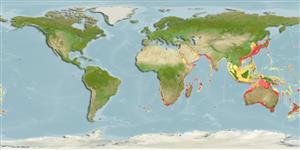
| Native range | All suitable habitat | Point map | Year 2050 |
|
| This map was computer-generated and has not yet been reviewed. |
| Bathytoshia brevicaudata AquaMaps Data sources: GBIF OBIS |
Classificazione / Nomi Nomi Comuni | Sinonimi | Catalog of Fishes(Genere, Specie) | ITIS | CoL | WoRMS | Cloffa
Elasmobranchi (squali e razze) (sharks and rays) > Myliobatiformes (Stingrays) > Dasyatidae (Stingrays) > Dasyatinae
Ambiente: milieu / zona climatica / distribuzione batimetrica / gamma di distribuzione Ecologia
marino; salmastro demersale; distribuzione batimetrica 0 - 476 m (Ref. 5578), usually 0 - 200 m (Ref. 89422). Temperate; 15°C - 29°C (Ref. 130650)
Distribuzione Territories | Aree FAO | Ecosistemi | Presenze | Mappa dei ritrovamenti | Introduzioni | Faunafri
Indo-West Pacific: antitropical; from southern Africa to New Zealand, and off Japan and Peter the Great Bay (eastern Russia).
Lunghezza alla prima maturità / Dimensione / Peso / Età
Maturità: Lm ?, range 120 - ? cm
Max length : 430 cm TL maschio/sesso non determinato; (Ref. 5578); common length : 125 cm TL maschio/sesso non determinato; (Ref. 9258)
Max length : 430 cm TL maschio/sesso non determinato; (Ref. 5578); common length : 125 cm TL maschio/sesso non determinato; (Ref. 9258)
Breve descrizione Chiavi di identificazione | Morfologia | Morfometria
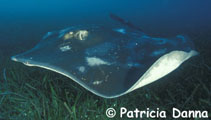
Spine dorsali (totale) : 0. This species is huge, plain-coloured, with a disc broad and rhombic, belly with transverse groove, tail short tapering strongly before caudal sting, thorns when present are confined to tail before sting, pectoral fin with an oblique rows of white spots dorsally; disc width ca. 1.1-1.2 times its length, very thick trunk; narrowly-rounded pectoral-fin apex; short snout, obtuse with tip barely extended and anterior margins weakly convex; small eyes with orbit length and spiracle 2.0-2.2 in snout length; broad interorbital space, up to 4 times orbit length in adults; mouth often with 5-7 oral papillae, deep labial furrows, weakly convex lower jaw; very broadly skirt-shaped nasal curtain, its margin fringed; oblique oval nostrils; smooth skin, no derml denticles, with specimens > 45 cm WD having a row of spear-shaped or starry-based thorns and tubercles on mid-line of tail before the caudal sting and the tail beyond this is covered with sharp thornlets; very broad tail depressed at the base, often shorter that width disc, often with one caudal sting, its ventral fold is short but prominent (extending to just beyond tip of sting), its dorsal fold reduced to a hard ridge; pelvic fins are rather small with narrowly-rounded apices. Colour of upper surface uniformly greyish brown and darkest on tail tip and above the eye; white inside of spiracles, pores around side of head and diagonal row of pores on each side of anterior disc; white ventrally; disc margin and undersurface of tail dusky (Ref. 114953).
Body shape (shape guide): other; Cross section: flattened.
Body shape (shape guide): other; Cross section: flattened.
Occurs offshore, on the outer shelf and uppermost slope; sometimes close inshore (Ref. 5578), in very shallow ( 0 m) depths (Ref. 26346). Found on sandy bottoms, in bays, harbors, and near rocky reefs (Ref. 12951). Often in aggregations (Ref. 12951). Feeds on fishes, bivalves, squid, and crustaceans (Ref. 12951). Ovoviviparous (Ref. 50449). Reputed to be the largest stingray in the world weighing more than 350,000 g (Ref. 6871). Frequently raises its tail in a scorpion-like fashion when approached, but is considered more as inquisitive rather than aggressive (Ref. 6871). The barbed tail however can inflict a severe or potentially fatal wound (Ref. 6871). Sometimes caught by anglers (Ref. 5578). It is parasitised by the monogenean Heterocotyle tokoloshei in the gills (Ref. 124053)
Ciclo vitale e comportamento di accoppiamento Maturità | Riproduzione | Deposizione | Uova | Fecondità | Larve
Exhibit ovoviparity (aplacental viviparity), with embryos feeding initially on yolk, then receiving additional nourishment from the mother by indirect absorption of uterine fluid enriched with mucus, fat or protein through specialised structures (Ref. 50449). Distinct pairing with embrace (Ref. 205). During courtship, the male will hold onto the pectoral margin of a female (sometimes for hours) as she swims through the water. The male flips under the female and inserts a clasper. The male beats his tail from side to side to move the clasper backward and forward in the cloca. Copulation lasts 3-5 minutes. Males have been observed to nudge the female's abdomen during parturition. Viviparous, young born at about 36 cm WD (Ref. 6871).
Riferimento principale
Caricare le referenze | Bibliografia | Coordinatore : McEachran, John | Collaboratori
Last, P.R., W.T. White, M.R. de Carvalho, B. Séret, M.F.W. Stehmann and G.J.P. Naylor, 2016. Rays of the world. CSIRO Publishing, Comstock Publishing Associates. i-ix + 1-790. (Ref. 114953)
Stato della Lista Rossa IUCN (Ref. 130435: Version 2025-2 (Global))
Least Concern (LC) ; Date assessed: 27 November 2020
CITES
Not Evaluated
Minaccia per l'uomo
Venomous (Ref. 4716)
Usi umani
Pesca: commerciale; Pesce da pesca sportiva: si; Acquario: Acquari pubblici
FAO - Publication: search | FishSource |
Informazioni ulteriori
Ecologia trofica
Articoli alimentari (prede)
Alimentazione
Consumo di cibo
Razioni alimentari
Predatori
Articoli alimentari (prede)
Alimentazione
Consumo di cibo
Razioni alimentari
Predatori
Dinamica della popolazione
Parametri di crescita
Età massima / dimensioni massime
Rapporto lunghezza-peso.
Lunghezza-lunghezza rel.
Lunghezza-frequenze
Conversione di massa
Reclutamento
Abbondanza
Parametri di crescita
Età massima / dimensioni massime
Rapporto lunghezza-peso.
Lunghezza-lunghezza rel.
Lunghezza-frequenze
Conversione di massa
Reclutamento
Abbondanza
Ciclo di vita
Riproduzione
Maturità
Maturità/Gli occhielli sono relativi.
Fecondità
Deposizione
Aggregazioni riproduttive
Uova
Sviluppo delle uova
Larve
Dinamica popolazioni larvali
Riproduzione
Maturità
Maturità/Gli occhielli sono relativi.
Fecondità
Deposizione
Aggregazioni riproduttive
Uova
Sviluppo delle uova
Larve
Dinamica popolazioni larvali
Fisiologia
Composizione corporea
Nutrienti
Consumo di ossigeno
Tipo di nuoto
Velocità di nuoto
Pigmenti visivi
Suono del pesce
Malattie e parassiti
Tossicità (LC50)
Composizione corporea
Nutrienti
Consumo di ossigeno
Tipo di nuoto
Velocità di nuoto
Pigmenti visivi
Suono del pesce
Malattie e parassiti
Tossicità (LC50)
Legato all'uomo
Sistemi di acquacoltura
Profili di acquacoltura
Varietà
Casi di Ciguatera
Francobolli, monete, materiale vario.
Sistemi di acquacoltura
Profili di acquacoltura
Varietà
Casi di Ciguatera
Francobolli, monete, materiale vario.
Strumenti
Quiz organico | Libro elettronico | Giuda pratica | Chiavi di identificazione | Generatore frequenze di lunghezza | Strumento Parametri Biologici | Mappa dei ritrovamenti |
Cattura-MSY |
Rapporti speciali
Controllo della manutenzione dell'acquario | Verificare la presenza di schede informative sulle specie | Verifica delle schede informative sull'acquacoltura
Scarica XML
Fonti Internet
AFORO (otoliths) | Aquatic Commons | BHL | Cloffa | Websites from users | Check FishWatcher | CISTI | Catalog of Fishes: Genere, Specie | DiscoverLife | ECOTOX | FAO - Publication: search | Faunafri | Fishipedia | Fishtrace | GloBI | Google Books | Google Scholar | Google | IGFA World Record | OneZoom | Open Tree of Life | Otolith Atlas of Taiwan Fishes | PubMed | Reef Life Survey | Socotra Atlas | TreeBase | Tree of Life | Wikipedia: Go, ricerca | World Records Freshwater Fishing | Record zoologico
Stime basate su modelli
Temperatura preferita (Fonte Biblio. 123201): 14.6 - 28.5, mean 24.1 °C (based on 2002 cells).
Indice di diversità filogenetica (Fonte Biblio. 82804): PD50 = 0.6250 [Uniqueness, from 0.5 = low to 2.0 = high].
Bayesian length-weight: a=0.00447 (0.00189 - 0.01058), b=3.12 (2.92 - 3.32), in cm total length, based on LWR estimates for this (Sub)family-body shape (Ref. 93245).
Livello trofico (Fonte Biblio. 69278): 3.9 ±0.45 se; based on food items.
Nutrienti (Ref. 124155): Calcium = 2.46 [0.37, 44.68] mg/100g; Iron = 0.194 [0.018, 2.273] mg/100g; Protein = 21.3 [18.7, 24.0] %; Omega3 = 0.362 [0.114, 1.026] g/100g; Selenium = 21.7 [4.4, 114.2] μg/100g; VitaminA = 1.89 [0.16, 20.28] μg/100g; Zinc = 0.26 [0.02, 2.86] mg/100g (wet weight);