



Tải lên của bạn hình ảnh Và Video
Các tranh (Ảnh) | Video | Google image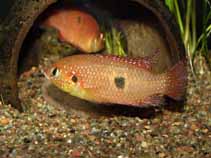 Rubricatochromis guttatus
Hình ảnh của Judy, T.
Các tranh (Ảnh) | Video | Google image
Hình ảnh của Judy, T.
Phân loại / Tên Tên thường gặp | Các synonym ( Các tên trùng) | Catalog of Fishes(Giống, Các loài) | ITIS | CoL | WoRMS | Cloffa
> Cichliformes (Cichlids, convict blennies) > Cichlidae (Cichlids) > Pseudocrenilabrinae
Etymology: Rubricatochromis: Name from rubricatus, Latin for red coloured, refers to the bright red colouration on body of most species when in dominance or broodcare; and chromis, a common ending for African cichlid fishes (Ref. 128620); guttatus: From the Latin guttatus, meaning 'speckled', apparently referring to the pattern of black dots in the cheek and opercular region of the type material (Ref. 43352).
More on author: Günther.
Etymology: Rubricatochromis: Name from rubricatus, Latin for red coloured, refers to the bright red colouration on body of most species when in dominance or broodcare; and chromis, a common ending for African cichlid fishes (Ref. 128620); guttatus: From the Latin guttatus, meaning 'speckled', apparently referring to the pattern of black dots in the cheek and opercular region of the type material (Ref. 43352).
More on author: Günther.
Taxonomic Remarks
According to Loiselle (1979; Ref. 43352) this species would be the true "jewel cichlid" of aquariologists, also used as an experimental animal by physiologists and ethologists and commonly named H. bimaculatus (Ref. 5644).
Môi trường: môi trường / vùng khí hậu / Mức độ sâu / phạm vi phân phối Sinh thái học
; nước ngọt; thuộc về nước lợ sống nổi và đáy. Tropical
Sự phân bố Lãnh thổ | Các khu vực của FAO | Các hệ sinh thái | Những lần xuất hiện | Bản đồ điểm | Những chỉ dẫn | Faunafri
Africa: coastal rivers from Sierra Leone (Ref. 81260) to Cameroon, excepted Lower Volta basin (Ref. 5644). A forest associated species (Ref. 5644). Introduced around 1970 in a stream fed by hot springs in Villach (Austria) (Ref. 59043).
Bộ gần gũi / Khối lượng (Trọng lượng) / Tuổi
Chín muồi sinh dục: Lm ? range ? - ? cm
Max length : 12.0 cm SL con đực/không giới tính; (Ref. 5644)
Max length : 12.0 cm SL con đực/không giới tính; (Ref. 5644)
Mô tả ngắn gọn Khóa để định loại | Hình thái học | Sinh trắc học
Các tia vây lưng cứng (tổng cộng) : 13 - 15; Các vây lưng mềm (tổng cộng) : 9 - 12; Tia cứng vây hậu môn: 3; Tia mềm vây hậu môn: 7 - 9; Động vật có xương sống: 25. Diagnosis: mouth small, premaxilla moderately protractile (Ref. 43352). Snout short (Ref. 43352) and obtuse, scarcely longer than eye (Ref. 522). 2 middle teeth of upper jaw scarcely longer than others; scales on cheek in 3-4 series (Ref. 552). Pharyngeal bone roughly triangular, heavily dentigerous (Ref. 43352), with 22-24 teeth along posterior margin (Ref. 3032, 43352). Pharyngeal teeth bicuspid with clearly defined minor cusp (Ref. 3032, 43352). Median pharyngeal teeth non-molariform (Ref. 3032). Orbit narrow, caudal peduncle deep (Ref. 43352). Dorsal fin commences before root of pectoral (Ref. 552). Operculum with large black spot (Ref. 552), another black oval spot on side of body (Ref. 552, 3032, 43352, 81260), latter sometimes absent (Ref. 81260). Black spot on caudal peduncle normally present, small and ovoid (Ref. 81260). Sides of head with round black spots (Ref. 552). Irregular distributed pattern of blue spangling on head, body and unpaired fins (Ref. 43352, 81260). Never with multiple series of distinct blotches or bars on flanks (Ref. 81260).
Body shape (shape guide): fusiform / normal; Cross section: oval.
Body shape (shape guide): fusiform / normal; Cross section: oval.
Eurytopic; found most frequently in association with stands of emergent or submerged aquatic plants; particularly abundant in shallower and quieter stretches of large rivers, in small lateral tributaries of such streams, in oxbow lakes and in swampy habitats; even maintains breeding populations in coastal lagoons; absent from rapids zone of streams or in headwaters flowing through montane forest (Ref. 43352). Forest-associated species (Ref. 43352, 52307). Pair-bonding, substrate brooders (Ref. 52307, 81260). Aquarium keeping: aggressive species, requires sufficient space to build territories; omnivore; spawns up to 300 eggs which hatch after 2 days, young are free-swimming after 5 days (Ref. 57572).
Vòng đời và hành vi giao phối Chín muồi sinh dục | Sự tái sinh sản | Đẻ trứng | Các trứng | Sự sinh sản | Ấu trùng
Reported to form pairs. Female deposits eggs on exposed hard surfaces such as stones or wood. Both parents guard larvae and juveniles for about 4 weeks (Ref. 59043).
Tài liệu tham khảo chính
Tải lên tài liệu tham khảo của bạn | Các tài liệu tham khảo | Người điều phối : Kullander, Sven O. | Người cộng tác
Lamboj, A. and S. Koblmüller, 2022. Molecular phylogeny and taxonomic revision of the cichlid genus Hemichromis (Teleostei, Cichliformes, Cichlidae), with description of a new genus and revalidation of H. angolensis. Hydrobiologia (2022):1-22. (Ref. 128620)
CITES
Not Evaluated
Mối đe dọa đối với con người
Harmless
Sử dụng của con người
Bể nuôi cá: Tính thương mại
FAO - Publication: search | FishSource |
Thêm thông tin
Sinh thái dinh dưỡng
Thức ăn (con mồi)
Thành phần thức ăn
Thành phần thức ăn
Khẩu phần ăn
Các động vật ăn mồi
Thức ăn (con mồi)
Thành phần thức ăn
Thành phần thức ăn
Khẩu phần ăn
Các động vật ăn mồi
Sinh thái học
Sinh thái học
Sinh thái học
Biến động dân số
Các thông số tăng trưởng
Độ tuổi / kích thước tối đa
Chiều dài-trọng lượng tương đối
Chiều dài-chiều dài tương đối.
Chiều dài-tần số
Chuyển đổi khối lượng
Bổ xung
Sự phong phú
Các thông số tăng trưởng
Độ tuổi / kích thước tối đa
Chiều dài-trọng lượng tương đối
Chiều dài-chiều dài tương đối.
Chiều dài-tần số
Chuyển đổi khối lượng
Bổ xung
Sự phong phú
Vòng đời
Sự tái sinh sản
Chín muồi sinh dục
Độ trưởng thành/Mang liên quan
Sự sinh sản
Đẻ trứng
Tập hợp sinh sản
Các trứng
Sự phát triển của trứng
Ấu trùng
Sự biến động ấu trùng
Sự tái sinh sản
Chín muồi sinh dục
Độ trưởng thành/Mang liên quan
Sự sinh sản
Đẻ trứng
Tập hợp sinh sản
Các trứng
Sự phát triển của trứng
Ấu trùng
Sự biến động ấu trùng
Sự phân bố
Lãnh thổ
Các khu vực của FAO
Các hệ sinh thái
Những lần xuất hiện
Những chỉ dẫn
BRUVS - Video
Lãnh thổ
Các khu vực của FAO
Các hệ sinh thái
Những lần xuất hiện
Những chỉ dẫn
BRUVS - Video
Giải phẫu
Vùng mang
Não
sỏi tai
Vùng mang
Não
sỏi tai
Sinh lý học
Thành phần cơ thể
Chất dinh dưỡng
Thành phần ô-xy
Kiểu bơi
Tốc độ bơi
Sắc tố thị giác
Tiếng cá
Bệnh tật & Ký sinh trùng
Độc tính (LC50)
Thành phần cơ thể
Chất dinh dưỡng
Thành phần ô-xy
Kiểu bơi
Tốc độ bơi
Sắc tố thị giác
Tiếng cá
Bệnh tật & Ký sinh trùng
Độc tính (LC50)
Di truyền
Bộ gen
Di truyền
Sự dị hợp tử
Di sản
Đa dạng di truyền
Bộ gen
Di truyền
Sự dị hợp tử
Di sản
Đa dạng di truyền
Liên quan đến con người
Hệ thống nuôi trồng thủy sản
Các tổng quan nuôi trồng thủy sản
Các giống
Các trường hợp ngộ độc Ciguatera
Tem, tiền xu, v.v.
Hệ thống nuôi trồng thủy sản
Các tổng quan nuôi trồng thủy sản
Các giống
Các trường hợp ngộ độc Ciguatera
Tem, tiền xu, v.v.
Các công cụ
Sách điện tử | Hướng dẫn hiện trường | Khóa để định loại | Tần suất chiều dài Wizard | Công cụ của vòng đời | Bản đồ điểm |
Bắt-MSY |
Báo cáo đặc biệt
Kiểm tra bảo trì bể cá | Kiểm tra các tờ thông tin về loài | Kiểm tra các tờ thông tin về nuôi trồng thủy sản
Tải xuống XML
Các nguồn internet
AFORO (otoliths) | Aquatic Commons | BHL | Cloffa | Websites from users | Check FishWatcher | CISTI | Catalog of Fishes: Giống, Các loài | DiscoverLife | ECOTOX | FAO - Publication: search | Faunafri | Fishipedia | Fishtrace | GloBI | Google Books | Google Scholar | Google | IGFA World Record | OneZoom | Open Tree of Life | Otolith Atlas of Taiwan Fishes | Bể cá công cộng | PubMed | Reef Life Survey | Socotra Atlas | TreeBase | Cây Đời sống | Wikipedia: Go, tìm | World Records Freshwater Fishing | Tạp chí Zoological Record
Ước tính dựa trên mô hình
Chỉ số đa dạng phát sinh loài (Tài liệu tham khảo 82804): PD50 = 0.5020 [Uniqueness, from 0.5 = low to 2.0 = high].
Bayesian length-weight: a=0.01445 (0.00671 - 0.03113), b=2.99 (2.82 - 3.16), in cm total length, based on LWR estimates for this (Sub)family-body shape (Ref. 93245).
Mức dinh dưỡng (Tài liệu tham khảo 69278): 3.5 ±0.5 se; based on size and trophs of closest relatives
Thích nghi nhanh (Tài liệu tham khảo 120179): Chiêù cao, thời gian nhân đôi của chủng quần tối thiểu là dưới 15 tháng (Preliminary K or Fecundity.).