



Klassifizierung / Names Namen | Synonyme | Catalog of Fishes(Gattung, Arten) | ITIS | CoL | WoRMS | Cloffa
> Cichliformes (Cichlids, convict blennies) > Cichlidae (Cichlids) > Pseudocrenilabrinae
Etymology: Rubricatochromis: Name from rubricatus, Latin for red coloured, refers to the bright red colouration on body of most species when in dominance or broodcare; and chromis, a common ending for African cichlid fishes (Ref. 128620); guttatus: From the Latin guttatus, meaning 'speckled', apparently referring to the pattern of black dots in the cheek and opercular region of the type material (Ref. 43352).
More on author: Günther.
Etymology: Rubricatochromis: Name from rubricatus, Latin for red coloured, refers to the bright red colouration on body of most species when in dominance or broodcare; and chromis, a common ending for African cichlid fishes (Ref. 128620); guttatus: From the Latin guttatus, meaning 'speckled', apparently referring to the pattern of black dots in the cheek and opercular region of the type material (Ref. 43352).
More on author: Günther.
Taxonomic Remarks
According to Loiselle (1979; Ref. 43352) this species would be the true "jewel cichlid" of aquariologists, also used as an experimental animal by physiologists and ethologists and commonly named H. bimaculatus (Ref. 5644).
Umwelt: Milieu / Klimazone / Tiefenbereich / Verbreitungsgebiet Ökologie
; süßwasser; brackwasser benthopelagisch. Tropical
Verbreitung Territorien | FAO Gebiete | Ökosysteme | Vorkommen | Punkt Karte | Einführungen | Faunafri
Africa: coastal rivers from Sierra Leone (Ref. 81260) to Cameroon, excepted Lower Volta basin (Ref. 5644). A forest associated species (Ref. 5644). Introduced around 1970 in a stream fed by hot springs in Villach (Austria) (Ref. 59043).
Größe / Gewicht / Alter
Kurzbeschreibung Bestimmungsschlüssel | Morphologie | Morphometrie
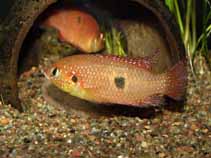
Rückenflossenstacheln (insgesamt) : 13 - 15; Rückenflossenweichstrahlen (insgesamt) : 9 - 12; Afterflossenstacheln: 3; Afterflossenweichstrahlen: 7 - 9; Wirbelzahl: 25. Diagnosis: mouth small, premaxilla moderately protractile (Ref. 43352). Snout short (Ref. 43352) and obtuse, scarcely longer than eye (Ref. 522). 2 middle teeth of upper jaw scarcely longer than others; scales on cheek in 3-4 series (Ref. 552). Pharyngeal bone roughly triangular, heavily dentigerous (Ref. 43352), with 22-24 teeth along posterior margin (Ref. 3032, 43352). Pharyngeal teeth bicuspid with clearly defined minor cusp (Ref. 3032, 43352). Median pharyngeal teeth non-molariform (Ref. 3032). Orbit narrow, caudal peduncle deep (Ref. 43352). Dorsal fin commences before root of pectoral (Ref. 552). Operculum with large black spot (Ref. 552), another black oval spot on side of body (Ref. 552, 3032, 43352, 81260), latter sometimes absent (Ref. 81260). Black spot on caudal peduncle normally present, small and ovoid (Ref. 81260). Sides of head with round black spots (Ref. 552). Irregular distributed pattern of blue spangling on head, body and unpaired fins (Ref. 43352, 81260). Never with multiple series of distinct blotches or bars on flanks (Ref. 81260).
Body shape (shape guide): fusiform / normal; Cross section: oval.
Body shape (shape guide): fusiform / normal; Cross section: oval.
Eurytopic; found most frequently in association with stands of emergent or submerged aquatic plants; particularly abundant in shallower and quieter stretches of large rivers, in small lateral tributaries of such streams, in oxbow lakes and in swampy habitats; even maintains breeding populations in coastal lagoons; absent from rapids zone of streams or in headwaters flowing through montane forest (Ref. 43352). Forest-associated species (Ref. 43352, 52307). Pair-bonding, substrate brooders (Ref. 52307, 81260). Aquarium keeping: aggressive species, requires sufficient space to build territories; omnivore; spawns up to 300 eggs which hatch after 2 days, young are free-swimming after 5 days (Ref. 57572).
Lebenszyklus und Paarungsverhalten Geschlechtsreife | Fortpflanzung | Ablaichen | Eier | Fruchtbarkeit | Larven
Reported to form pairs. Female deposits eggs on exposed hard surfaces such as stones or wood. Both parents guard larvae and juveniles for about 4 weeks (Ref. 59043).
Hauptreferenz
Laden Sie Ihre Referenzen hoch | Referenzen | Koordinator : Kullander, Sven O. | Partner
Lamboj, A. and S. Koblmüller, 2022. Molecular phylogeny and taxonomic revision of the cichlid genus Hemichromis (Teleostei, Cichliformes, Cichlidae), with description of a new genus and revalidation of H. angolensis. Hydrobiologia (2022):1-22. (Ref. 128620)
CITES
Not Evaluated
Bedrohung für Menschen
Harmless
Nutzung durch Menschen
Aquarium: Kommerziell
FAO - Publication: search | FishSource |
Mehr Information
Trophische Ökologie
Lebensmittel (Beutetiere)
Nahrungszusammensetzung
Nahrungsaufnahme
Lebensmittelrationen
Räuber
Lebensmittel (Beutetiere)
Nahrungszusammensetzung
Nahrungsaufnahme
Lebensmittelrationen
Räuber
Ökologie
Ökologie
Ökologie
Populationsdynamik
Wachstumsparameter
Max. Alter/Größen
Länge-Gewicht-Rel.
Länge-Länge-Verhältnis.
Längenhäufigkeiten
Massenkonvertierung
Rekrutierung
Dichte
Wachstumsparameter
Max. Alter/Größen
Länge-Gewicht-Rel.
Länge-Länge-Verhältnis.
Längenhäufigkeiten
Massenkonvertierung
Rekrutierung
Dichte
Lebenszyklus
Fortpflanzung
Geschlechtsreife
Reifung/Kiemen rel.
Fruchtbarkeit
Ablaichen
Laichaggregationen
Eier
Eientwicklung
Larven
Larven Pop.Dyn.
Fortpflanzung
Geschlechtsreife
Reifung/Kiemen rel.
Fruchtbarkeit
Ablaichen
Laichaggregationen
Eier
Eientwicklung
Larven
Larven Pop.Dyn.
Anatomie
Kiemenoberfläche
Gehirn
Otolith
Kiemenoberfläche
Gehirn
Otolith
Physiologie
Körperliche Zusammensetzung
Nährstoffe
Sauerstoffverbrauch
Schwimmart
Schwimmgeschwindigkeit
Visuelle Pigmente
Fischgeräusche
Krankheiten und Parasiten
Toxizität (LC50s)
Körperliche Zusammensetzung
Nährstoffe
Sauerstoffverbrauch
Schwimmart
Schwimmgeschwindigkeit
Visuelle Pigmente
Fischgeräusche
Krankheiten und Parasiten
Toxizität (LC50s)
Genetik
Genom
Genetik
Heterozygotie
Vererbbarkeit
Genetische Vielfalt
Genom
Genetik
Heterozygotie
Vererbbarkeit
Genetische Vielfalt
Menschenbezogen
Aquakultur-Systeme
Aquakultur Profile
Zuchtlinien
Ciguatera-Fälle
Briefmarken, Münzen, Verschiedenes.
Aquakultur-Systeme
Aquakultur Profile
Zuchtlinien
Ciguatera-Fälle
Briefmarken, Münzen, Verschiedenes.
Tools
E-Book | Feldführer | Bestimmungsschlüssel | Längenhäufigkeits Tool | Lebensdaten Tool | Punkt Karte |
Catch-MSY |
Zusatzinformationen
Download XML
Zusammenfassung | Punktdaten | Namen | Photos
Internet Quellen
AFORO (otoliths) | Aquatic Commons | BHL | Cloffa | Websites from users | FishWatcher Einträge suchen | CISTI | Catalog of Fishes: Gattung, Arten | DiscoverLife | ECOTOX | FAO - Publication: search | Faunafri | Fishipedia | Fishtrace | GloBI | Google Books | Google Scholar | Google | IGFA World Record | OneZoom | Open Tree of Life | Otolith Atlas of Taiwan Fishes | Öffentliche Aquarien | PubMed | Reef Life Survey | Socotra Atlas | TreeBase | Tree of Life | Wikipedia: Gehe zu, Suchen | World Records Freshwater Fishing | Zoologischer Rekord
Schätzungen auf der Grundlage von Modellen
Phylogenetischer Diversitätsindex (Ref. 82804): PD50 = 0.5020 [Uniqueness, from 0.5 = low to 2.0 = high].
Bayesian length-weight: a=0.01445 (0.00671 - 0.03113), b=2.99 (2.82 - 3.16), in cm total length, based on LWR estimates for this (Sub)family-body shape (Ref. 93245).
Trophische Ebene (Ref. 69278): 3.5 ±0.5 se; based on size and trophs of closest relatives
Widerstandsfähigkeit (Ref. 120179): hoch, Verdopplung der Population dauert weniger als 15 Monate. (Preliminary K or Fecundity.).