



Clasificación / Nombres Nombres comunes | Sinónimos | Catalog of Fishes(Género, Especie) | ITIS | CoL | WoRMS | Cloffa
> Cichliformes (Cichlids, convict blennies) > Cichlidae (Cichlids) > Pseudocrenilabrinae
Etymology: Rubricatochromis: Name from rubricatus, Latin for red coloured, refers to the bright red colouration on body of most species when in dominance or broodcare; and chromis, a common ending for African cichlid fishes (Ref. 128620); guttatus: From the Latin guttatus, meaning 'speckled', apparently referring to the pattern of black dots in the cheek and opercular region of the type material (Ref. 43352).
More on author: Günther.
Etymology: Rubricatochromis: Name from rubricatus, Latin for red coloured, refers to the bright red colouration on body of most species when in dominance or broodcare; and chromis, a common ending for African cichlid fishes (Ref. 128620); guttatus: From the Latin guttatus, meaning 'speckled', apparently referring to the pattern of black dots in the cheek and opercular region of the type material (Ref. 43352).
More on author: Günther.
Taxonomic Remarks
According to Loiselle (1979; Ref. 43352) this species would be the true "jewel cichlid" of aquariologists, also used as an experimental animal by physiologists and ethologists and commonly named H. bimaculatus (Ref. 5644).
Entorno: milieu / zona climática / rango de profundidad / gama de distribución Ecología
; agua dulce; salobre bentopelágico. Tropical
Distribución Territorios | Áreas FAO | Ecosistemas | Ocurrencias, apariciones | Mapa de puntos | Introducciones | Faunafri
Africa: coastal rivers from Sierra Leone (Ref. 81260) to Cameroon, excepted Lower Volta basin (Ref. 5644). A forest associated species (Ref. 5644). Introduced around 1970 in a stream fed by hot springs in Villach (Austria) (Ref. 59043).
Tamaño / Peso / Edad
Descripción breve Claves de identificación | Morfología | Morfometría
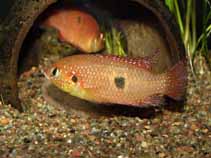
Espinas dorsales (total) : 13 - 15; Radios blandos dorsales (total) : 9 - 12; Espinas anales: 3; Radios blandos anales: 7 - 9; Vértebra: 25. Diagnosis: mouth small, premaxilla moderately protractile (Ref. 43352). Snout short (Ref. 43352) and obtuse, scarcely longer than eye (Ref. 522). 2 middle teeth of upper jaw scarcely longer than others; scales on cheek in 3-4 series (Ref. 552). Pharyngeal bone roughly triangular, heavily dentigerous (Ref. 43352), with 22-24 teeth along posterior margin (Ref. 3032, 43352). Pharyngeal teeth bicuspid with clearly defined minor cusp (Ref. 3032, 43352). Median pharyngeal teeth non-molariform (Ref. 3032). Orbit narrow, caudal peduncle deep (Ref. 43352). Dorsal fin commences before root of pectoral (Ref. 552). Operculum with large black spot (Ref. 552), another black oval spot on side of body (Ref. 552, 3032, 43352, 81260), latter sometimes absent (Ref. 81260). Black spot on caudal peduncle normally present, small and ovoid (Ref. 81260). Sides of head with round black spots (Ref. 552). Irregular distributed pattern of blue spangling on head, body and unpaired fins (Ref. 43352, 81260). Never with multiple series of distinct blotches or bars on flanks (Ref. 81260).
Body shape (shape guide): fusiform / normal; Cross section: oval.
Body shape (shape guide): fusiform / normal; Cross section: oval.
Eurytopic; found most frequently in association with stands of emergent or submerged aquatic plants; particularly abundant in shallower and quieter stretches of large rivers, in small lateral tributaries of such streams, in oxbow lakes and in swampy habitats; even maintains breeding populations in coastal lagoons; absent from rapids zone of streams or in headwaters flowing through montane forest (Ref. 43352). Forest-associated species (Ref. 43352, 52307). Pair-bonding, substrate brooders (Ref. 52307, 81260). Aquarium keeping: aggressive species, requires sufficient space to build territories; omnivore; spawns up to 300 eggs which hatch after 2 days, young are free-swimming after 5 days (Ref. 57572).
Ciclo vital y comportamiento de apareamiento Madurez | Reproducción | Puesta | Huevos | Fecundidad | Larva
Reported to form pairs. Female deposits eggs on exposed hard surfaces such as stones or wood. Both parents guard larvae and juveniles for about 4 weeks (Ref. 59043).
Referencia principal
Suba sus referencias | Referencias | Coordinador : Kullander, Sven O. | Colaboradores
Lamboj, A. and S. Koblmüller, 2022. Molecular phylogeny and taxonomic revision of the cichlid genus Hemichromis (Teleostei, Cichliformes, Cichlidae), with description of a new genus and revalidation of H. angolensis. Hydrobiologia (2022):1-22. (Ref. 128620)
CITES
Not Evaluated
Amenaza para el ser humano
Harmless
Usos humanos
Acuario: Comercial
FAO - Publication: search | FishSource |
Más información
Ecología Trófica
Alimentos (presas)
Composición de la dieta
consumo de alimento
Raciones de comida
Despredadores
Alimentos (presas)
Composición de la dieta
consumo de alimento
Raciones de comida
Despredadores
Ecología
Ecología
Ecología
Dinámica de la población
Coeficiente del crecimiento para
Edades / tallas máximas
Longitud-peso rel.
Longitud-longitud rel.
Longitud-frecuencias
Conversión de masas
Reclutamiento
Abundancia
Coeficiente del crecimiento para
Edades / tallas máximas
Longitud-peso rel.
Longitud-longitud rel.
Longitud-frecuencias
Conversión de masas
Reclutamiento
Abundancia
Ciclo de vida
Reproducción
Madurez
Madurez/Gills rel.
Fecundidad
Puesta
Agregaciones de desove
Huevos
Desarrollo de los huevos
Larva
Dinámica larvaria
Reproducción
Madurez
Madurez/Gills rel.
Fecundidad
Puesta
Agregaciones de desove
Huevos
Desarrollo de los huevos
Larva
Dinámica larvaria
Distribución
Territorios
Áreas FAO
Ecosistemas
Ocurrencias, apariciones
Introducciones
BRUVS - Vídeos
Territorios
Áreas FAO
Ecosistemas
Ocurrencias, apariciones
Introducciones
BRUVS - Vídeos
Anatomía
Superficie branquial
Cerebro
Otolito
Superficie branquial
Cerebro
Otolito
Fisiología
Composición corporal
Nutrientes
Consumo del oxígeno
Tipo de natación
Velocidad de natación
Pigmentos visuales
Sonido de peces
Enfermedades y parásitos
Toxicidad (CL50)
Composición corporal
Nutrientes
Consumo del oxígeno
Tipo de natación
Velocidad de natación
Pigmentos visuales
Sonido de peces
Enfermedades y parásitos
Toxicidad (CL50)
Genética
Genoma
Genética
Heterocigosidad
heritabilidad
Diversidad genética
Genoma
Genética
Heterocigosidad
heritabilidad
Diversidad genética
Relacionados con el ser humano
Sistemas de acuicultura
Perfiles de acuicultura
Razas
Ciguatera cases
Sellos, monedas, varios
Sistemas de acuicultura
Perfiles de acuicultura
Razas
Ciguatera cases
Sellos, monedas, varios
Herramientas
Libro electrónico | Guía de campo | Claves de identificación | Asistente para frecuencias de tallas | Herramienta de ciclo de vida | Mapa de puntos |
Catch-MSY |
Informes especiales
Comprobar el mantenimiento del acuario | Buscar fichas sobre especies | Consulte las hojas informativas sobre acuicultura
Descargar XML
Fuentes de Internet
AFORO (otoliths) | Aquatic Commons | BHL | Cloffa | Websites from users | Check FishWatcher | CISTI | Catalog of Fishes: Género, Especie | DiscoverLife | ECOTOX | FAO - Publication: search | Faunafri | Fishipedia | Fishtrace | GloBI | Google Books | Google Scholar | Google | IGFA World Record | OneZoom | Open Tree of Life | Otolith Atlas of Taiwan Fishes | Acuarios públicos | PubMed | Reef Life Survey | Socotra Atlas | TreeBase | Árbol de la vida | Wikipedia: Go, búsqueda | World Records Freshwater Fishing | Expediente Zoológico
Estimaciones basadas en modelos
Índice de diversidad filogenética (Referencia 82804): PD50 = 0.5020 [Uniqueness, from 0.5 = low to 2.0 = high].
Bayesian length-weight: a=0.01445 (0.00671 - 0.03113), b=2.99 (2.82 - 3.16), in cm total length, based on LWR estimates for this (Sub)family-body shape (Ref. 93245).
Nivel trófico (Referencia 69278): 3.5 ±0.5 se; based on size and trophs of closest relatives
Resiliencia (Referencia 120179): Alto, población duplicada en un tiempo mínimo inferior a 15 meses (Preliminary K or Fecundity.).