



Atelomycterus baliensis White, Last & Dharmadi, 2005
Bali catshark
Beobachtung melden im Fish Watcher
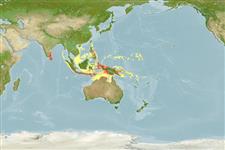
| Native range | All suitable habitat | Point map | Year 2050 |
|
| This map was computer-generated and has not yet been reviewed. |
| Atelomycterus baliensis AquaMaps Data sources: GBIF OBIS |
Hochladen Photos und videos
Bilder | Google Bild Atelomycterus baliensis
Female Photo von Last, P.
Bilder | Google Bild
Female Photo von Last, P.
Klassifizierung / Names Namen | Synonyme | Catalog of Fishes(Gattung, Arten) | ITIS | CoL | WoRMS | Cloffa
Elasmobranchii (Haie und Rochen) (sharks and rays) > Carcharhiniformes (Ground sharks) > Atelomycteridae (Coloured catsharks)
Etymology: Atelomycterus: ateles (Gr.), imperfect, unfilled or exempt; mycteros (Gr.), nostril, referring to lack of posterior nasal valve (See ETYFish); baliensis: -ensis, Latin suffix denoting place: Bali, Indonesia, only known area of occurrence (See ETYFish).
More on authors: White, Last & Dharmadi.
Etymology: Atelomycterus: ateles (Gr.), imperfect, unfilled or exempt; mycteros (Gr.), nostril, referring to lack of posterior nasal valve (See ETYFish); baliensis: -ensis, Latin suffix denoting place: Bali, Indonesia, only known area of occurrence (See ETYFish).
More on authors: White, Last & Dharmadi.
Umwelt: Milieu / Klimazone / Tiefenbereich / Verbreitungsgebiet Ökologie
seewasser demersal. Tropical
Verbreitung Territorien | FAO Gebiete | Ökosysteme | Vorkommen | Punkt Karte | Einführungen | Faunafri
Western Pacific: known only from the Indonesian island of Bali.
Größe / Gewicht / Alter
Kurzbeschreibung Bestimmungsschlüssel | Morphologie | Morphometrie
A relatively small (max. size 474 mm TL) Atelomycterus with the following combination of characters: relatively short preoral length, 4.0-4.6% T; short interdorsal space, 11.6-12.9% TL; high pectoral-pelvic to pelvic-anal ratio 1.28-1.48; dorsal fins weakly falcate, with posterior margins vertical or sloping anteroventrally from fin apices; prebranchial denticles strongly tricuspid with narrow, elongate medial cusps; claspers of adults short, not stubby, not tapering sharply distally, outer length 8.3-9% TL, base width 5.4-6.3% of outer length; clasper glans covering more than half of clasper; cover rhipidion relatively narrow; rhipidion large, relatively low, and only partly concealed by cover rhipidion and exorhipidion; exorhipidion small with proximal end well behind distal end of cover rhipidion; total vertebral centra 154-163, precaudal centra 101-106; dorsal surface with well-defined dark saddles consisting mainly of four, partly coalesced, diffuse-edged, dark brown blotches; white partly coalesced, diffuse-edged, dark brown blotches; white spots absent from body and rarely on fins; inner margin of pale tips of dorsal fins orientated almost vertically; upper pectoral fin lacking a broad, sharply defined whitish margin.
Body shape (shape guide): elongated.
Body shape (shape guide): elongated.
Biology unknown; presumably reef-dwelling, inhabiting holes and crevices on reefs, like other related catsharks. Presumably oviparous. Diet probably dominated by small invertebrates . Caught irregularly by fisheries operating over coral reefs. Utilized for its meat but of limited value (Ref.58048).
Lebenszyklus und Paarungsverhalten Geschlechtsreife | Fortpflanzung | Ablaichen | Eier | Fruchtbarkeit | Larven
Hauptreferenz
Laden Sie Ihre Referenzen hoch | Referenzen | Koordinator | Partner
White, W.T., P.R. Last and Dharmadi, 2005. Description of a new species of catshark, Atelomycterus baliensis (Carcharhiniformes: Scyliorhinidae) from eastern Indonesia. Cybium 29(1):33-40. (Ref. 54850)
IUCN Rote Liste Status (Ref. 130435: Version 2025-2 (Global))
nicht bedroht (LC) ; Date assessed: 20 May 2020
CITES
Not Evaluated
Bedrohung für Menschen
Harmless
Nutzung durch Menschen
Fischereien: nicht kommerziell
FAO - Publication: search | FishSource |
Mehr Information
Trophische Ökologie
Lebensmittel (Beutetiere)
Nahrungszusammensetzung
Nahrungsaufnahme
Lebensmittelrationen
Räuber
Lebensmittel (Beutetiere)
Nahrungszusammensetzung
Nahrungsaufnahme
Lebensmittelrationen
Räuber
Ökologie
Ökologie
Ökologie
Populationsdynamik
Wachstumsparameter
Max. Alter/Größen
Länge-Gewicht-Rel.
Länge-Länge-Verhältnis.
Längenhäufigkeiten
Massenkonvertierung
Rekrutierung
Dichte
Wachstumsparameter
Max. Alter/Größen
Länge-Gewicht-Rel.
Länge-Länge-Verhältnis.
Längenhäufigkeiten
Massenkonvertierung
Rekrutierung
Dichte
Lebenszyklus
Fortpflanzung
Geschlechtsreife
Reifung/Kiemen rel.
Fruchtbarkeit
Ablaichen
Laichaggregationen
Eier
Eientwicklung
Larven
Larven Pop.Dyn.
Fortpflanzung
Geschlechtsreife
Reifung/Kiemen rel.
Fruchtbarkeit
Ablaichen
Laichaggregationen
Eier
Eientwicklung
Larven
Larven Pop.Dyn.
Anatomie
Kiemenoberfläche
Gehirn
Otolith
Kiemenoberfläche
Gehirn
Otolith
Physiologie
Körperliche Zusammensetzung
Nährstoffe
Sauerstoffverbrauch
Schwimmart
Schwimmgeschwindigkeit
Visuelle Pigmente
Fischgeräusche
Krankheiten und Parasiten
Toxizität (LC50s)
Körperliche Zusammensetzung
Nährstoffe
Sauerstoffverbrauch
Schwimmart
Schwimmgeschwindigkeit
Visuelle Pigmente
Fischgeräusche
Krankheiten und Parasiten
Toxizität (LC50s)
Genetik
Genom
Genetik
Heterozygotie
Vererbbarkeit
Genetische Vielfalt
Genom
Genetik
Heterozygotie
Vererbbarkeit
Genetische Vielfalt
Menschenbezogen
Aquakultur-Systeme
Aquakultur Profile
Zuchtlinien
Ciguatera-Fälle
Briefmarken, Münzen, Verschiedenes.
Aquakultur-Systeme
Aquakultur Profile
Zuchtlinien
Ciguatera-Fälle
Briefmarken, Münzen, Verschiedenes.
Tools
Zusatzinformationen
Download XML
Zusammenfassung | Punktdaten | Namen | Photos
Internet Quellen
AFORO (otoliths) | Aquatic Commons | BHL | Cloffa | Websites from users | FishWatcher Einträge suchen | CISTI | Catalog of Fishes: Gattung, Arten | DiscoverLife | ECOTOX | FAO - Publication: search | Faunafri | Fishipedia | Fishtrace | GloBI | Google Books | Google Scholar | Google | IGFA World Record | OneZoom | Open Tree of Life | Otolith Atlas of Taiwan Fishes | PubMed | Reef Life Survey | Socotra Atlas | TreeBase | Tree of Life | Wikipedia: Gehe zu, Suchen | World Records Freshwater Fishing | Zoobank | Zoologischer Rekord
Schätzungen auf der Grundlage von Modellen
Phylogenetischer Diversitätsindex (Ref. 82804): PD50 = 0.5157 [Uniqueness, from 0.5 = low to 2.0 = high].
Bayesian length-weight: a=0.00389 (0.00180 - 0.00842), b=3.12 (2.94 - 3.30), in cm total length, based on all LWR estimates for this body shape (Ref. 93245).
Trophische Ebene (Ref. 69278): 3.7 ±0.3 se; based on size and trophs of closest relatives
Widerstandsfähigkeit (Ref. 120179): niedrig, Verdopplung der Population dauert 4,5 - 14 Jahre. (Low fecundity (RF)).