This website uses cookies to enhance your browsing experience and ensure the functionality of our site. For more detailed information about the types of cookies we use and how we protect your privacy, please visit our Privacy Information page.
×
Cookie Settings
This website uses different types of cookies to enhance your experience. Please select your preferences below:
Plagiotremus tapeinosoma, Piano fangblenny : fisheries, aquarium
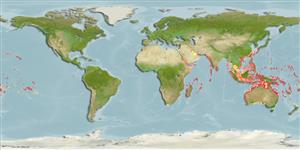
Indo-Pacific: Red Sea and East Africa (to False Bay, South Africa, Ref. 4404) to the Line, Marquesan, and Tuamoto Islands, north to southern Japan, south to New Zealand and Rapa. Replaced Plagiotremus goslinei in the Hawaiian Islands (Ref. 37816).
Размер / Вес / Возраст
половая зрелость: Lm? range ? - ? cm Max length : 14.0 cm TL самец/пол неопределен; (Ref. 9710)
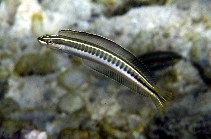
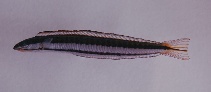
колючие лучи спинного плавника (общее число) : 7 - 9; членистые (мягкие) лучи спинного плавника (общее число) : 34 - 39; колючие лучи анального плавника: 2; членистые (мягкие) лучи анального плавника: 28 - 33. About 20 oblong segments form the dark midlateral body stripe (Ref. 4404). Body shape (shape guide): elongated.
Adults inhabit clear lagoon and seaward reefs (Ref. 9710), usually the lower surge zone to deeper areas. They hide in deserted worm tubes when alarmed (Ref. 1602). They feed by attacking other fishes and removing dermal tissue, mucus and sometimes scales; occasionally makes harmless 'attacks' on divers (Ref. 2334, 48636). Some individuals usually strike from behind and quickly dive in the reef for cover to avoid punishment (Ref. 48636). Their wriggling swimming mode possibly mimics other non-scale eating species. Oviparous. Eggs are demersal and adhesive (Ref. 205), and are attached to the substrate via a filamentous, adhesive pad or pedestal (Ref. 94114). Larvae are planktonic, often found in shallow, coastal waters (Ref. 94114). Minimum depth reported taken from Ref. 128797.
Жизненный цикл и брачное поведение половая зрелость | размножение | нерест | икра | Плодовитость | личинки
Randall, J.E., G.R. Allen and R.C. Steene, 1990. Fishes of the Great Barrier Reef and Coral Sea. University of Hawaii Press, Honolulu, Hawaii. 506 p. (Ref. 2334)
Статус Красного Списка МСОП (Ref. 130435: Version 2025-2 (Global))
Физиология Состав тела Питательные вещества Потребление кислорода Тип плавания Скорость плавания Зрительные пигменты Звук рыбы Болезни и паразиты Токсичность (LC50s)