



Thrissina vitrirostris (Gilchrist & Thompson, 1908)
Orangemouth anchovy
Tải lên của bạn hình ảnh Và Video
Các tranh (Ảnh) | Google image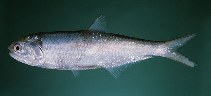 Thrissina vitrirostris
Hình ảnh của Randall, J.E.
Các tranh (Ảnh) | Google image
Hình ảnh của Randall, J.E.
Phân loại / Tên Tên thường gặp | Các synonym ( Các tên trùng) | Catalog of Fishes(Giống, Các loài) | ITIS | CoL | WoRMS | Cloffa
> Clupeiformes (Herrings) > Engraulidae (Anchovies) > Coiliinae
More on authors: Gilchrist & Thompson.
More on authors: Gilchrist & Thompson.
Môi trường: môi trường / vùng khí hậu / Mức độ sâu / phạm vi phân phối Sinh thái học
biển; thuộc về nước lợ pelagic-neritic; mức độ sâu 0 - 50 m (Ref. 189). Tropical; 2°S - 40°S, 20°E - 51°E
Sự phân bố Lãnh thổ | Các khu vực của FAO | Các hệ sinh thái | Những lần xuất hiện | Bản đồ điểm | Những chỉ dẫn | Faunafri
Western Indian Ocean: from the east coast of Africa, Kenya to Natal, South Africa, and Madagascar.
Bộ gần gũi / Khối lượng (Trọng lượng) / Tuổi
Chín muồi sinh dục: Lm ? range ? - ? cm
Max length : 22.0 cm TL con đực/không giới tính; (Ref. 5430)
Max length : 22.0 cm TL con đực/không giới tính; (Ref. 5430)
Mô tả ngắn gọn Khóa để định loại | Hình thái học | Sinh trắc học
Các tia vây lưng cứng (tổng cộng) : 0; Các vây lưng mềm (tổng cộng) : 13 - 14; Tia cứng vây hậu môn: 0; Tia mềm vây hậu môn: 34 - 44; Động vật có xương sống: 43 - 45. Diagnosis: Body compressed, belly with 16-19 pre-pelvic and 8-12 post-pelvic scutes, a total of 24-30 keeled scutes from isthmus to anus; maxilla long, reaching beyond base of first pectoral finray; first supra-maxilla a minute oval; lower gillrakers 18-24, the serrae on the inner edge in distinct clumps in larger fishes; anal fin with 3-4 unbranched rays and 31-40 branched rays; a dark blotch behind upper part of gill opening; inside of gill cavity bright orange (Ref. 189). This species overlaps the range of different other species of Thryssa, of which five have a similar maxilla, very small first supra-maxilla and overlapping gillraker counts; however of these five species, T. gautamiensis, T. malabarica, T. purava and T. whiteheadi all have the tip of the snout at or above the level of the centre of the eye, and the last two, plus T. stenosoma, have at least 38 branched anal finrays (Ref. 189).
Body shape (shape guide): elongated; Cross section: compressed.
Body shape (shape guide): elongated; Cross section: compressed.
A coastal, pelagic species (Ref. 28), apparently common along shore and in estuaries (Ref. 5430). Presumably schooling, occurring inshore and entering estuaries and lagoons, perhaps used as nursery areas, but moving further out in rainy seasons when coastal waters are freshened up by rivers (Ref. 189). It feeds on plankton organisms (Ref. 28). May be caught using ringnets (Ref. 5213). Generally marketed fresh, may be salted or dried (Ref. 5284).
Vòng đời và hành vi giao phối Chín muồi sinh dục | Sự tái sinh sản | Đẻ trứng | Các trứng | Sự sinh sản | Ấu trùng
Tài liệu tham khảo chính
Tải lên tài liệu tham khảo của bạn | Các tài liệu tham khảo | Người điều phối | Người cộng tác
Hata, H. and H. Motomura, 2019. Two new species of Thrissina (Clupeiformes: Engraulidae) from the northern Indian Ocean and redescription of Thrissina vitrirostris (Gilchrist and Thompson 1908). Ichthyol. Res. 67(1):155-166 (Ref. 128122)
Tình trạng Sách đỏ IUCN (Ref. 130435: Version 2025-2 (Global))
Least Concern (LC) ; Date assessed: 09 March 2020
CITES
Not Evaluated
Mối đe dọa đối với con người
Harmless
Sử dụng của con người
Các nghề cá: buôn bán nhỏ; mồi: usually
FAO - Publication: search | FishSource |
Thêm thông tin
Sinh thái dinh dưỡng
Thức ăn (con mồi)
Thành phần thức ăn
Thành phần thức ăn
Khẩu phần ăn
Các động vật ăn mồi
Thức ăn (con mồi)
Thành phần thức ăn
Thành phần thức ăn
Khẩu phần ăn
Các động vật ăn mồi
Biến động dân số
Các thông số tăng trưởng
Độ tuổi / kích thước tối đa
Chiều dài-trọng lượng tương đối
Chiều dài-chiều dài tương đối.
Chiều dài-tần số
Chuyển đổi khối lượng
Bổ xung
Sự phong phú
Các thông số tăng trưởng
Độ tuổi / kích thước tối đa
Chiều dài-trọng lượng tương đối
Chiều dài-chiều dài tương đối.
Chiều dài-tần số
Chuyển đổi khối lượng
Bổ xung
Sự phong phú
Vòng đời
Sự tái sinh sản
Chín muồi sinh dục
Độ trưởng thành/Mang liên quan
Sự sinh sản
Đẻ trứng
Tập hợp sinh sản
Các trứng
Sự phát triển của trứng
Ấu trùng
Sự biến động ấu trùng
Sự tái sinh sản
Chín muồi sinh dục
Độ trưởng thành/Mang liên quan
Sự sinh sản
Đẻ trứng
Tập hợp sinh sản
Các trứng
Sự phát triển của trứng
Ấu trùng
Sự biến động ấu trùng
Sự phân bố
Lãnh thổ
Các khu vực của FAO
Các hệ sinh thái
Những lần xuất hiện
Những chỉ dẫn
BRUVS - Video
Lãnh thổ
Các khu vực của FAO
Các hệ sinh thái
Những lần xuất hiện
Những chỉ dẫn
BRUVS - Video
Giải phẫu
Vùng mang
Não
sỏi tai
Vùng mang
Não
sỏi tai
Sinh lý học
Thành phần cơ thể
Chất dinh dưỡng
Thành phần ô-xy
Kiểu bơi
Tốc độ bơi
Sắc tố thị giác
Tiếng cá
Bệnh tật & Ký sinh trùng
Độc tính (LC50)
Thành phần cơ thể
Chất dinh dưỡng
Thành phần ô-xy
Kiểu bơi
Tốc độ bơi
Sắc tố thị giác
Tiếng cá
Bệnh tật & Ký sinh trùng
Độc tính (LC50)
Liên quan đến con người
Hệ thống nuôi trồng thủy sản
Các tổng quan nuôi trồng thủy sản
Các giống
Các trường hợp ngộ độc Ciguatera
Tem, tiền xu, v.v.
Hệ thống nuôi trồng thủy sản
Các tổng quan nuôi trồng thủy sản
Các giống
Các trường hợp ngộ độc Ciguatera
Tem, tiền xu, v.v.
Các công cụ
Sách điện tử | Hướng dẫn hiện trường | Tần suất chiều dài Wizard | Công cụ của vòng đời | Bản đồ điểm |
Bắt-MSY |
Báo cáo đặc biệt
Kiểm tra bảo trì bể cá | Kiểm tra các tờ thông tin về loài | Kiểm tra các tờ thông tin về nuôi trồng thủy sản
Tải xuống XML
Các nguồn internet
AFORO (otoliths) | Aquatic Commons | BHL | Cloffa | Websites from users | Check FishWatcher | CISTI | Catalog of Fishes: Giống, Các loài | DiscoverLife | ECOTOX | FAO - Publication: search | Faunafri | Fishipedia | Fishtrace | GloBI | Google Books | Google Scholar | Google | IGFA World Record | Các cơ sở dữ liệu quốc gia | OneZoom | Open Tree of Life | Otolith Atlas of Taiwan Fishes | PubMed | Reef Life Survey | Socotra Atlas | TreeBase | Cây Đời sống | Wikipedia: Go, tìm | World Records Freshwater Fishing | Tạp chí Zoological Record
Ước tính dựa trên mô hình
Nhiệt độ ưa thích (Tài liệu tham khảo 123201): 24.6 - 29.3, mean 27.4 °C (based on 294 cells).
Chỉ số đa dạng phát sinh loài (Tài liệu tham khảo 82804): PD50 = 0.5020 [Uniqueness, from 0.5 = low to 2.0 = high].
Bayesian length-weight: a=0.00513 (0.00309 - 0.00850), b=3.15 (3.01 - 3.29), in cm total length, based on LWR estimates for this species & (Sub)family-body (Ref. 93245).
Mức dinh dưỡng (Tài liệu tham khảo 69278): 3.4 ±0.5 se; based on size and trophs of closest relatives
Thích nghi nhanh (Tài liệu tham khảo 120179): Chiêù cao, thời gian nhân đôi của chủng quần tối thiểu là dưới 15 tháng (K=0.5).