



Thrissina vitrirostris (Gilchrist & Thompson, 1908)
Orangemouth anchovy
Ladda upp din foton och Videor
Bilder | Google image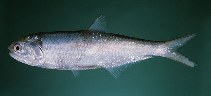 Thrissina vitrirostris
Bild av Randall, J.E.
Bilder | Google image
Bild av Randall, J.E.
Klassificering / Namn Populärnamn | synonymer | Catalog of Fishes(Släkte, Arter) | ITIS | CoL | WoRMS | Cloffa
> Clupeiformes (Herrings) > Engraulidae (Anchovies) > Coiliinae
More on authors: Gilchrist & Thompson.
More on authors: Gilchrist & Thompson.
Miljö: miljö / Klimatzon / djupintervall / distributionsområde Ekologi
marina; brackvatten pelagic-neritic; djupintervall 0 - 50 m (Ref. 189). Tropical; 2°S - 40°S, 20°E - 51°E
Utbredning Territorier | FAO områden | Ekosystem | Förekomster | Prickkarta | Utplanteringar | Faunafri
Western Indian Ocean: from the east coast of Africa, Kenya to Natal, South Africa, and Madagascar.
Storlek / Vikt / Ålder
Kort beskrivning Bestämningsnycklar | Morfologi | Morfometri
Taggstrålar i ryggfenan (totalt) : 0; Mjukstrålar i ryggfenan (totalt) : 13 - 14; Taggstrålar i analfenan: 0; Mjukstrålar i analfenan: 34 - 44; Ryggkotor: 43 - 45. Diagnosis: Body compressed, belly with 16-19 pre-pelvic and 8-12 post-pelvic scutes, a total of 24-30 keeled scutes from isthmus to anus; maxilla long, reaching beyond base of first pectoral finray; first supra-maxilla a minute oval; lower gillrakers 18-24, the serrae on the inner edge in distinct clumps in larger fishes; anal fin with 3-4 unbranched rays and 31-40 branched rays; a dark blotch behind upper part of gill opening; inside of gill cavity bright orange (Ref. 189). This species overlaps the range of different other species of Thryssa, of which five have a similar maxilla, very small first supra-maxilla and overlapping gillraker counts; however of these five species, T. gautamiensis, T. malabarica, T. purava and T. whiteheadi all have the tip of the snout at or above the level of the centre of the eye, and the last two, plus T. stenosoma, have at least 38 branched anal finrays (Ref. 189).
Body shape (shape guide): elongated; Cross section: compressed.
Body shape (shape guide): elongated; Cross section: compressed.
A coastal, pelagic species (Ref. 28), apparently common along shore and in estuaries (Ref. 5430). Presumably schooling, occurring inshore and entering estuaries and lagoons, perhaps used as nursery areas, but moving further out in rainy seasons when coastal waters are freshened up by rivers (Ref. 189). It feeds on plankton organisms (Ref. 28). May be caught using ringnets (Ref. 5213). Generally marketed fresh, may be salted or dried (Ref. 5284).
Livscykel och parningsbeteende Könsmognad | Reproduktion | Lek | Ägg | Fekunditet | Larver
Huvudreferens
Ladda upp dina referenser | referenser | Koordinator | Medarbetare
Hata, H. and H. Motomura, 2019. Two new species of Thrissina (Clupeiformes: Engraulidae) from the northern Indian Ocean and redescription of Thrissina vitrirostris (Gilchrist and Thompson 1908). Ichthyol. Res. 67(1):155-166 (Ref. 128122)
Status på IUCN:s rödlista (Ref. 130435: Version 2025-2 (Global))
Least Concern (LC) ; Date assessed: 09 March 2020
CITES
Not Evaluated
Hot mot människor
Harmless
Mänskliga användningsområden
Fiskeri: mindre kommeriell; bete: usually
FAO - Publication: search | FishSource |
Ytterligare information
Populationsdynamik
Tillväxtparametrar
Max. åldrar / storlekar
Längd-vikt rel.
Längd-längd rel.
Längd-frekvenser
Massakonvertering
Rekrytering
Abundans
Tillväxtparametrar
Max. åldrar / storlekar
Längd-vikt rel.
Längd-längd rel.
Längd-frekvenser
Massakonvertering
Rekrytering
Abundans
Livscykel
Reproduktion
Könsmognad
Mognad/Gills rel.
Fekunditet
Lek
Lekande aggregat
Ägg
Utveckling av ägg
Larver
Larvdynamik
Reproduktion
Könsmognad
Mognad/Gills rel.
Fekunditet
Lek
Lekande aggregat
Ägg
Utveckling av ägg
Larver
Larvdynamik
Anatomi
Gälyta
Hjärna
Otolit
Gälyta
Hjärna
Otolit
Fysiologi
Kroppssammansättning
Näringsämnen
Syreförbrukning
Typ av simning
Simhastighet
Visuella pigment
Ljud från fisk
Sjukdomar & Parasiter
Toxicitet (LC50)
Kroppssammansättning
Näringsämnen
Syreförbrukning
Typ av simning
Simhastighet
Visuella pigment
Ljud från fisk
Sjukdomar & Parasiter
Toxicitet (LC50)
Människorelaterad
Vattenbrukssystem
Vattenbruksprofiler
Avelslinjer
Ciguatera-fall
Frimärken, mynt, diverse.
Vattenbrukssystem
Vattenbruksprofiler
Avelslinjer
Ciguatera-fall
Frimärken, mynt, diverse.
Verktyg
Särskilda rapporter
Kontrollera för underhåll av akvarium | Kontrollera om det finns faktablad om arter | Kontrollera om det finns faktablad om vattenbruk
Ladda ner XML
Internet-källor
AFORO (otoliths) | Aquatic Commons | BHL | Cloffa | Websites from users | Check FishWatcher | CISTI | Catalog of Fishes: Släkte, Arter | DiscoverLife | ECOTOX | FAO - Publication: search | Faunafri | Fishipedia | Fishtrace | GloBI | Google Books | Google Scholar | Google | IGFA World Record | Nationella databaser | OneZoom | Open Tree of Life | Otolith Atlas of Taiwan Fishes | PubMed | Reef Life Survey | Socotra Atlas | TreeBase | Tree of Life | Wikipedia: Go, sök | World Records Freshwater Fishing | Zoologiskt register
Uppskattningar baserade på modeller
Önskad temperatur (Ref. 123201): 24.6 - 29.3, mean 27.4 °C (based on 294 cells).
Index för fylogenetisk mångfald (Ref. 82804): PD50 = 0.5020 [Uniqueness, from 0.5 = low to 2.0 = high].
Bayesian length-weight: a=0.00513 (0.00309 - 0.00850), b=3.15 (3.01 - 3.29), in cm total length, based on LWR estimates for this species & (Sub)family-body (Ref. 93245).
Trofisk nivå (Ref. 69278): 3.4 ±0.5 se; based on size and trophs of closest relatives
Resiliens (Ref. 120179): Hög, lägsta populationsfördubblingstid mindre än 15 månader (K=0.5).