



Thrissina vitrirostris (Gilchrist & Thompson, 1908)
Orangemouth anchovy
Carregue seu(sua) Fotos e vídeos
Fotos | Imagem do Google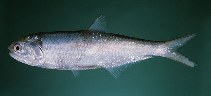 Thrissina vitrirostris
Foto de Randall, J.E.
Fotos | Imagem do Google
Foto de Randall, J.E.
Classificação / Nomes Nomes comuns | Sinônimos | Catalog of Fishes(Gênero, Espécies) | ITIS | CoL | WoRMS | Cloffa
> Clupeiformes (Herrings) > Engraulidae (Anchovies) > Coiliinae
More on authors: Gilchrist & Thompson.
More on authors: Gilchrist & Thompson.
Meio ambiente: milieu / Zona climática / intervalo de profundidade / faixa de distribuição Ecologia
marinhas; estuarina pelagic-neritic; intervalo de profundidade 0 - 50 m (Ref. 189). Tropical; 2°S - 40°S, 20°E - 51°E
Distribuição Territórios | Áreas da FAO | Ecossistemas | Ocorrências | Mapa de pontos | Introduções | Faunafri
Western Indian Ocean: from the east coast of Africa, Kenya to Natal, South Africa, and Madagascar.
Tamanho / Peso / Idade
Descrição suscinta Chaves de identificação | Morfologia | Morfometria
Espinhos dorsais (total) : 0; Raios dorsais (total) : 13 - 14; Espinhos anais: 0; Raios anais : 34 - 44; Vértebras: 43 - 45. Diagnosis: Body compressed, belly with 16-19 pre-pelvic and 8-12 post-pelvic scutes, a total of 24-30 keeled scutes from isthmus to anus; maxilla long, reaching beyond base of first pectoral finray; first supra-maxilla a minute oval; lower gillrakers 18-24, the serrae on the inner edge in distinct clumps in larger fishes; anal fin with 3-4 unbranched rays and 31-40 branched rays; a dark blotch behind upper part of gill opening; inside of gill cavity bright orange (Ref. 189). This species overlaps the range of different other species of Thryssa, of which five have a similar maxilla, very small first supra-maxilla and overlapping gillraker counts; however of these five species, T. gautamiensis, T. malabarica, T. purava and T. whiteheadi all have the tip of the snout at or above the level of the centre of the eye, and the last two, plus T. stenosoma, have at least 38 branched anal finrays (Ref. 189).
Body shape (shape guide): elongated; Cross section: compressed.
Body shape (shape guide): elongated; Cross section: compressed.
A coastal, pelagic species (Ref. 28), apparently common along shore and in estuaries (Ref. 5430). Presumably schooling, occurring inshore and entering estuaries and lagoons, perhaps used as nursery areas, but moving further out in rainy seasons when coastal waters are freshened up by rivers (Ref. 189). It feeds on plankton organisms (Ref. 28). May be caught using ringnets (Ref. 5213). Generally marketed fresh, may be salted or dried (Ref. 5284).
Ciclo de vida ou comportamento de acasalamento Maturidade | Reprodução | Desova | Ovos | Fecundidade | Larvas
Referência principal
Carregar suas referências | Referências | Coordenador | Colaboradores
Hata, H. and H. Motomura, 2019. Two new species of Thrissina (Clupeiformes: Engraulidae) from the northern Indian Ocean and redescription of Thrissina vitrirostris (Gilchrist and Thompson 1908). Ichthyol. Res. 67(1):155-166 (Ref. 128122)
Status na Lista Vermelha da UICN (Ref. 130435: Version 2025-2 (Global))
Segura ou pouco preocupante (LC) ; Date assessed: 09 March 2020
CITES
Not Evaluated
Ameaça para os humanos
Harmless
Uso pelos humanos
Pescarias: pouco comercial; isca: usually
FAO - Publication: search | FishSource |
Mais informação
Ecologia Trófica
Itens alimentares (presas)
Composição da dieta
Consumo alimentar
Rações alimentares
Predadores
Itens alimentares (presas)
Composição da dieta
Consumo alimentar
Rações alimentares
Predadores
Dinâmica populacional
Parâmetros de crescimento
Idade máxima / tamanhos
Relação comprimento-peso.
Relação comprimento-comprimento.
Frequências de comprimento
Conversão de massa
Recrutamento
Abundância
Parâmetros de crescimento
Idade máxima / tamanhos
Relação comprimento-peso.
Relação comprimento-comprimento.
Frequências de comprimento
Conversão de massa
Recrutamento
Abundância
Ciclo de vida
Reprodução
Maturidade
Maturidade/Rel. das guelras
Fecundidade
Desova
Agregações de desova
Ovos
Desenvolvimento dos ovos
Larvas
Dinâmica larval
Reprodução
Maturidade
Maturidade/Rel. das guelras
Fecundidade
Desova
Agregações de desova
Ovos
Desenvolvimento dos ovos
Larvas
Dinâmica larval
Anatomia
Área branquial
Cérebro
Otólito
Área branquial
Cérebro
Otólito
Fisiologia
Composição corporal
Nutrientes
Consumo de oxigênio
Tipo de natação
Velocidade de natação
Pigmentos visuais
Som de peixe
Doenças e Parasitas
Toxicidade (LC50s)
Composição corporal
Nutrientes
Consumo de oxigênio
Tipo de natação
Velocidade de natação
Pigmentos visuais
Som de peixe
Doenças e Parasitas
Toxicidade (LC50s)
Relacionado a humanos
Sistemas de aquicultura
Perfis para aquacultura
Estirpes
Casos de Ciguatera
Selos, moedas, diversos.
Sistemas de aquicultura
Perfis para aquacultura
Estirpes
Casos de Ciguatera
Selos, moedas, diversos.
Ferramentas
Livro eletrônico | Guia de campo | Ferramenta auxiliar de frequências de comprimento | Ferramenta sobre a história de vida | Mapa de pontos |
Catch-MSY |
Relatórios especiais
Checar Manutenção em Aquário | Checar Planilhas de Fatos sobre as Espécies | Checar Planilhas de Fatos sobre Aquicultura
Baixar XML
Fontes da internet
AFORO (otoliths) | Aquatic Commons | BHL | Cloffa | Websites from users | Checar Observador de Peixes (FishWatcher) | CISTI | Catalog of Fishes: Gênero, Espécies | DiscoverLife | ECOTOX | FAO - Publication: search | Faunafri | Fishipedia | Fishtrace | GloBI | Google Books | Google Scholar | Google | IGFA World Record | Bases de dados nacionais | OneZoom | Open Tree of Life | Otolith Atlas of Taiwan Fishes | PubMed | Reef Life Survey | Socotra Atlas | TreeBase | Árvore da vida | Wikipedia: Ir para, procura | World Records Freshwater Fishing | Registro zoológico
Estimativas baseadas em modelos
Temperatura preferida (Ref. 123201): 24.6 - 29.3, mean 27.4 °C (based on 294 cells).
Índice de diversidade filogenética (Ref. 82804): PD50 = 0.5020 [Uniqueness, from 0.5 = low to 2.0 = high].
Bayesian length-weight: a=0.00513 (0.00309 - 0.00850), b=3.15 (3.01 - 3.29), in cm total length, based on LWR estimates for this species & (Sub)family-body (Ref. 93245).
Nível Trófico (Ref. 69278): 3.4 ±0.5 se; based on size and trophs of closest relatives
Resiliência (Ref. 120179): Elevada, tempo mínimo de duplicação da população menor que 15 meses (K=0.5).