This website uses cookies to enhance your browsing experience and ensure the functionality of our site. For more detailed information about the types of cookies we use and how we protect your privacy, please visit our Privacy Information page.
×
Cookie Settings
This website uses different types of cookies to enhance your experience. Please select your preferences below:
> Eupercaria/misc (Various families in series Eupercaria) > Nemipteridae (Threadfin breams, Whiptail breams)
Etymology: Scolopsis:Name from the Greek masculine noun 'skolos' meaning 'thorn' and suffix '-opsis' (from Greek feminine n. 'opsis' meaning 'aspect', 'appearance') meaning ‘thorny appearance’ presumably referring to 'les dentelures de la préopercule, en ont aussi, et même d'épineuses, aux sous-orbitaires' mentioned by Cuvier (1814) in his designation of the genus. Name ending in -'opsis' are treated as feminine according to ICZN 1999: Article 30.1.2 (Ref. 130620). More on author: Bloch.
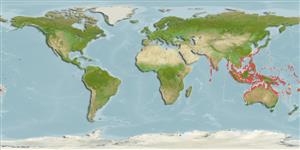
Indo-West Pacific: Maldives (Ref. 11303) and the Laccadive Islands to Fiji, north to southern Japan, south to Lord Howe Island. Recently reported from Tonga (Ref. 37816).
ขนาด / น้ำหนัก / อายุ
วัยเจริญพันธุ์: Lm? range ? - ? cm Max length : 25.0 cm TL เพศผู้/กระเทย; (Ref. 90102); common length : 13.0 cm SL เพศผู้/กระเทย; (Ref. 3810)
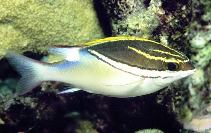
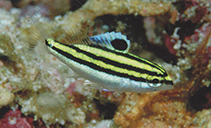
เงี่ยงครีบหลัง (รวม) : 10; ก้านครีบอ่อนที่หาง (รวม) : 9; เงี่ยงครีบก้น: 3; ก้านครีบอ่อนที่ก้น: 7. This species is distinguished by the following characters: head scales reaching to or just in front of anterior nostrils; lateral line scales 43-47 (usually 45-46); pectoral fin rays 16-18 (usually 17); snout length less than eye diameter; greatest body depth 2.5-3.0 in SL. Colour dark grey on head and back with diagonal black-edged white band separating dark area from the rest of the mainly whitish body; white blotch below posterior dorsal fin; 3 yellow stripes on upper head; juveniles with alternating black and yellow stripes on the upper half and whitish below, Batesian mimic of the poison-fanged blenny Meiacanthus grammistes (Ref. 90102). Body shape (shape guide): fusiform / normal; Cross section: oval.
Common on coral reefs. Adults occur on most reef habitats, usually in pairs, and juveniles inshore or in lagoons or rubble zones (Ref. 48635). Occurs singly or in small aggregations. Feeds on small fishes and benthic invertebrates. A protogynous hermaphrodite (Ref. 9785). Juvenile mimics poison-fanged blenny Miacanthus grammistes, Batesian mimic (Ref. 90102). Caught mainly by handline and live specimens captured by hand net for the aquarium export trade; no major fishery exists (Ref. 9785). It is parasitised by the monogenean Anoplodiscus hutsonae on the pectoral fins and body surface (Ref. 124057).
Russell, B.C., 1990. FAO Species Catalogue. Vol. 12. Nemipterid fishes of the world. (Threadfin breams, whiptail breams, monocle breams, dwarf monocle breams, and coral breams). Family Nemipteridae. An annotated and illustrated catalogue of nemipterid species known to date. FAO Fish. Synop. 125(12):149p. Rome: FAO. (Ref. 3810)
สถานะบัญชีแดงของ IUCN (Ref. 130435: Version 2025-2 (Global))
อุณหภูมิที่ต้องการ (อ้างอิง 123201): 25.1 - 29.3, mean 28.6 °C (based on 2688 cells).
ดัชนีความหลากหลายทางวิวัฒนาการ (อ้างอิง 82804): PD50 = 0.5000 [Uniqueness, from 0.5 = low to 2.0 = high].
Bayesian length-weight: a=0.01318 (0.00843 - 0.02061), b=3.06 (2.94 - 3.18), in cm total length, based on LWR estimates for this species & Genus-body shape (Ref. 93245).
ระดับชั้นอาหาร (อ้างอิง 69278): 3.6 ±0.50 se; based on food items.
ความสามารถในการกลับคืนสู่ปกติ (อ้างอิง 120179): ความสูง, เวลาต่ำสุดที่จะทำให้ประชากรเพิ่มขึ้นเป็น 2 เท่าใช้เวลาน้อยกว่า 15 เดือน (Preliminary K or Fecundity.).
ความเสี่ยงต่อการตกปลา (Ref. 59153): Low vulnerability (15 of 100). 🛈