



Envoyez vos Photos et vidéos
Images | Images Google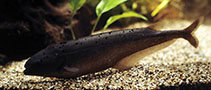 Hyperopisus bebe
Photo de Muséum-Aquarium de Nancy/D. Terver
Images | Images Google
Photo de Muséum-Aquarium de Nancy/D. Terver
Classification / Noms Noms communs | Synonymes | Catalog of Fishes(Genre, Espèce) | ITIS | CoL | WoRMS | Cloffa
> Osteoglossiformes (Bony tongues) > Mormyridae (Elephantfishes)
Etymology: Hyperopisus: Greek, yper = over, up + Greek, pisos, -eos, ous = a wet place.
More on author: Lacepède.
Etymology: Hyperopisus: Greek, yper = over, up + Greek, pisos, -eos, ous = a wet place.
More on author: Lacepède.
Environnement : milieu / zone climatique / profondeur / gamme de distribution Écologie
Distribution Territoires | Zones FAO | Écosystèmes | Occurrences | Carte par point | Introductions | Faunafri
Africa: all Sahelo-Sudanese river basins (Ref. 81274), including the Senegal, Gambia, Niger, Volta, Ouémé, Ogun and Chad (Ref. 2915). Also in the Nile basin, up to the Albert and Murchison Niles (Ref. 3203).
Longueur à la première maturité / Taille / Poids / Âge
Maturité: Lm 33.0 range ? - ? cm
Max length : 51.0 cm SL mâle / non sexé; (Ref. 2915); poids max. publié: 1.0 kg (Ref. 3799)
Max length : 51.0 cm SL mâle / non sexé; (Ref. 2915); poids max. publié: 1.0 kg (Ref. 3799)
Description synthétique Clés d'identification | Morphologie | Morphométrie
Épines dorsales (Total) : 0; Rayons mous dorsaux (Total) : 12 - 16; Épines anales: 0; Rayons mous anaux: 52 - 71. Diagnosis: body depth 3.5-6.2 times in SL, head length 4.5-6.2 times (Ref. 2915, 4903, 81274). Head length 1.6-2.3 times greater than its width (Ref. 2915, 81274) and 6-13.5 times greater than eye diameter (Ref. 81274). Dorsal head profile strongly curved (Ref. 4903), rounded, snout short, thick and blunt (Ref. 81274). Eye small, diameter 1/6 (in young fishes) to 1/9 of head length in adults; mouth small and terminal, teeth notched, 3-5 in upper and 4-6 in lower jaw (Ref. 4903). Anal fin with 52-71 rays, its origin about equidistant from snout tip and caudal-fin base (Ref. 81274). Dorsal fin very short (Ref. 28714, 81274), one fifth or less of the anal fin length (Ref. 4903, 28714), with 12-16 rays (Ref. 4903, 81274) of which the first 2-3 unbranched (Ref. 4903). Anal-fin base 4-7.7 times longer than dorsal-fin base; pectoral fins 1.1- 1.7 times in head length; pelvic fins about half as long as the pectorals (Ref. 2915, 81274). 90-120 lateral line scales (Ref. 4903, 81274) and 16-20 (exceptionally 22) around caudal peduncle (Ref. 81274). Depth of caudal peduncle 1.5-3.6 times in its length (Ref. 2915, 81274).
Coloration: ground color silvery, back darker, olivaceous, brownish or yellowish, with scattered black dots in adults; belly greyish; neck greyish or white; fins greyish (Ref. 81274).
Body shape (shape guide): fusiform / normal; Cross section: compressed.
Body shape (shape guide): fusiform / normal; Cross section: compressed.
Adults inhabit both still and flowing waters, breed in the flood season and feed on mollusks (Ref. 28714). They posses electroreceptors over the entire head and on the ventral and dorsal regions of the body, but absent from the side and the caudal peduncle where the electric organ is located (Ref. 10011). This electric organ discharge (EOD) is steroid-sensitive (Ref. 10763; 10764). Fecundity value of 18,924 eggs has been reported for this species (Ref. 10607).
Cycle de vie et comportement reproducteur Maturité | Reproduction | Frai | Œufs | Fécondité | Larves
Référence principale
Téléchargez vos références | Références | Coordinateur | Collaborateurs
Bigorne, R., 1990. Mormyridae. p. 122-184. In C. Lévêque, D. Paugy and G.G. Teugels (eds.) Faune des poissons d'eaux saumâtres d'Afrique de l'Ouest. tome 1. Faune Trop. 28. Musée Royal de l'Afrique Centrale, Tervuren, and ORSTOM, Paris. (Ref. 2915)
Statut dans la liste rouge de l'IUCN (Ref. 130435: Version 2025-2 (Global))
Préoccupation mineure (LC) ; Date assessed: 23 October 2019
CITES
Not Evaluated
Menace pour l'homme
Harmless
Utilisations par l'homme
Pêcheries: commercial
FAO - Publication: search | FishSource |
Plus d'informations
Écologie trophique
Aliments (proies)
Composition du régime alimentaire
Consommation alimentaire
Rations alimentaires
Prédateurs
Aliments (proies)
Composition du régime alimentaire
Consommation alimentaire
Rations alimentaires
Prédateurs
Dynamique des populations
Paramètres de croissance
Âges / tailles maximales
Longueur-poids rel.
Rel. longueur-longueur.
Fréquences de longueurs
Conversion de masse
Recrutement
Abondance
Paramètres de croissance
Âges / tailles maximales
Longueur-poids rel.
Rel. longueur-longueur.
Fréquences de longueurs
Conversion de masse
Recrutement
Abondance
Anatomie
Surface branchiale
Cerveau
Otolithe
Surface branchiale
Cerveau
Otolithe
Physiologie
Composition corporelle
Nutriments
Consommation d'oxygène
Type de natation
Vitesse de nage
Pigments visuels
Son de poisson
Maladies et parasites
Toxicité (CL50)
Composition corporelle
Nutriments
Consommation d'oxygène
Type de natation
Vitesse de nage
Pigments visuels
Son de poisson
Maladies et parasites
Toxicité (CL50)
Génétique
génôme
Génétique
Hétérozygotie
Héritabilité
Diversité génétique
génôme
Génétique
Hétérozygotie
Héritabilité
Diversité génétique
Liées à l'homme
Systèmes d'aquaculture
Profils d'aquaculture
Souches
Cas de ciguatera
Timbres, pièces de monnaie, divers
Systèmes d'aquaculture
Profils d'aquaculture
Souches
Cas de ciguatera
Timbres, pièces de monnaie, divers