



Heteropneustes fossilis (Bloch, 1794)
Stinging catfish
Uploaden van uw Foto's en video's
Afbeeldingen | video's | Google afbeelding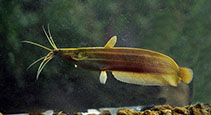 Heteropneustes fossilis
Afbeelding van Ramani Shirantha
Afbeeldingen | video's | Google afbeelding
Afbeelding van Ramani Shirantha
Classificatie / Namen Lokale namen | Synoniemen | Catalog of Fishes(Genus, Soort(en)) | ITIS | CoL | WoRMS | Cloffa
> Siluriformes (Catfishes) > Heteropneustidae (Airsac catfishes)
Etymology: Heteropneustes: Greek, heteros = other + Greek, pneo = to breath (Ref. 45335).
More on author: Bloch.
Etymology: Heteropneustes: Greek, heteros = other + Greek, pneo = to breath (Ref. 45335).
More on author: Bloch.
Milieu: milieu / Klimaatzone / Diepte / verspreidingsgebied Ecologie
; zoet water; brak water demersaal; pH range: 6.0 - 8.0; dH range: ? - 30; diepte ? - 1 m (Ref. 105091). Tropical; 21°C - 25°C (Ref. 2060); 33°N - 5°N, 64°E - 97°E
Verspreiding Gebieden | FAO regio's | Ecosystemen | Voorkomen | Verspreidingskaart | Introducties | Faunafri
Asia: Pakistan and Sri Lanka to Myanmar. Introduced elsewhare.
Lengte bij maturiteit / Grootte / Gewicht / Leeftijd
Maturiteit: Lm ?, range 12 - ? cm
Max length : 41.2 cm TL mannelijk / geslacht onbekend; (Ref. 125280); max. gepubliceerd gewicht: 400.00 g (Ref. 125280)
Max length : 41.2 cm TL mannelijk / geslacht onbekend; (Ref. 125280); max. gepubliceerd gewicht: 400.00 g (Ref. 125280)
Korte beschrijving Determinatiesleutels | Morfologie | Morfometrie
Body shape (shape guide): elongated.
Facultative air-breathing (Ref. 126274); Adults found mainly in ponds, ditches, swamps and marshes, but sometimes occur in muddy rivers. Recorded as having been or being farmed in rice fields (Ref. 119549). Can tolerate slightly brackish water. Omnivorous. Breed in confined waters during the monsoon months, but can breed in ponds, derelict ponds and ditches when sufficient rain-water accumulates. Oviparous, distinct pairing possibly like other members of the same family (Ref. 205). In great demand due to its medicinal value. Venomous fish, from its pectoral spines (Ref. 94495).
Levenscyclus en paargedrag Maturiteit | Voortplanting | Paaien | Eieren | Fecunditeit | Larven
Eggs are deposited in a depression usually excavated by both parents in mud, in shallow water. Parents guard the eggs and young until they can fend for themselves which lasts for about one month (Ref. 6028).
Hoofdreferentie
Upload uw referenties | Referenties | Coördinator | Medewerkers
Talwar, P.K. and A.G. Jhingran, 1991. Inland fishes of India and adjacent countries. Volume 2. A.A. Balkema, Rotterdam, i-xxii + 543-1158, 1 pl. (Ref. 4833)
Status op de Rode Lijst van het IUCN (Ref. 130435: Version 2025-2 (Global))
Niet bedreigd (LC) ; Date assessed: 11 August 2019
CITES
Not Evaluated
Gevaar voor de mens
Traumatogenic (Ref. 4716)
Gebruik door de mens
Visserij: van groot commercieel belang; Aquacultuur: commercieel; Aquarium: Commercieel
FAO - Publication: search | FishSource |
Meer informatie
Trofische ecologie
Voedsel (prooien)
Dieetsamenstelling
Voedselconsumptie
Voedselrantsoenen
Predatoren
Voedsel (prooien)
Dieetsamenstelling
Voedselconsumptie
Voedselrantsoenen
Predatoren
Populatiedynamica
Groeiparameters
Max. leeftijden / maten
Lengte-gewicht rel.
Lengte-lengte rel.
Lengtefrequenties
Massaconversie
Rekrutering
Abundantie
Groeiparameters
Max. leeftijden / maten
Lengte-gewicht rel.
Lengte-lengte rel.
Lengtefrequenties
Massaconversie
Rekrutering
Abundantie
Levenscyclus
Voortplanting
Maturiteit
Rijpheid/kieuwen rel.
Fecunditeit
Paaien
Paaibestanden
Eieren
Ontwikkeling van de eieren
Larven
Larvale populatiedynamiek
Voortplanting
Maturiteit
Rijpheid/kieuwen rel.
Fecunditeit
Paaien
Paaibestanden
Eieren
Ontwikkeling van de eieren
Larven
Larvale populatiedynamiek
Fysiologie
Lichaamssamenstelling
Voedingsstoffen
Zuurstofverbruik
Type zwemmen
Zwemsnelheid
Visuele pigmenten
Vis geluid
Ziekten en parasieten
Toxiciteit (LC50)
Lichaamssamenstelling
Voedingsstoffen
Zuurstofverbruik
Type zwemmen
Zwemsnelheid
Visuele pigmenten
Vis geluid
Ziekten en parasieten
Toxiciteit (LC50)
Menselijk gerelateerd
Aquacultuursystemen
Aquacultuurprofielen
Kweeklijnen
Ciguatera gevallen
Postzegels, munten, diversen.
Aquacultuursystemen
Aquacultuurprofielen
Kweeklijnen
Ciguatera gevallen
Postzegels, munten, diversen.
Tools
Biologische quiz | E-boek | Veldgids | Lengtefrequentie Tool | Levenscyclus tool | Verspreidingskaart |
Vangst-MSY |
Speciale rapporten
Bekijk gegevens voor het houden in een aquarium | Bekijk Fact Sheets voor de soort | Bekijk Aquacultuur Fact Sheets
Download XML
Internetbronnen
AFORO (otoliths) | Exoten/Invasieve soorten database | Aquatic Commons | BHL | Cloffa | Websites from users | Bekijk FishWatcher | CISTI | Catalog of Fishes: Genus, Soort(en) | DiscoverLife | ECOTOX | FAO - Publication: search | Faunafri | Fishipedia | Fishtrace | GloBI | Google Books | Google Scholar | Google | IGFA World Record | Nationale databanken | OneZoom | Open Tree of Life | Otolith Atlas of Taiwan Fishes | Publieke aquaria | PubMed | Reef Life Survey | Socotra Atlas | TreeBase | Tree of Life | Wikipedia: ga naar, zoek | World Records Freshwater Fishing | Zoological Record
Schattingen op basis van modellen
Fylogenetische diversiteitsindex (Ref. 82804): PD50 = 0.5312 [Uniqueness, from 0.5 = low to 2.0 = high].
Bayesian length-weight: a=0.00437 (0.00193 - 0.00988), b=3.09 (2.88 - 3.30), in cm total length, based on LWR estimates for this (Sub)family-body shape (Ref. 93245).
Trofisch niveau (Ref. 69278): 3.6 ±0.3 se; based on diet studies.
Weerstandsvermogen (Ref. 120179): Gemiddeld, minimale populatieverdubbelingstijd 1,4-4,4 jaar (K=0.23; tm=1; Fec=4,200).
Voedingsstoffen (Ref. 124155): Calcium = 148 [78, 332] mg/100g; Iron = 1.86 [1.01, 3.31] mg/100g; Protein = 16.8 [15.3, 18.3] %; Omega3 = 0.144 [0.070, 0.301] g/100g; Selenium = 55.9 [27.3, 116.7] μg/100g; VitaminA = 14.2 [6.2, 34.2] μg/100g; Zinc = 1.19 [0.78, 2.05] mg/100g (wet weight); based on nutrient studies.