



Ammodytes personatus Girard, 1856
Pacific sandlance
Adicionar as suas observações no Fish Watcher
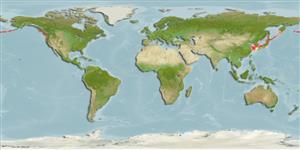
| Native range | All suitable habitat | Point map | Year 2050 |
|
| This map was computer-generated and has not yet been reviewed. |
| Ammodytes personatus AquaMaps Data sources: GBIF OBIS |
Adicionar o seu Fotografias e vídeos
Fotografias | Imagem do Google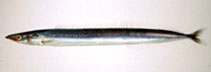 Ammodytes personatus
Fotografia de Suzuki, T.
Fotografias | Imagem do Google
Fotografia de Suzuki, T.
Classificação / Nomes Nomes comuns | Sinónimos | Catalog of Fishes(Género, Espécies) | ITIS | CoL | WoRMS | Cloffa
> Perciformes/Uranoscopoidei (Sand dwellers) > Ammodytidae (Sand lances)
Etymology: Ammodytes: Greek, ammos = sand + Greek, dytes = anyone that likes immersions, diving (Ref. 45335).
More on author: Girard.
Etymology: Ammodytes: Greek, ammos = sand + Greek, dytes = anyone that likes immersions, diving (Ref. 45335).
More on author: Girard.
Ambiente: milieu / zona climática / intervalo de profundidade / gama de distribuição Ecologia
marinhas demersal; oceanódromo (Ref. 51243); intervalo de profundidade 0 - 172 m (Ref. 114018). Temperate; 54°N - 30°N, 118°E - 118°W
Distribuição Territórios | Áreas FAO | Ecossistemas | Ocorrências | Mapa dos pontos | Introduções | Faunafri
Northwest Pacific: inland Sea of Japan to Kyushu, Japan. Northeast Pacific: From southern California to the western Aleutian Islands (Ref. 114018), Alaska (Ref. 11366).
Tamanho / Peso / Idade
Maturidade: Lm ? range ? - ? cm
Max length : 15.0 cm SL macho/indeterminado; (Ref. 559); common length : 10.0 cm SL macho/indeterminado; (Ref. 559); peso máx. Publicado: 10.60 g (Ref. 112063); Idade máx. registada: 3.00 anos (Ref. 125612)
Max length : 15.0 cm SL macho/indeterminado; (Ref. 559); common length : 10.0 cm SL macho/indeterminado; (Ref. 559); peso máx. Publicado: 10.60 g (Ref. 112063); Idade máx. registada: 3.00 anos (Ref. 125612)
Descrição breve Chaves de identificação | Morfologia | Morfometria
Espinhos dorsais (total) : 0; Raios dorsais moles (total) : 55 - 59; Espinhos anais: 0; Raios anais moles: 28 - 32; Vértebras: 62 - 67. Characterized by having a horizontal skin fold along its ventral contour, and the absence of pelvic fin and teeth. Lateral plicae 160 to 180. Lower jaw pointed. Lateral line system on head not continuous with that on the body.
Body shape (shape guide): elongated; Cross section: circular.
Body shape (shape guide): elongated; Cross section: circular.
Found in sand bottoms and may enter semi-enclosed sea areas (Ref. 11230). Forms large schools. Important food fish in Japan (marketed fresh or dried) and marketed fresh but mainly used for meal and oil manufacture in Europe (Ref. 10384). Common size taken from picture in Ref. 559. Maximum size estimated as 1.5 * common size. Two genetically different lineages were found in Japan Sea/East Sea, perhaps representing two different species (J.K. Kim, oral.comm, FishBoL2012, June 2012).
Ciclo de vida e comportamento de acasalamento Maturidade | Reprodução | Desova | Ovos | Fecundidade | Larvas
Referência principal
Carregar as suas referências | Referências | Coordenador | Colaboradores
Masuda, H., K. Amaoka, C. Araga, T. Uyeno and T. Yoshino, 1984. The fishes of the Japanese Archipelago. Vol. 1. Tokai University Press, Tokyo, Japan. 437 p. (text). (Ref. 559)
CITES
Not Evaluated
Ameaça para o homem
Harmless
Utilização humana
Pescarias: altamente comercial
FAO - pescarias: desembarques, perfil da espécie; Publication: search | FishSource | Sea Around Us
Mais informação
Ecologia Trófica
Produtos alimentares (presas)
Composição da dieta
Consumo alimentar
Rações alimentares
Predadores
Produtos alimentares (presas)
Composição da dieta
Consumo alimentar
Rações alimentares
Predadores
Dinâmica das populações
Parâmetros de crescimento
Idades / tamanhos máximos
Comprimento-peso rel.
Comprimento-comprimento rel.
Frequência de comprimento
Conversão de massa
Recrutamento
Abundância
Parâmetros de crescimento
Idades / tamanhos máximos
Comprimento-peso rel.
Comprimento-comprimento rel.
Frequência de comprimento
Conversão de massa
Recrutamento
Abundância
Ciclo de vida
Reprodução
Maturidade
Maturidade/Rel. das guelras
Fecundidade
Desova
Agregações de desova
Ovos
Desenvolvimento dos ovos
Larvas
Dinâmica larvar
Reprodução
Maturidade
Maturidade/Rel. das guelras
Fecundidade
Desova
Agregações de desova
Ovos
Desenvolvimento dos ovos
Larvas
Dinâmica larvar
Anatomia
Área branquial
Cérebro
Otólitos
Área branquial
Cérebro
Otólitos
Fisiologia
Composição corporal
Nutrientes
Consumo de oxigénio
Tipo de natação
Velocidade de natação
Pigmentos visuais
Som de peixe
Doenças e Parasitas
Toxicidade (LC50s)
Composição corporal
Nutrientes
Consumo de oxigénio
Tipo de natação
Velocidade de natação
Pigmentos visuais
Som de peixe
Doenças e Parasitas
Toxicidade (LC50s)
Genética
genoma
Genética
Heterozigotia
Hereditariedade
Diversidade genética
genoma
Genética
Heterozigotia
Hereditariedade
Diversidade genética
Relacionado com o ser humano
Sistemas de aquacultura
Perfis para aquacultura
Estirpes
Casos de Ciguatera
Selos, moedas, diversos.
Sistemas de aquacultura
Perfis para aquacultura
Estirpes
Casos de Ciguatera
Selos, moedas, diversos.
Ferramentas
E-book | Guia de campo | Ferramenta auxiliar de frequências de comprimento | Ferramenta sobre a história de vida | Mapa dos pontos |
Captura-MSY |
Relatórios especiais
Descarregue XML
Fontes da internet
AFORO (otoliths) | Alien/Invasive Species database | Aquatic Commons | BHL | Cloffa | Websites from users | Consultar FishWatcher | CISTI | Catalog of Fishes: Género, Espécies | DiscoverLife | ECOTOX | FAO - pescarias: desembarques, perfil da espécie; Publication: search | Faunafri | Fishipedia | Fishtrace | GloBI | Google Books | Google Scholar | Google | IGFA World Record | OceanAdapt | OneZoom | Open Tree of Life | Otolith Atlas of Taiwan Fishes | PubMed | Reef Life Survey | Socotra Atlas | TreeBase | Árvore da vida | Wikipedia: ir para, procurar | World Records Freshwater Fishing | Zoobank | Registo zoológico
Estimativas baseadas em modelos
Temperatura preferida (Ref. 123201): 11.9 - 23, mean 19.1 °C (based on 74 cells).
Índice de diversidade filogenética (Ref. 82804): PD50 = 0.5078 [Uniqueness, from 0.5 = low to 2.0 = high].
Bayesian length-weight: a=0.00617 (0.00349 - 0.01089), b=3.05 (2.90 - 3.20), in cm total length, based on LWR estimates for this species & Genus-body shape (Ref. 93245).
Nível Trófico (Ref. 69278): 3.1 ±0.1 se; based on size and trophs of closest relatives
Generation time: 1.1 ( na - na) years. Estimated as median ln(3)/K based on 1 growth studies.
Resiliência (Ref. 120179): Elevada, tempo mínimo de duplicação da população menor que 15 meses (K=0.6).
Prior r = 0.79, 95% CL = 0.52 - 1.18, Based on 4 data-limited stock assessments.
Nutrientes (Ref. 124155): Calcium = 86.7 [47.1, 189.0] mg/100g; Iron = 0.509 [0.278, 0.951] mg/100g; Protein = 18.8 [17.3, 20.2] %; Omega3 = 0.467 [0.238, 0.873] g/100g; Selenium = 12.6 [5.7, 28.3] μg/100g; VitaminA = 31.4 [7.8, 121.8] μg/100g; Zinc = 0.773 [0.521, 1.136] mg/100g (wet weight);