



Adicionar as suas observações no Fish Watcher
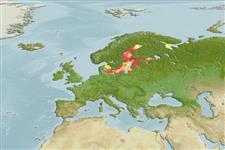
| Native range | All suitable habitat | Point map | Year 2050 |
|
| This map was computer-generated and has not yet been reviewed. |
| Coregonus maraena AquaMaps Data sources: GBIF OBIS |
Adicionar o seu Fotografias e vídeos
Fotografias | Imagem do Google Coregonus maraena
Fotografia de Freyhof, J.
Fotografias | Imagem do Google
Fotografia de Freyhof, J.
Classificação / Nomes Nomes comuns | Sinónimos | Catalog of Fishes(Género, Espécies) | ITIS | CoL | WoRMS | Cloffa
> Salmoniformes (Salmons) > Salmonidae (Salmonids) > Coregoninae
Etymology: Coregonus: Greek, kore = pupils of the eye + Greek, gonia = angle (Ref. 45335).
More on author: Bloch.
Etymology: Coregonus: Greek, kore = pupils of the eye + Greek, gonia = angle (Ref. 45335).
More on author: Bloch.
Ambiente: milieu / zona climática / intervalo de profundidade / gama de distribuição Ecologia
marinhas; Água doce; estuarina demersal; anádromo (Ref. 88171); intervalo de profundidade 10 - 20 m (Ref. 130226). Temperate; 69°N - 49°N, 7°E - 37°E (Ref. 59043)
Distribuição Territórios | Áreas FAO | Ecossistemas | Ocorrências | Mapa dos pontos | Introduções | Faunafri
Europe: In the Baltic Sea: Swedish coast (including Bothnian Gulf, not in Gotland); in southern Baltic, extending from the Schlei to Gulf of Finland. Southeast North Sea Basin: Ems, Weser and Elbe drainages and small rivers of Schleswig-Holstein and Denmark. Landlocked in several lakes in Poland, Sweden, and Russia. Introduced and transplanted in many drainages within its native range and outside westward to Rhine drainage (Ref. 59043). Apparent abundance in Germany, Poland and Scandinavia results from the massive stocking programs without which the populations would rapidly decline.
Usually known as C. lavaretus in the Baltic Sea basin. North Sea population might represent a distinct species (Ref. 59043).
Tamanho / Peso / Idade
Maturidade: Lm ? range ? - ? cm
Max length : 130 cm TL macho/indeterminado; (Ref. 593); peso máx. Publicado: 10.0 kg (Ref. 593)
Max length : 130 cm TL macho/indeterminado; (Ref. 593); peso máx. Publicado: 10.0 kg (Ref. 593)
Descrição breve Chaves de identificação | Morfologia | Morfometria
Body shape (shape guide): fusiform / normal.
Forages along coasts. Also reported from deep, oligo-mesotrophic lakes. Feeds on benthic prey (crustaceans, molluscs, large insect larvae, small fish). Spawns in shallow water, in rapids or small rivers or over firm sediments in lowland rivers and estuaries. Northernmost stocks undertake the longest migrations between spawning and foraging grounds. In the northern part of the range, individuals may travel as much as 700 km between these areas (Ref. 59043).
Growth parameters from Russia suggest a maximum age of 20 years (Ref. 56506) .
Members of the genus Coregonus readily hybridise with other Coregonus species and populations (Ref. 89548).
Ciclo de vida e comportamento de acasalamento Maturidade | Reprodução | Desova | Ovos | Fecundidade | Larvas
Adults ascend rivers between June and October (northern Baltic) or November (southern Baltic), when water temperature drops below 10 °C.
Spawning occurs in estuarine areas with low salinities or lower reaches of rivers or rapids (Ref. 59043). Coregonus species spawn on gravel and sand bottoms (Ref. 35387). Spawns for the first time at 3-5 years. Some females spawn only every second year (Ref. 59043). Spawners may spend the winter in rivers or near estuaries along the coast (Ref. 89484). Eggs hatch in early spring and larvae drift downstream to estuarine bays or to the sea; juveniles migrate to the sea in summer (Ref. 59043).
Referência principal
Carregar as suas referências | Referências | Coordenador | Colaboradores
Kottelat, M., 1997. European freshwater fishes. An heuristic checklist of the freshwater fishes of Europe (exclusive of former USSR), with an introduction for non-systematists and comments on nomenclature and conservation. Biologia, Bratislava, 52/Suppl. 5:1-271. (Ref. 13696)
Categoria na Lista Vermelha da IUCN (Ref. 130435: Version 2025-2 (Global))
Preocupação menor (LC) ; Date assessed: 06 November 2023
CITES
Not Evaluated
Ameaça para o homem
Harmless
Utilização humana
Pescarias: pouco comercial; Aquacultura: espécies comerciais
FAO - Publication: search | FishSource |
Mais informação
Ecologia Trófica
Produtos alimentares (presas)
Composição da dieta
Consumo alimentar
Rações alimentares
Predadores
Produtos alimentares (presas)
Composição da dieta
Consumo alimentar
Rações alimentares
Predadores
Dinâmica das populações
Parâmetros de crescimento
Idades / tamanhos máximos
Comprimento-peso rel.
Comprimento-comprimento rel.
Frequência de comprimento
Conversão de massa
Recrutamento
Abundância
Parâmetros de crescimento
Idades / tamanhos máximos
Comprimento-peso rel.
Comprimento-comprimento rel.
Frequência de comprimento
Conversão de massa
Recrutamento
Abundância
Ciclo de vida
Reprodução
Maturidade
Maturidade/Rel. das guelras
Fecundidade
Desova
Agregações de desova
Ovos
Desenvolvimento dos ovos
Larvas
Dinâmica larvar
Reprodução
Maturidade
Maturidade/Rel. das guelras
Fecundidade
Desova
Agregações de desova
Ovos
Desenvolvimento dos ovos
Larvas
Dinâmica larvar
Anatomia
Área branquial
Cérebro
Otólitos
Área branquial
Cérebro
Otólitos
Fisiologia
Composição corporal
Nutrientes
Consumo de oxigénio
Tipo de natação
Velocidade de natação
Pigmentos visuais
Som de peixe
Doenças e Parasitas
Toxicidade (LC50s)
Composição corporal
Nutrientes
Consumo de oxigénio
Tipo de natação
Velocidade de natação
Pigmentos visuais
Som de peixe
Doenças e Parasitas
Toxicidade (LC50s)
Genética
genoma
Genética
Heterozigotia
Hereditariedade
Diversidade genética
genoma
Genética
Heterozigotia
Hereditariedade
Diversidade genética
Relacionado com o ser humano
Sistemas de aquacultura
Perfis para aquacultura
Estirpes
Casos de Ciguatera
Selos, moedas, diversos.
Sistemas de aquacultura
Perfis para aquacultura
Estirpes
Casos de Ciguatera
Selos, moedas, diversos.
Ferramentas
E-book | Guia de campo | Ferramenta auxiliar de frequências de comprimento | Ferramenta sobre a história de vida | Mapa dos pontos |
Captura-MSY |
Relatórios especiais
Descarregue XML
Fontes da internet
AFORO (otoliths) | Alien/Invasive Species database | Aquatic Commons | BHL | Cloffa | Websites from users | Consultar FishWatcher | CISTI | Catalog of Fishes: Género, Espécies | DiscoverLife | ECOTOX | FAO - Publication: search | Faunafri | Fishipedia | Fishtrace | GloBI | Google Books | Google Scholar | Google | IGFA World Record | Bases de dados nacionais | OneZoom | Open Tree of Life | Otolith Atlas of Taiwan Fishes | PubMed | Reef Life Survey | Socotra Atlas | TreeBase | Árvore da vida | Wikipedia: ir para, procurar | World Records Freshwater Fishing | Registo zoológico
Estimativas baseadas em modelos
Temperatura preferida (Ref. 123201): 4.5 - 9.7, mean 7.5 °C (based on 174 cells).
Índice de diversidade filogenética (Ref. 82804): PD50 = 0.5000 [Uniqueness, from 0.5 = low to 2.0 = high].
Bayesian length-weight: a=0.00550 (0.00333 - 0.00907), b=3.20 (3.06 - 3.34), in cm total length, based on LWR estimates for this species & Genus-body shape (Ref. 93245).
Nível Trófico (Ref. 69278): 3.5 ±0.3 se; based on size and trophs of closest relatives
Resiliência (Ref. 120179): Médio, tempo mínimo de duplicação da população 1,4 - 4,4 anos (tm=2-3).