



Ajouter votre observation dans Fish Watcher
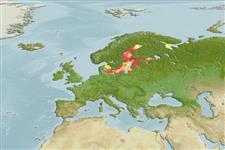
| Native range | All suitable habitat | Point map | Year 2050 |
|
| This map was computer-generated and has not yet been reviewed. |
| Coregonus maraena AquaMaps Data sources: GBIF OBIS |
Envoyez vos Photos et vidéos
Images | Images Google Coregonus maraena
Photo de Freyhof, J.
Images | Images Google
Photo de Freyhof, J.
Classification / Noms Noms communs | Synonymes | Catalog of Fishes(Genre, Espèce) | ITIS | CoL | WoRMS | Cloffa
> Salmoniformes (Salmons) > Salmonidae (Salmonids) > Coregoninae
Etymology: Coregonus: Greek, kore = pupils of the eye + Greek, gonia = angle (Ref. 45335).
More on author: Bloch.
Etymology: Coregonus: Greek, kore = pupils of the eye + Greek, gonia = angle (Ref. 45335).
More on author: Bloch.
Environnement : milieu / zone climatique / profondeur / gamme de distribution Écologie
marin; eau douce; saumâtre démersal; anadrome (Ref. 88171); profondeur 10 - 20 m (Ref. 130226). Temperate; 69°N - 49°N, 7°E - 37°E (Ref. 59043)
Distribution Territoires | Zones FAO | Écosystèmes | Occurrences | Carte par point | Introductions | Faunafri
Europe: In the Baltic Sea: Swedish coast (including Bothnian Gulf, not in Gotland); in southern Baltic, extending from the Schlei to Gulf of Finland. Southeast North Sea Basin: Ems, Weser and Elbe drainages and small rivers of Schleswig-Holstein and Denmark. Landlocked in several lakes in Poland, Sweden, and Russia. Introduced and transplanted in many drainages within its native range and outside westward to Rhine drainage (Ref. 59043). Apparent abundance in Germany, Poland and Scandinavia results from the massive stocking programs without which the populations would rapidly decline.
Usually known as C. lavaretus in the Baltic Sea basin. North Sea population might represent a distinct species (Ref. 59043).
Taille / Poids / Âge
Maturité: Lm ? range ? - ? cm
Max length : 130 cm TL mâle / non sexé; (Ref. 593); poids max. publié: 10.0 kg (Ref. 593)
Max length : 130 cm TL mâle / non sexé; (Ref. 593); poids max. publié: 10.0 kg (Ref. 593)
Description synthétique Clés d'identification | Morphologie | Morphométrie
Body shape (shape guide): fusiform / normal.
Forages along coasts. Also reported from deep, oligo-mesotrophic lakes. Feeds on benthic prey (crustaceans, molluscs, large insect larvae, small fish). Spawns in shallow water, in rapids or small rivers or over firm sediments in lowland rivers and estuaries. Northernmost stocks undertake the longest migrations between spawning and foraging grounds. In the northern part of the range, individuals may travel as much as 700 km between these areas (Ref. 59043).
Growth parameters from Russia suggest a maximum age of 20 years (Ref. 56506) .
Members of the genus Coregonus readily hybridise with other Coregonus species and populations (Ref. 89548).
Cycle de vie et comportement reproducteur Maturité | Reproduction | Frai | Œufs | Fécondité | Larves
Adults ascend rivers between June and October (northern Baltic) or November (southern Baltic), when water temperature drops below 10 °C.
Spawning occurs in estuarine areas with low salinities or lower reaches of rivers or rapids (Ref. 59043). Coregonus species spawn on gravel and sand bottoms (Ref. 35387). Spawns for the first time at 3-5 years. Some females spawn only every second year (Ref. 59043). Spawners may spend the winter in rivers or near estuaries along the coast (Ref. 89484). Eggs hatch in early spring and larvae drift downstream to estuarine bays or to the sea; juveniles migrate to the sea in summer (Ref. 59043).
Référence principale
Téléchargez vos références | Références | Coordinateur | Collaborateurs
Kottelat, M., 1997. European freshwater fishes. An heuristic checklist of the freshwater fishes of Europe (exclusive of former USSR), with an introduction for non-systematists and comments on nomenclature and conservation. Biologia, Bratislava, 52/Suppl. 5:1-271. (Ref. 13696)
Statut dans la liste rouge de l'IUCN (Ref. 130435: Version 2025-2 (Global))
Préoccupation mineure (LC) ; Date assessed: 06 November 2023
CITES
Not Evaluated
Menace pour l'homme
Harmless
Utilisations par l'homme
Pêcheries: intérêt commercial mineur; Aquaculture: commercial
FAO - Publication: search | FishSource |
Plus d'informations
Écologie trophique
Aliments (proies)
Composition du régime alimentaire
Consommation alimentaire
Rations alimentaires
Prédateurs
Aliments (proies)
Composition du régime alimentaire
Consommation alimentaire
Rations alimentaires
Prédateurs
Dynamique des populations
Paramètres de croissance
Âges / tailles maximales
Longueur-poids rel.
Rel. longueur-longueur.
Fréquences de longueurs
Conversion de masse
Recrutement
Abondance
Paramètres de croissance
Âges / tailles maximales
Longueur-poids rel.
Rel. longueur-longueur.
Fréquences de longueurs
Conversion de masse
Recrutement
Abondance
Cycle de vie
Reproduction
Maturité
Maturité/épines rel.
Fécondité
Frai
Agrégats de frai
Œufs
Développement de l'œuf
Larves
Dynamique des populations larvaires
Reproduction
Maturité
Maturité/épines rel.
Fécondité
Frai
Agrégats de frai
Œufs
Développement de l'œuf
Larves
Dynamique des populations larvaires
Anatomie
Surface branchiale
Cerveau
Otolithe
Surface branchiale
Cerveau
Otolithe
Physiologie
Composition corporelle
Nutriments
Consommation d'oxygène
Type de natation
Vitesse de nage
Pigments visuels
Son de poisson
Maladies et parasites
Toxicité (CL50)
Composition corporelle
Nutriments
Consommation d'oxygène
Type de natation
Vitesse de nage
Pigments visuels
Son de poisson
Maladies et parasites
Toxicité (CL50)
Génétique
génôme
Génétique
Hétérozygotie
Héritabilité
Diversité génétique
génôme
Génétique
Hétérozygotie
Héritabilité
Diversité génétique
Liées à l'homme
Systèmes d'aquaculture
Profils d'aquaculture
Souches
Cas de ciguatera
Timbres, pièces de monnaie, divers
Systèmes d'aquaculture
Profils d'aquaculture
Souches
Cas de ciguatera
Timbres, pièces de monnaie, divers
Outils
E-book | Guide de terrain | Générateur de fréquences de longueur | Outil de dynamique de population | Carte par point |
Capture-MSY |
Articles particuliers
Télécharger en XML
Sources Internet
AFORO (otoliths) | Alien/Invasive Species database | Aquatic Commons | BHL | Cloffa | Websites from users | FishWatcher | CISTI | Catalog of Fishes: Genre, Espèce | DiscoverLife | ECOTOX | FAO - Publication: search | Faunafri | Fishipedia | Fishtrace | GloBI | Google Books | Google Scholar | Google | IGFA World Record | Bases de données nationales | OneZoom | Open Tree of Life | Otolith Atlas of Taiwan Fishes | PubMed | Reef Life Survey | Socotra Atlas | TreeBase | Arbre de Vie | Wikipedia: aller à, chercher | World Records Freshwater Fishing | Zoological Record
Estimations basées sur des modèles
Température préférée (Réf. 123201): 4.5 - 9.7, mean 7.5 °C (based on 174 cells).
Indice de diversité phylogénétique (Réf. 82804): PD50 = 0.5000 [Uniqueness, from 0.5 = low to 2.0 = high].
Bayesian length-weight: a=0.00550 (0.00333 - 0.00907), b=3.20 (3.06 - 3.34), in cm total length, based on LWR estimates for this species & Genus-body shape (Ref. 93245).
Niveau trophique (Réf. 69278): 3.5 ±0.3 se; based on size and trophs of closest relatives
Résilience (Réf. 120179): Milieu, temps minimum de doublement de population : 1,4 à 4,4 années (tm=2-3).