



Lycodes terraenovae Collett, 1896
添加你自己的观测位置在 Fish Watcher
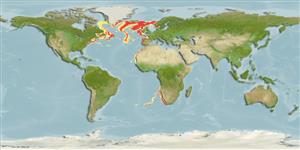
| Native range | All suitable habitat | Point map | Year 2050 |
|
| This map was computer-generated and has not yet been reviewed. |
| Lycodes terraenovae AquaMaps Data sources: GBIF OBIS |

分类 / 名称 俗名 | 同种异名 | Catalog of Fishes(属, 种) | ITIS | CoL | WoRMS | Cloffa
Teleostei > Perciformes/Zoarcoidei (Eelpouts and pricklebacks) > Zoarcidae (Eelpouts) > Lycodinae
Etymology: Lycodes: Greek, lykos = wolf + Greek, suffix, oides = similar to (Ref. 45335).
Etymology: Lycodes: Greek, lykos = wolf + Greek, suffix, oides = similar to (Ref. 45335).
环境:氛围 / 气候带 / 深度上下限 / 分布范围 生态学
分布 领土 | FAO区域 | 生态系 | 标本纪录 | 分布图 | 简介 | Faunafri
Western Atlantic: Davis Strait, off Newfoundland and Middle Atlantic Bight. Eastern Atlantic: Rockall Trough/ Bill Bailey Bank, off Mauritania and off southwestern Africa.
西大西洋: 戴維斯海峽, 外海的紐芬蘭與中央的大西洋的灣。 東大西洋: Rockall 溝槽/比爾外牆淺堆, 茅利塔尼亞外海到與外海的非洲西南方。
西大西洋: 戴維斯海峽, 外海的紐芬蘭與中央的大西洋的灣。 東大西洋: Rockall 溝槽/比爾外牆淺堆, 茅利塔尼亞外海到與外海的非洲西南方。
大小 / 重量 / 年龄
简单描述 检索表 | 型态特徵 | 形态测量图
背的软条 (总数) : 15 - 17. Body uniformly brown with dark fins. Head pores unreduced. Lateral line system with dorsolateral, a mediolateral and a ventral lateral line. Long tail, preanal 33.5-45.9% SL. Body scaled, including neck, fins and abdomen (Ref. 27255). Differs from sympatric species L. vahlii and L. esmarkii by its uniform coloration (vs. bars or marks present), lack of predorsal lateral line, smaller and fewer palatine teeth (3-5 vs. 8-22 and 5-13 respectively) and position of the last precaudal vertebrae in relation to dorsal fin (ray number 15-17 vs.18-19 and 19-20 respectively) (Ref. 36375).
Body shape (shape guide): eel-like; Cross section: oval.
身体全身褐色的有深色的鳍。 头部孔不缩小的。 侧线系统具有背外侧的, 一侧面中央的与一条腹的侧线。 长的尾部, 肛门前的 33.5-45.9% SL。 身体覆有鳞片, 包括颈部,鳍与腹部.(参考文献 27255) 用它的均匀颜色 (vs. 横带或者标志存在的) 有别于分布区重叠的种 L. vahlii 与 L. esmarkii, 没有最后尾前椎的前背侧线,更小与更少的颚齿 (3-5 vs.8-22 与 5-13 分别地) 与位置相较于背鳍 (15 号鳍条-17 vs.18-19 与 19-20 分别地).(参考文献 36375)
Body shape (shape guide): eel-like; Cross section: oval.
身体全身褐色的有深色的鳍。 头部孔不缩小的。 侧线系统具有背外侧的, 一侧面中央的与一条腹的侧线。 长的尾部, 肛门前的 33.5-45.9% SL。 身体覆有鳞片, 包括颈部,鳍与腹部.(参考文献 27255) 用它的均匀颜色 (vs. 横带或者标志存在的) 有别于分布区重叠的种 L. vahlii 与 L. esmarkii, 没有最后尾前椎的前背侧线,更小与更少的颚齿 (3-5 vs.8-22 与 5-13 分别地) 与位置相较于背鳍 (15 号鳍条-17 vs.18-19 与 19-20 分别地).(参考文献 36375)
Benthic; feeds on sponge remains, worms, molluscs, pycnogonids, crustaceans and brittle stars (Ref. 58426). Species forgotten in CLOFNAM (10007) and FNAM (4695).
在 CLOFNAM(10007) 与 FNAM 被忘记的种.(4695)
在 CLOFNAM(10007) 与 FNAM 被忘记的种.(4695)
生命周期和交配行为 成熟度 | 繁殖 | 产卵场 | 卵 | 孕卵数 | 仔鱼
西大西洋: 戴維斯海峽, 外海的紐芬蘭與中央的大西洋的灣。 東大西洋: Rockall 溝槽/比爾外牆淺堆, 茅利塔尼亞外海到與外海的非洲西南方。
主要参考文献
上传您的参考资料 | 参考文献 | 合作者 | 合作者
Anderson, M.E., 1994. Systematics and osteology of the Zoarcidae (Teleostei: Perciformes). Ichthyol. Bull. J.L.B. Smith Inst. Ichthyol. 60:120 p. (Ref. 11954)
CITES
Not Evaluated
对人类的威胁
无害处的
人类利用
FAO - Publication: search | FishSource |
更多信息
解剖学
鳃区
大脑
耳石
鳃区
大脑
耳石
生理学
身体成分
营养素
耗氧量
游泳类型
游泳速度
视觉色素
鱼声
疾病与寄生虫
毒性(半数致死浓度)
身体成分
营养素
耗氧量
游泳类型
游泳速度
视觉色素
鱼声
疾病与寄生虫
毒性(半数致死浓度)
遗传学
基因组
遗传学
异质性
遗传率
基因多样性
基因组
遗传学
异质性
遗传率
基因多样性
工具
特别资料
下载 XML
网络资源
AFORO (otoliths) | Aquatic Commons | BHL | Cloffa | Websites from users | 核实 FishWatcher | CISTI | Catalog of Fishes: 属, 种 | DiscoverLife | ECOTOX | FAO - Publication: search | Faunafri | Fishipedia | Fishtrace | GloBI | Google Books | Google Scholar | Google | IGFA World Record | OneZoom | Open Tree of Life | Otolith Atlas of Taiwan Fishes | PubMed | Reef Life Survey | Socotra Atlas | TreeBase | 树状分类阶层 | Wikipedia: 转至, 搜寻 | World Records Freshwater Fishing | Zoobank | 动物学的记录
基于模型的估算
首选温度 (参考文献 123201): 3.1 - 7.1, mean 4.1 °C (based on 329 cells).
系统发育多样性指数 (参考文献 82804): PD50 = 0.5000 [Uniqueness, from 0.5 = low to 2.0 = high].
Bayesian length-weight: a=0.00182 (0.00104 - 0.00318), b=3.20 (3.04 - 3.36), in cm total length, based on LWR estimates for this species & (Sub)family-body (Ref. 93245).
营养阶层 (参考文献 69278): 3.5 ±0.45 se; based on food items.
回复力 (参考文献 120179): 非常低的, 最小族群倍增时间超过14 年 (Preliminary K or Fecundity.).