



Devario malabaricus (Jerdon, 1849)
Malabar danio
Sube tu fotos y Vídeos
Imágenes | Google image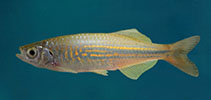 Devario malabaricus
Foto de Ramani Shirantha
Imágenes | Google image
Foto de Ramani Shirantha
Clasificación / Nombres Nombres comunes | Sinónimos | Catalog of Fishes(Género, Especie) | ITIS | CoL | WoRMS | Cloffa
> Cypriniformes (Carps) > Danionidae (Danios) > Danioninae
Etymology: Devario: Bangla/Bengali:‘debari’, local name for these fishes; also meaning ‘brother in law’ (Ref. 2031).
More on author: Jerdon.
Etymology: Devario: Bangla/Bengali:‘debari’, local name for these fishes; also meaning ‘brother in law’ (Ref. 2031).
More on author: Jerdon.
Entorno: milieu / zona climática / rango de profundidad / gama de distribución Ecología
; agua dulce bentopelágico. Tropical; 18°C - 25°C; 22°N - 6°N, 72°E - 81°E
Distribución Territorios | Áreas FAO | Ecosistemas | Ocurrencias, apariciones | Mapa de puntos | Introducciones | Faunafri
Asia: west coast of India and Sri Lanka. Has been widely transported around the world through the aquarium fish trade industry.
Tamaño / Peso / Edad
Madurez: Lm ? range ? - ? cm
Max length : 12.0 cm TL macho / no sexado; (Ref. 41236); common length : 8.0 cm TL macho / no sexado; (Ref. 6028)
Max length : 12.0 cm TL macho / no sexado; (Ref. 41236); common length : 8.0 cm TL macho / no sexado; (Ref. 6028)
Descripción breve Claves de identificación | Morfología | Morfometría
Radios blandos dorsales (total) : 12 - 16; Radios blandos anales: 15 - 20; Vértebra: 34 - 36. Devario malabaricus differs from all its congeners by the combination of the following characters: absence of process on 1st infraorbital; body depth 27-35 %SL; predorsal scales15-17; dorsal fin with 11½-12½ branched rays; anal fin with 12½-17½ branched rays; presence of danionin notch; origin of dorsal fin to hypural distance when carried forward falling well short of posterior border of eye; tip of pectoral fin almost reaching origin of pelvic fin when adpressed; snout length subequal to or greater than eye diameter; P stripe originating level with pelvic-fin origin, 1-2 scale-widths anterior to dorsal-fin origin; P-1 stripe less than half width of P stripe, bifurcated anteriorly by a more or less broken whitish line; 5-6 dark, irregular, vertical bars on the anterior half of body; and absence of nuptial tubercles in both sexes (ref. 118056).
Body shape (shape guide): fusiform / normal.
Body shape (shape guide): fusiform / normal.
Found in a variety of habitats from boulder-strewn mountain torrents to small pools in dry zone streams. Most common in flowing water than in reservoirs and tanks. Adults form medium sized shoals and prefer flowing water. They feed on terrestrial insects and detritus. They spawn in shallow water, among marginal weeds and roots usually after heavy rains. Eggs are light orange and sticky; more than 200 eggs are laid and hatch in 1-2 days. Fry are free-swimming on fifth day. They exhibit cannibalism on eggs (Ref. 6028). Individuals rarely reach 12 cm (Ref. 41236). Migratory behaviour is undetermined (Ref. 126106).
Ciclo vital y comportamiento de apareamiento Madurez | Reproducción | Puesta | Huevos | Fecundidad | Larva
Spawns in shallow water, among marginal weeds and roots usually after heavy rains. Eggs are light orange and sticky; more than 200 eggs are laid and hatch in 1-2 days. Fry are free-swimming on fifth day. Exhibits cannibalism on eggs (Ref. 6028).
Referencia principal
Suba sus referencias | Referencias | Coordinador | Colaboradores
Kullander, F.F., 2001. Phylogeny and species diversity of the South and Southeast Asian cyprinid genus Danio Hamilton (Teleostei, Cyprinidae). Ph.D. Thesis-Stockholm University, Department of Zoology. p. 1-26. Sweden, Stockholm University. Department of Zoology. (Ref. 38392)
Situación en la Lista Roja de la UICN (Ref. 130435: Version 2025-2 (Global))
Least Concern (LC) ; Date assessed: 13 August 2019
CITES
Not Evaluated
Amenaza para el ser humano
Harmless
Usos humanos
Pesquerías: sin interés; Acuario: muy comercial
FAO - Publication: search | FishSource |
Más información
Ecología Trófica
Alimentos (presas)
Composición de la dieta
consumo de alimento
Raciones de comida
Despredadores
Alimentos (presas)
Composición de la dieta
consumo de alimento
Raciones de comida
Despredadores
Dinámica de la población
Coeficiente del crecimiento para
Edades / tallas máximas
Longitud-peso rel.
Longitud-longitud rel.
Longitud-frecuencias
Conversión de masas
Reclutamiento
Abundancia
Coeficiente del crecimiento para
Edades / tallas máximas
Longitud-peso rel.
Longitud-longitud rel.
Longitud-frecuencias
Conversión de masas
Reclutamiento
Abundancia
Ciclo de vida
Reproducción
Madurez
Madurez/Gills rel.
Fecundidad
Puesta
Agregaciones de desove
Huevos
Desarrollo de los huevos
Larva
Dinámica larvaria
Reproducción
Madurez
Madurez/Gills rel.
Fecundidad
Puesta
Agregaciones de desove
Huevos
Desarrollo de los huevos
Larva
Dinámica larvaria
Distribución
Territorios
Áreas FAO
Ecosistemas
Ocurrencias, apariciones
Introducciones
BRUVS - Vídeos
Territorios
Áreas FAO
Ecosistemas
Ocurrencias, apariciones
Introducciones
BRUVS - Vídeos
Anatomía
Superficie branquial
Cerebro
Otolito
Superficie branquial
Cerebro
Otolito
Fisiología
Composición corporal
Nutrientes
Consumo del oxígeno
Tipo de natación
Velocidad de natación
Pigmentos visuales
Sonido de peces
Enfermedades y parásitos
Toxicidad (CL50)
Composición corporal
Nutrientes
Consumo del oxígeno
Tipo de natación
Velocidad de natación
Pigmentos visuales
Sonido de peces
Enfermedades y parásitos
Toxicidad (CL50)
Relacionados con el ser humano
Sistemas de acuicultura
Perfiles de acuicultura
Razas
Ciguatera cases
Sellos, monedas, varios
Sistemas de acuicultura
Perfiles de acuicultura
Razas
Ciguatera cases
Sellos, monedas, varios
Herramientas
Cuestionario orgánico | Libro electrónico | Guía de campo | Asistente para frecuencias de tallas | Herramienta de ciclo de vida | Mapa de puntos |
Catch-MSY |
Informes especiales
Comprobar el mantenimiento del acuario | Buscar fichas sobre especies | Consulte las hojas informativas sobre acuicultura
Descargar XML
Fuentes de Internet
AFORO (otoliths) | Alien/Invasive Species database | Aquatic Commons | BHL | Cloffa | Websites from users | Check FishWatcher | CISTI | Catalog of Fishes: Género, Especie | DiscoverLife | ECOTOX | FAO - Publication: search | Faunafri | Fishipedia | Fishtrace | GloBI | Google Books | Google Scholar | Google | IGFA World Record | OneZoom | Open Tree of Life | Otolith Atlas of Taiwan Fishes | Acuarios públicos | PubMed | Reef Life Survey | Socotra Atlas | TreeBase | Árbol de la vida | Wikipedia: Go, búsqueda | World Records Freshwater Fishing | Expediente Zoológico
Estimaciones basadas en modelos
Índice de diversidad filogenética (Referencia 82804): PD50 = 0.5000 [Uniqueness, from 0.5 = low to 2.0 = high].
Bayesian length-weight: a=0.00977 (0.00422 - 0.02262), b=3.04 (2.84 - 3.24), in cm total length, based on LWR estimates for this (Sub)family-body shape (Ref. 93245).
Nivel trófico (Referencia 69278): 3.2 ±0.2 se; based on diet studies.
Resiliencia (Referencia 120179): Alto, población duplicada en un tiempo mínimo inferior a 15 meses (tm<1; assuming multiple spawing events per year; Fec=200).