



Devario malabaricus (Jerdon, 1849)
Malabar danio
Carregue seu(sua) Fotos e vídeos
Fotos | Imagem do Google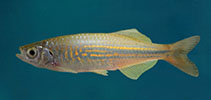 Devario malabaricus
Foto de Ramani Shirantha
Fotos | Imagem do Google
Foto de Ramani Shirantha
Classificação / Nomes Nomes comuns | Sinônimos | Catalog of Fishes(Gênero, Espécies) | ITIS | CoL | WoRMS | Cloffa
> Cypriniformes (Carps) > Danionidae (Danios) > Danioninae
Etymology: Devario: Bangla/Bengali:‘debari’, local name for these fishes; also meaning ‘brother in law’ (Ref. 2031).
More on author: Jerdon.
Etymology: Devario: Bangla/Bengali:‘debari’, local name for these fishes; also meaning ‘brother in law’ (Ref. 2031).
More on author: Jerdon.
Meio ambiente: milieu / Zona climática / intervalo de profundidade / faixa de distribuição Ecologia
; Água doce bentopelágico. Tropical; 18°C - 25°C; 22°N - 6°N, 72°E - 81°E
Distribuição Territórios | Áreas da FAO | Ecossistemas | Ocorrências | Mapa de pontos | Introduções | Faunafri
Asia: west coast of India and Sri Lanka. Has been widely transported around the world through the aquarium fish trade industry.
Tamanho / Peso / Idade
Maturidade: Lm ? range ? - ? cm
Max length : 12.0 cm TL macho/indeterminado; (Ref. 41236); common length : 8.0 cm TL macho/indeterminado; (Ref. 6028)
Max length : 12.0 cm TL macho/indeterminado; (Ref. 41236); common length : 8.0 cm TL macho/indeterminado; (Ref. 6028)
Descrição suscinta Chaves de identificação | Morfologia | Morfometria
Raios dorsais (total) : 12 - 16; Raios anais : 15 - 20; Vértebras: 34 - 36. Devario malabaricus differs from all its congeners by the combination of the following characters: absence of process on 1st infraorbital; body depth 27-35 %SL; predorsal scales15-17; dorsal fin with 11½-12½ branched rays; anal fin with 12½-17½ branched rays; presence of danionin notch; origin of dorsal fin to hypural distance when carried forward falling well short of posterior border of eye; tip of pectoral fin almost reaching origin of pelvic fin when adpressed; snout length subequal to or greater than eye diameter; P stripe originating level with pelvic-fin origin, 1-2 scale-widths anterior to dorsal-fin origin; P-1 stripe less than half width of P stripe, bifurcated anteriorly by a more or less broken whitish line; 5-6 dark, irregular, vertical bars on the anterior half of body; and absence of nuptial tubercles in both sexes (ref. 118056).
Body shape (shape guide): fusiform / normal.
Body shape (shape guide): fusiform / normal.
Found in a variety of habitats from boulder-strewn mountain torrents to small pools in dry zone streams. Most common in flowing water than in reservoirs and tanks. Adults form medium sized shoals and prefer flowing water. They feed on terrestrial insects and detritus. They spawn in shallow water, among marginal weeds and roots usually after heavy rains. Eggs are light orange and sticky; more than 200 eggs are laid and hatch in 1-2 days. Fry are free-swimming on fifth day. They exhibit cannibalism on eggs (Ref. 6028). Individuals rarely reach 12 cm (Ref. 41236). Migratory behaviour is undetermined (Ref. 126106).
Ciclo de vida ou comportamento de acasalamento Maturidade | Reprodução | Desova | Ovos | Fecundidade | Larvas
Spawns in shallow water, among marginal weeds and roots usually after heavy rains. Eggs are light orange and sticky; more than 200 eggs are laid and hatch in 1-2 days. Fry are free-swimming on fifth day. Exhibits cannibalism on eggs (Ref. 6028).
Referência principal
Carregar suas referências | Referências | Coordenador | Colaboradores
Kullander, F.F., 2001. Phylogeny and species diversity of the South and Southeast Asian cyprinid genus Danio Hamilton (Teleostei, Cyprinidae). Ph.D. Thesis-Stockholm University, Department of Zoology. p. 1-26. Sweden, Stockholm University. Department of Zoology. (Ref. 38392)
Status na Lista Vermelha da UICN (Ref. 130435: Version 2025-2 (Global))
Segura ou pouco preocupante (LC) ; Date assessed: 13 August 2019
CITES
Not Evaluated
Ameaça para os humanos
Harmless
Uso pelos humanos
Pescarias: sem interesse; Aquário: Altamente comercial
FAO - Publication: search | FishSource |
Mais informação
Ecologia Trófica
Itens alimentares (presas)
Composição da dieta
Consumo alimentar
Rações alimentares
Predadores
Itens alimentares (presas)
Composição da dieta
Consumo alimentar
Rações alimentares
Predadores
Dinâmica populacional
Parâmetros de crescimento
Idade máxima / tamanhos
Relação comprimento-peso.
Relação comprimento-comprimento.
Frequências de comprimento
Conversão de massa
Recrutamento
Abundância
Parâmetros de crescimento
Idade máxima / tamanhos
Relação comprimento-peso.
Relação comprimento-comprimento.
Frequências de comprimento
Conversão de massa
Recrutamento
Abundância
Ciclo de vida
Reprodução
Maturidade
Maturidade/Rel. das guelras
Fecundidade
Desova
Agregações de desova
Ovos
Desenvolvimento dos ovos
Larvas
Dinâmica larval
Reprodução
Maturidade
Maturidade/Rel. das guelras
Fecundidade
Desova
Agregações de desova
Ovos
Desenvolvimento dos ovos
Larvas
Dinâmica larval
Anatomia
Área branquial
Cérebro
Otólito
Área branquial
Cérebro
Otólito
Fisiologia
Composição corporal
Nutrientes
Consumo de oxigênio
Tipo de natação
Velocidade de natação
Pigmentos visuais
Som de peixe
Doenças e Parasitas
Toxicidade (LC50s)
Composição corporal
Nutrientes
Consumo de oxigênio
Tipo de natação
Velocidade de natação
Pigmentos visuais
Som de peixe
Doenças e Parasitas
Toxicidade (LC50s)
Relacionado a humanos
Sistemas de aquicultura
Perfis para aquacultura
Estirpes
Casos de Ciguatera
Selos, moedas, diversos.
Sistemas de aquicultura
Perfis para aquacultura
Estirpes
Casos de Ciguatera
Selos, moedas, diversos.
Ferramentas
Questionário orgânico | Livro eletrônico | Guia de campo | Ferramenta auxiliar de frequências de comprimento | Ferramenta sobre a história de vida | Mapa de pontos |
Catch-MSY |
Relatórios especiais
Checar Manutenção em Aquário | Checar Planilhas de Fatos sobre as Espécies | Checar Planilhas de Fatos sobre Aquicultura
Baixar XML
Fontes da internet
AFORO (otoliths) | Banco de dados para Espécies Aliens/Invasivas | Aquatic Commons | BHL | Cloffa | Websites from users | Checar Observador de Peixes (FishWatcher) | CISTI | Catalog of Fishes: Gênero, Espécies | DiscoverLife | ECOTOX | FAO - Publication: search | Faunafri | Fishipedia | Fishtrace | GloBI | Google Books | Google Scholar | Google | IGFA World Record | OneZoom | Open Tree of Life | Otolith Atlas of Taiwan Fishes | Aquários públicos | PubMed | Reef Life Survey | Socotra Atlas | TreeBase | Árvore da vida | Wikipedia: Ir para, procura | World Records Freshwater Fishing | Registro zoológico
Estimativas baseadas em modelos
Índice de diversidade filogenética (Ref. 82804): PD50 = 0.5000 [Uniqueness, from 0.5 = low to 2.0 = high].
Bayesian length-weight: a=0.00977 (0.00422 - 0.02262), b=3.04 (2.84 - 3.24), in cm total length, based on LWR estimates for this (Sub)family-body shape (Ref. 93245).
Nível Trófico (Ref. 69278): 3.2 ±0.2 se; based on diet studies.
Resiliência (Ref. 120179): Elevada, tempo mínimo de duplicação da população menor que 15 meses (tm<1; assuming multiple spawing events per year; Fec=200).