



Devario malabaricus (Jerdon, 1849)
Malabar danio
Carica il tuo foto e Video
Immagini | Google image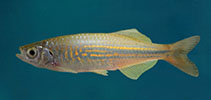 Devario malabaricus
Immagine di Ramani Shirantha
Immagini | Google image
Immagine di Ramani Shirantha
Classificazione / Nomi Nomi Comuni | Sinonimi | Catalog of Fishes(Genere, Specie) | ITIS | CoL | WoRMS | Cloffa
> Cypriniformes (Carps) > Danionidae (Danios) > Danioninae
Etymology: Devario: Bangla/Bengali:‘debari’, local name for these fishes; also meaning ‘brother in law’ (Ref. 2031).
More on author: Jerdon.
Etymology: Devario: Bangla/Bengali:‘debari’, local name for these fishes; also meaning ‘brother in law’ (Ref. 2031).
More on author: Jerdon.
Ambiente: milieu / zona climatica / distribuzione batimetrica / gamma di distribuzione Ecologia
; acqua dolce benthopelagico. Tropical; 18°C - 25°C; 22°N - 6°N, 72°E - 81°E
Distribuzione Territories | Aree FAO | Ecosistemi | Presenze | Mappa dei ritrovamenti | Introduzioni | Faunafri
Asia: west coast of India and Sri Lanka. Has been widely transported around the world through the aquarium fish trade industry.
Dimensione / Peso / Età
Maturità: Lm ? range ? - ? cm
Max length : 12.0 cm TL maschio/sesso non determinato; (Ref. 41236); common length : 8.0 cm TL maschio/sesso non determinato; (Ref. 6028)
Max length : 12.0 cm TL maschio/sesso non determinato; (Ref. 41236); common length : 8.0 cm TL maschio/sesso non determinato; (Ref. 6028)
Breve descrizione Chiavi di identificazione | Morfologia | Morfometria
Raggi dorsali molli (totale) : 12 - 16; Raggi anali molli: 15 - 20; Vertebre: 34 - 36. Devario malabaricus differs from all its congeners by the combination of the following characters: absence of process on 1st infraorbital; body depth 27-35 %SL; predorsal scales15-17; dorsal fin with 11½-12½ branched rays; anal fin with 12½-17½ branched rays; presence of danionin notch; origin of dorsal fin to hypural distance when carried forward falling well short of posterior border of eye; tip of pectoral fin almost reaching origin of pelvic fin when adpressed; snout length subequal to or greater than eye diameter; P stripe originating level with pelvic-fin origin, 1-2 scale-widths anterior to dorsal-fin origin; P-1 stripe less than half width of P stripe, bifurcated anteriorly by a more or less broken whitish line; 5-6 dark, irregular, vertical bars on the anterior half of body; and absence of nuptial tubercles in both sexes (ref. 118056).
Body shape (shape guide): fusiform / normal.
Body shape (shape guide): fusiform / normal.
Found in a variety of habitats from boulder-strewn mountain torrents to small pools in dry zone streams. Most common in flowing water than in reservoirs and tanks. Adults form medium sized shoals and prefer flowing water. They feed on terrestrial insects and detritus. They spawn in shallow water, among marginal weeds and roots usually after heavy rains. Eggs are light orange and sticky; more than 200 eggs are laid and hatch in 1-2 days. Fry are free-swimming on fifth day. They exhibit cannibalism on eggs (Ref. 6028). Individuals rarely reach 12 cm (Ref. 41236). Migratory behaviour is undetermined (Ref. 126106).
Ciclo vitale e comportamento di accoppiamento Maturità | Riproduzione | Deposizione | Uova | Fecondità | Larve
Spawns in shallow water, among marginal weeds and roots usually after heavy rains. Eggs are light orange and sticky; more than 200 eggs are laid and hatch in 1-2 days. Fry are free-swimming on fifth day. Exhibits cannibalism on eggs (Ref. 6028).
Riferimento principale
Caricare le referenze | Bibliografia | Coordinatore | Collaboratori
Kullander, F.F., 2001. Phylogeny and species diversity of the South and Southeast Asian cyprinid genus Danio Hamilton (Teleostei, Cyprinidae). Ph.D. Thesis-Stockholm University, Department of Zoology. p. 1-26. Sweden, Stockholm University. Department of Zoology. (Ref. 38392)
Stato della Lista Rossa IUCN (Ref. 130435: Version 2025-2 (Global))
Least Concern (LC) ; Date assessed: 13 August 2019
CITES
Not Evaluated
Minaccia per l'uomo
Harmless
Usi umani
Pesca: di nessun interesse; Acquario: elevato interesse commerciale
FAO - Publication: search | FishSource |
Informazioni ulteriori
Ecologia trofica
Articoli alimentari (prede)
Alimentazione
Consumo di cibo
Razioni alimentari
Predatori
Articoli alimentari (prede)
Alimentazione
Consumo di cibo
Razioni alimentari
Predatori
Dinamica della popolazione
Parametri di crescita
Età massima / dimensioni massime
Rapporto lunghezza-peso.
Lunghezza-lunghezza rel.
Lunghezza-frequenze
Conversione di massa
Reclutamento
Abbondanza
Parametri di crescita
Età massima / dimensioni massime
Rapporto lunghezza-peso.
Lunghezza-lunghezza rel.
Lunghezza-frequenze
Conversione di massa
Reclutamento
Abbondanza
Ciclo di vita
Riproduzione
Maturità
Maturità/Gli occhielli sono relativi.
Fecondità
Deposizione
Aggregazioni riproduttive
Uova
Sviluppo delle uova
Larve
Dinamica popolazioni larvali
Riproduzione
Maturità
Maturità/Gli occhielli sono relativi.
Fecondità
Deposizione
Aggregazioni riproduttive
Uova
Sviluppo delle uova
Larve
Dinamica popolazioni larvali
Anatomia
Area branchiale
Cervello
Otolite
Area branchiale
Cervello
Otolite
Fisiologia
Composizione corporea
Nutrienti
Consumo di ossigeno
Tipo di nuoto
Velocità di nuoto
Pigmenti visivi
Suono del pesce
Malattie e parassiti
Tossicità (LC50)
Composizione corporea
Nutrienti
Consumo di ossigeno
Tipo di nuoto
Velocità di nuoto
Pigmenti visivi
Suono del pesce
Malattie e parassiti
Tossicità (LC50)
Legato all'uomo
Sistemi di acquacoltura
Profili di acquacoltura
Varietà
Casi di Ciguatera
Francobolli, monete, materiale vario.
Sistemi di acquacoltura
Profili di acquacoltura
Varietà
Casi di Ciguatera
Francobolli, monete, materiale vario.
Strumenti
Quiz organico | Libro elettronico | Giuda pratica | Generatore frequenze di lunghezza | Strumento Parametri Biologici | Mappa dei ritrovamenti |
Cattura-MSY |
Rapporti speciali
Controllo della manutenzione dell'acquario | Verificare la presenza di schede informative sulle specie | Verifica delle schede informative sull'acquacoltura
Scarica XML
Fonti Internet
AFORO (otoliths) | Alien/Invasive Species database | Aquatic Commons | BHL | Cloffa | Websites from users | Check FishWatcher | CISTI | Catalog of Fishes: Genere, Specie | DiscoverLife | ECOTOX | FAO - Publication: search | Faunafri | Fishipedia | Fishtrace | GloBI | Google Books | Google Scholar | Google | IGFA World Record | OneZoom | Open Tree of Life | Otolith Atlas of Taiwan Fishes | Acquari pubblici | PubMed | Reef Life Survey | Socotra Atlas | TreeBase | Tree of Life | Wikipedia: Go, ricerca | World Records Freshwater Fishing | Record zoologico
Stime basate su modelli
Indice di diversità filogenetica (Fonte Biblio. 82804): PD50 = 0.5000 [Uniqueness, from 0.5 = low to 2.0 = high].
Bayesian length-weight: a=0.00977 (0.00422 - 0.02262), b=3.04 (2.84 - 3.24), in cm total length, based on LWR estimates for this (Sub)family-body shape (Ref. 93245).
Livello trofico (Fonte Biblio. 69278): 3.2 ±0.2 se; based on diet studies.
Resilienza (Fonte Biblio. 120179): Alto, tempo minimo di raddoppiamento della popolazione meno di 15 mesi (tm<1; assuming multiple spawing events per year; Fec=200).