



Perccottus glenii Dybowski, 1877
Chinese sleeper
Hochladen Photos und videos
Bilder | Google Bild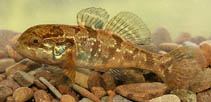 Perccottus glenii
Photo von Sediva, A.
Bilder | Google Bild
Photo von Sediva, A.
Klassifizierung / Names Namen | Synonyme | Catalog of Fishes(Gattung, Arten) | ITIS | CoL | WoRMS | Cloffa
> Gobiiformes (Gobies) > Odontobutidae (Freshwater sleepers)
Etymology: Perccottus: Greek, perke = perch + Gr, kottos = a fish (Ref. 45335).
Eponymy: Colonel Nikolay Alexandrovich Glen was honoured because of his efforts that improved the well-being of the Ussuri River area (Ussuriland) of Russia, the type locality. (Ref. 128868), visit book page.
More on author: Dybowski.
Etymology: Perccottus: Greek, perke = perch + Gr, kottos = a fish (Ref. 45335).
Eponymy: Colonel Nikolay Alexandrovich Glen was honoured because of his efforts that improved the well-being of the Ussuri River area (Ussuriland) of Russia, the type locality. (Ref. 128868), visit book page.
More on author: Dybowski.
Umwelt: Milieu / Klimazone / Tiefenbereich / Verbreitungsgebiet Ökologie
; süßwasser; brackwasser demersal. Temperate; 15°C - 30°C (Ref. 2059); 54°N - 39°N, 106°E - 141°E
Verbreitung Territorien | FAO Gebiete | Ökosysteme | Vorkommen | Punkt Karte | Einführungen | Faunafri
Asia: Tugur (Sea of Okhotsk) and Amur southward to Yangtze and Fujian. In Amur, historically known from the middle and lower Amur (from Tygda Rive down to the estuary) with tributaries Zeya, Sungari, Ussuri and the Khanka Lake basin. Reported from Shilka in the upper Amur where it is introduced (Ref. 82587). Introduced in Europe (Ref. 59043). At least one country reports adverse ecological impact after introduction (Ref. 2058).
Länge bei der ersten Reifung / Größe / Gewicht / Alter
Geschlechtsreife: Lm 7.0, range 6 - 8 cm
Max length : 25.0 cm TL Männchen/unbestimmt; (Ref. 2059); max. veröff. Gewicht: 250.00 g (Ref. 80031); max. veröff. Alter: 7 Jahre (Ref. 56557)
Max length : 25.0 cm TL Männchen/unbestimmt; (Ref. 2059); max. veröff. Gewicht: 250.00 g (Ref. 80031); max. veröff. Alter: 7 Jahre (Ref. 56557)
Kurzbeschreibung Bestimmungsschlüssel | Morphologie | Morphometrie
Rückenflossenstacheln (insgesamt) : 6 - 8; Rückenflossenweichstrahlen (insgesamt) : 9 - 11; Afterflossenstacheln: 1 - 3; Afterflossenweichstrahlen: 7 - 10. Distinguished from other European freshwater species by the following characters: 2 dorsals with the first with 6-8 simple rays, and the second with 2-3 simple and 8-12 branched rays; no spines on first dorsal; no barbels; pelvics not fused into a disc; no lateral line canals; males during spawning period, develop a hump on nape and become black with bright green spots on body and unpaired fins (Ref. 59043).
Body shape (shape guide): fusiform / normal.
Body shape (shape guide): fusiform / normal.
Occurs in lentic waters, lakes, ponds, backwaters and marshes with dense underwater vegetation and avoids river stretches with fast and even slow current (Ref. 59043). Prefers stagnant rivers and bogs (Ref. 80031). Can tolerate poorly oxygenated water and able to survive in dried out or completely frozen water bodies by digging itself into mud where it hibernates. A voracious predatory fish (wide variety of invertebrates, tadpoles and fish) constituting a most serious threat to aquatic fauna wherever it occurs. In small water bodies; known to extirpate almost all other fish species and amphibian larvae. Spawns for the first time at 1-3 years and about 6.0 cm SL. Spawns several potions of eggs in May to June at 15-20°C. Elongated eggs (3.8 x 1.3 mm) with sticky filaments usually deposited in one row close to water surface on underwater structures such as roots, leaves and others. Males guard the eggs and pelagic larvae (Ref. 59043).
Lebenszyklus und Paarungsverhalten Geschlechtsreife | Fortpflanzung | Ablaichen | Eier | Fruchtbarkeit | Larven
Spawns several portions of eggs (Ref. 59043).
Hauptreferenz
Laden Sie Ihre Referenzen hoch | Referenzen | Koordinator | Partner
Berg, L.S., 1965. Freshwater fishes of the U.S.S.R. and adjacent countries. volume 3, 4th edition. Israel Program for Scientific Translations Ltd, Jerusalem. (Russian version published 1949). (Ref. 2058)
IUCN Rote Liste Status (Ref. 130435: Version 2025-2 (Global))
nicht bedroht (LC) ; Date assessed: 09 March 2020
CITES
Not Evaluated
Bedrohung für Menschen
Potential pest
Nutzung durch Menschen
Fischereien: weniger kommerziell; Aquarium: Potenzial
FAO - Publication: search | FishSource |
Mehr Information
Trophische Ökologie
Lebensmittel (Beutetiere)
Nahrungszusammensetzung
Nahrungsaufnahme
Lebensmittelrationen
Räuber
Lebensmittel (Beutetiere)
Nahrungszusammensetzung
Nahrungsaufnahme
Lebensmittelrationen
Räuber
Populationsdynamik
Wachstumsparameter
Max. Alter/Größen
Länge-Gewicht-Rel.
Länge-Länge-Verhältnis.
Längenhäufigkeiten
Massenkonvertierung
Rekrutierung
Dichte
Wachstumsparameter
Max. Alter/Größen
Länge-Gewicht-Rel.
Länge-Länge-Verhältnis.
Längenhäufigkeiten
Massenkonvertierung
Rekrutierung
Dichte
Lebenszyklus
Fortpflanzung
Geschlechtsreife
Reifung/Kiemen rel.
Fruchtbarkeit
Ablaichen
Laichaggregationen
Eier
Eientwicklung
Larven
Larven Pop.Dyn.
Fortpflanzung
Geschlechtsreife
Reifung/Kiemen rel.
Fruchtbarkeit
Ablaichen
Laichaggregationen
Eier
Eientwicklung
Larven
Larven Pop.Dyn.
Anatomie
Kiemenoberfläche
Gehirn
Otolith
Kiemenoberfläche
Gehirn
Otolith
Physiologie
Körperliche Zusammensetzung
Nährstoffe
Sauerstoffverbrauch
Schwimmart
Schwimmgeschwindigkeit
Visuelle Pigmente
Fischgeräusche
Krankheiten und Parasiten
Toxizität (LC50s)
Körperliche Zusammensetzung
Nährstoffe
Sauerstoffverbrauch
Schwimmart
Schwimmgeschwindigkeit
Visuelle Pigmente
Fischgeräusche
Krankheiten und Parasiten
Toxizität (LC50s)
Menschenbezogen
Aquakultur-Systeme
Aquakultur Profile
Zuchtlinien
Ciguatera-Fälle
Briefmarken, Münzen, Verschiedenes.
Aquakultur-Systeme
Aquakultur Profile
Zuchtlinien
Ciguatera-Fälle
Briefmarken, Münzen, Verschiedenes.
Tools
Bio-Quiz | E-Book | Feldführer | Längenhäufigkeits Tool | Lebensdaten Tool | Punkt Karte |
Catch-MSY |
Zusatzinformationen
Download XML
Zusammenfassung | Punktdaten | Namen | Photos
Internet Quellen
AFORO (otoliths) | Alien/Invasive Species database | Aquatic Commons | BHL | Cloffa | Websites from users | FishWatcher Einträge suchen | CISTI | Catalog of Fishes: Gattung, Arten | DiscoverLife | ECOTOX | FAO - Publication: search | Faunafri | Fishipedia | Fishtrace | GloBI | Google Books | Google Scholar | Google | IGFA World Record | Nationale Datenbanken | OneZoom | Open Tree of Life | Otolith Atlas of Taiwan Fishes | PubMed | Reef Life Survey | Socotra Atlas | TreeBase | Tree of Life | Wikipedia: Gehe zu, Suchen | World Records Freshwater Fishing | Zoobank | Zoologischer Rekord
Schätzungen auf der Grundlage von Modellen
Phylogenetischer Diversitätsindex (Ref. 82804): PD50 = 1.0000 [Uniqueness, from 0.5 = low to 2.0 = high].
Bayesian length-weight: a=0.01096 (0.00638 - 0.01885), b=3.09 (2.94 - 3.24), in cm total length, based on LWR estimates for this species & (Sub)family-body (Ref. 93245).
Trophische Ebene (Ref. 69278): 3.6 ±0.54 se; based on food items.
Generation time: 8.5 ( na - na) years. Estimated as median ln(3)/K based on 1 growth studies.
Widerstandsfähigkeit (Ref. 120179): niedrig, Verdopplung der Population dauert 4,5 - 14 Jahre. (Preliminary K or Fecundity.).