



Luciobarbus brachycephalus (Kessler, 1872)
Aral barbel
Envoyez vos Photos et vidéos
Images | Images Google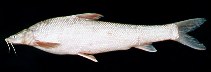 Luciobarbus brachycephalus
Photo de Salnikov, V.B.
Images | Images Google
Photo de Salnikov, V.B.
Classification / Noms Noms communs | Synonymes | Catalog of Fishes(Genre, Espèce) | ITIS | CoL | WoRMS | Cloffa
Environnement : milieu / zone climatique / profondeur / gamme de distribution Écologie
; eau douce; saumâtre benthopélagique; potamodrome (Ref. 51243). Temperate
Distribution Territoires | Zones FAO | Écosystèmes | Occurrences | Carte par point | Introductions | Faunafri
Europe and Asia: Southern and western Caspian Sea; Aral basin; River Chun (Kasakhstan). For spawning, migrates up to larger tributaries of western and southern coasts: Terek, Samur, Kura, lower Aras. Rarely in lower Volga (up to Volgograd) and Ural.
Longueur à la première maturité / Taille / Poids / Âge
Maturité: Lm 60.0, range 50 - 70 cm
Max length : 90.0 cm TL mâle / non sexé; (Ref. 1441); 105.0 cm TL (female); common length : 66.0 cm NG mâle / non sexé; (Ref. 1441); common length :62 cm (female); poids max. publié: 22.0 kg (Ref. 4537)
Max length : 90.0 cm TL mâle / non sexé; (Ref. 1441); 105.0 cm TL (female); common length : 66.0 cm NG mâle / non sexé; (Ref. 1441); common length :62 cm (female); poids max. publié: 22.0 kg (Ref. 4537)
Description synthétique Clés d'identification | Morphologie | Morphométrie
Diagnosed from other species of Barbus and Luciobarbus in Caspian Se basin by having the following characters: predorsal length shorter than postdorsal length; dorsal fin usually with 7½ branched rays; 16-25 gill rakers; back between head and dorsal origin laterally compressed, forming a keel; lateral line with 62-90 (usually 65-77) scales; and lower lip thin, without median lobe or pad (Ref. 59043).
Body shape (shape guide): fusiform / normal.
Body shape (shape guide): fusiform / normal.
Found in rivers, reservoirs, lakes and canals (Ref. 11145). Occurs in the sea at depths of up to 25 m and in rivers in deep stretches with gravel or stone bottom. In freshened parts of sea, preys mainly on benthic crustaceans. Does not feed while migrating upstream and starts to feed again at the spawning sites mainly on insects, juveniles of other fishes, rarely on algae, seeds and other plant material. Spawns in fast-flowing water at areas with hard bottom and depths of 1-2 m (Ref. 59043).
Cycle de vie et comportement reproducteur Maturité | Reproduction | Frai | Œufs | Fécondité | Larves
Eggs are semipelagic and hatch while drifting downstream after at least 2 days at 25°C. Larvae settle into places with slow current; after 2-12 months juveniles drift downstream to sea or reservoir if river is dammed (Ref. 59043).
Référence principale
Téléchargez vos références | Références | Coordinateur | Collaborateurs
Fricke, R., M. Bilecenoglu and H.M. Sari, 2007. Annotated checklist of fish and lamprey species (Gnathostoma and Petromyzontomorphi) of Turkey, including a Red List of threatened and declining species. Stuttgarter Beitr. Naturk. Sea A (706):1-172. (Ref. 58342)
Statut dans la liste rouge de l'IUCN (Ref. 130435: Version 2025-2 (Global))
Menacé (EN) (A2cd); Date assessed: 02 March 2021
CITES
Not Evaluated
Menace pour l'homme
Harmless
Utilisations par l'homme
Pêcheries: commercial
FAO - Publication: search | FishSource |
Plus d'informations
Écologie trophique
Aliments (proies)
Composition du régime alimentaire
Consommation alimentaire
Rations alimentaires
Prédateurs
Aliments (proies)
Composition du régime alimentaire
Consommation alimentaire
Rations alimentaires
Prédateurs
Dynamique des populations
Paramètres de croissance
Âges / tailles maximales
Longueur-poids rel.
Rel. longueur-longueur.
Fréquences de longueurs
Conversion de masse
Recrutement
Abondance
Paramètres de croissance
Âges / tailles maximales
Longueur-poids rel.
Rel. longueur-longueur.
Fréquences de longueurs
Conversion de masse
Recrutement
Abondance
Cycle de vie
Reproduction
Maturité
Maturité/épines rel.
Fécondité
Frai
Agrégats de frai
Œufs
Développement de l'œuf
Larves
Dynamique des populations larvaires
Reproduction
Maturité
Maturité/épines rel.
Fécondité
Frai
Agrégats de frai
Œufs
Développement de l'œuf
Larves
Dynamique des populations larvaires
Anatomie
Surface branchiale
Cerveau
Otolithe
Surface branchiale
Cerveau
Otolithe
Physiologie
Composition corporelle
Nutriments
Consommation d'oxygène
Type de natation
Vitesse de nage
Pigments visuels
Son de poisson
Maladies et parasites
Toxicité (CL50)
Composition corporelle
Nutriments
Consommation d'oxygène
Type de natation
Vitesse de nage
Pigments visuels
Son de poisson
Maladies et parasites
Toxicité (CL50)
Liées à l'homme
Systèmes d'aquaculture
Profils d'aquaculture
Souches
Cas de ciguatera
Timbres, pièces de monnaie, divers
Systèmes d'aquaculture
Profils d'aquaculture
Souches
Cas de ciguatera
Timbres, pièces de monnaie, divers
Outils
E-book | Guide de terrain | Générateur de fréquences de longueur | Outil de dynamique de population | Carte par point |
Capture-MSY |
Articles particuliers
Télécharger en XML
Sources Internet
AFORO (otoliths) | Aquatic Commons | BHL | Cloffa | Websites from users | FishWatcher | CISTI | Catalog of Fishes: Genre, Espèce | DiscoverLife | ECOTOX | FAO - Publication: search | Faunafri | Fishipedia | Fishtrace | GloBI | Google Books | Google Scholar | Google | IGFA World Record | Bases de données nationales | OneZoom | Open Tree of Life | Otolith Atlas of Taiwan Fishes | PubMed | Reef Life Survey | Socotra Atlas | TreeBase | Arbre de Vie | Wikipedia: aller à, chercher | World Records Freshwater Fishing | Zoological Record
Estimations basées sur des modèles
Indice de diversité phylogénétique (Réf. 82804): PD50 = 0.5000 [Uniqueness, from 0.5 = low to 2.0 = high].
Bayesian length-weight: a=0.01047 (0.00504 - 0.02175), b=2.99 (2.82 - 3.16), in cm total length, based on LWR estimates for this Genus-body shape (Ref. 93245).
Niveau trophique (Réf. 69278): 2.8 ±0.3 se; based on size and trophs of closest relatives
Résilience (Réf. 120179): Faible, temps minimum de doublement de population : 4,5 à 14 années (K=0.12).