



Forsterygion malcolmi Hardy, 1987
Mottled triplefin
Lägg till din observation i Fish Watcher
| Native range | All suitable habitat | Point map | Year 2050 |

|
| This map was computer-generated and has not yet been reviewed. |
| Forsterygion malcolmi AquaMaps Data sources: GBIF OBIS |
Ladda upp din foton och Videor
Bilder | Google image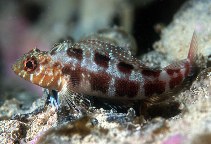 Forsterygion malcolmi
Bild av Clements, K.
Bilder | Google image
Bild av Clements, K.
Klassificering / Namn Populärnamn | synonymer | Catalog of Fishes(Släkte, Arter) | ITIS | CoL | WoRMS | Cloffa
> Blenniiformes (Blennies) > Tripterygiidae (Triplefin blennies) > Tripterygiinae
Etymology: malcolmi: The genus is named after J.R. Forster, naturalist on Cook's second voyage to New Zealand. malcolmi named after Malcolm Francis, collector of the holotype of this species.
Eponymy: Dr Malcolm Philip Francis (d: 1954) is a New Zealand fisheries scientist and marine ecologist who has spent over thirty-nine years studying the population biology of coastal and pelagic fishes. [...] (Ref. 128868), visit book page.
Etymology: malcolmi: The genus is named after J.R. Forster, naturalist on Cook's second voyage to New Zealand. malcolmi named after Malcolm Francis, collector of the holotype of this species.
Eponymy: Dr Malcolm Philip Francis (d: 1954) is a New Zealand fisheries scientist and marine ecologist who has spent over thirty-nine years studying the population biology of coastal and pelagic fishes. [...] (Ref. 128868), visit book page.
Miljö: miljö / Klimatzon / djupintervall / distributionsområde Ekologi
Utbredning Territorier | FAO områden | Ekosystem | Förekomster | Prickkarta | Utplanteringar | Faunafri
Southwest Pacific: endemic to New Zealand.
Storlek / Vikt / Ålder
Kort beskrivning Bestämningsnycklar | Morfologi | Morfometri
Taggstrålar i ryggfenan (totalt) : 27 - 32; Mjukstrålar i ryggfenan (totalt) : 12 - 16; Taggstrålar i analfenan: 2; Mjukstrålar i analfenan: 26 - 30; Ryggkotor: 43 - 47. Body elongated, laterally compressed posteriorly; mouth strongly angled upward; notched scales absent; short, distally complex gill rakers, body yellow with a broad, black stripe
extending along upper side of body. Dorsal fin formula V-0N-0-1-0-1. Six procurrent rays in upper lobe, 10 in lower lobe; in upper caudal lobe, one procurrent ray between upper lobe and posterior epural, 4 rays opposite epurals, 1 anterior first epural; in lower lobe, 1 procurrent ray between lower lobe and haemal spine of second preural vertebra, 4 opposite haemal spine of second preural vertebra, 5 anterior to haemal spine of second preural vertebra (Ref. 84085). Head and gill cover olive brown with pale stripes, body with 6 broad reddish vertical bands with irregular white bands between. Anterior bands extending to the dorsal fin (Ref. 9003).
Body shape (shape guide): fusiform / normal.
Body shape (shape guide): fusiform / normal.
Facultative air-breathing in the genus (Ref. 126274); Adults are abundant on rocky reefs from 10 to 25m, recorded from 2 to 33m (Ref. 84085). They occur in low tide pools and subtidal areas and prefer overhangs and holes containing sponges and bryozoans (Ref. 9003). Juveniles are found in shallow waters, while adults are more abundant in deeper waters. They feed mainly on crustaceans and small gastropods (Ref. 13227). Eggs are hemispherical and covered with numerous sticky threads that anchor them in the algae on the nesting sites (Ref. 240). Larvae are planktonic which occur primarily in shallow, nearshore waters (Ref. 94114).
Livscykel och parningsbeteende Könsmognad | Reproduktion | Lek | Ägg | Fekunditet | Larver
Huvudreferens
Ladda upp dina referenser | referenser | Koordinator : Fricke, Ronald | Medarbetare
Fricke, R., 1994. Tripterygiid fishes of Australia, New Zealand and the southwest Pacific Ocean (Teleostei). Theses Zool. 24:1-585. (Ref. 13227)
Status på IUCN:s rödlista (Ref. 130435: Version 2025-2 (Global))
Least Concern (LC) ; Date assessed: 04 May 2010
CITES
Not Evaluated
Hot mot människor
Harmless
Mänskliga användningsområden
FAO - Publication: search | FishSource |
Ytterligare information
Populationsdynamik
Tillväxtparametrar
Max. åldrar / storlekar
Längd-vikt rel.
Längd-längd rel.
Längd-frekvenser
Massakonvertering
Rekrytering
Abundans
Tillväxtparametrar
Max. åldrar / storlekar
Längd-vikt rel.
Längd-längd rel.
Längd-frekvenser
Massakonvertering
Rekrytering
Abundans
Anatomi
Gälyta
Hjärna
Otolit
Gälyta
Hjärna
Otolit
Fysiologi
Kroppssammansättning
Näringsämnen
Syreförbrukning
Typ av simning
Simhastighet
Visuella pigment
Ljud från fisk
Sjukdomar & Parasiter
Toxicitet (LC50)
Kroppssammansättning
Näringsämnen
Syreförbrukning
Typ av simning
Simhastighet
Visuella pigment
Ljud från fisk
Sjukdomar & Parasiter
Toxicitet (LC50)
Genetik
Genom
Genetik
Heterozygositet
Ärftlighet
Genetisk mångfald
Genom
Genetik
Heterozygositet
Ärftlighet
Genetisk mångfald
Människorelaterad
Vattenbrukssystem
Vattenbruksprofiler
Avelslinjer
Ciguatera-fall
Frimärken, mynt, diverse.
Vattenbrukssystem
Vattenbruksprofiler
Avelslinjer
Ciguatera-fall
Frimärken, mynt, diverse.
Verktyg
Organisk frågesport | E-bok | Fälthandbok | Längdfördelnings-verktyg | Livshistorie-verktyg | Prickkarta |
Fångst-MSY |
Särskilda rapporter
Kontrollera för underhåll av akvarium | Kontrollera om det finns faktablad om arter | Kontrollera om det finns faktablad om vattenbruk
Ladda ner XML
Internet-källor
AFORO (otoliths) | Aquatic Commons | BHL | Cloffa | Websites from users | Check FishWatcher | CISTI | Catalog of Fishes: Släkte, Arter | DiscoverLife | ECOTOX | FAO - Publication: search | Faunafri | Fishipedia | Fishtrace | GloBI | Google Books | Google Scholar | Google | IGFA World Record | OneZoom | Open Tree of Life | Otolith Atlas of Taiwan Fishes | PubMed | Reef Life Survey | Socotra Atlas | TreeBase | Tree of Life | Wikipedia: Go, sök | World Records Freshwater Fishing | Zoobank | Zoologiskt register
Uppskattningar baserade på modeller
Önskad temperatur (Ref. 123201): 15.5 - 18.1, mean 16.6 °C (based on 10 cells).
Index för fylogenetisk mångfald (Ref. 82804): PD50 = 0.5039 [Uniqueness, from 0.5 = low to 2.0 = high].
Bayesian length-weight: a=0.00646 (0.00330 - 0.01265), b=3.09 (2.91 - 3.27), in cm total length, based on LWR estimates for this species & (Sub)family-body (Ref. 93245).
Trofisk nivå (Ref. 69278): 3.4 ±0.54 se; based on food items.
Resiliens (Ref. 120179): Hög, lägsta populationsfördubblingstid mindre än 15 månader (Preliminary K or Fecundity.).
Näringsämnen (Ref. 124155): Calcium = 112 [68, 258] mg/100g; Iron = 0.621 [0.373, 1.104] mg/100g; Protein = 18.5 [17.5, 19.5] %; Omega3 = 0.686 [0.368, 1.327] g/100g; Selenium = 9.97 [4.73, 21.02] μg/100g; VitaminA = 15.9 [4.3, 57.7] μg/100g; Zinc = 0.911 [0.619, 1.332] mg/100g (wet weight);