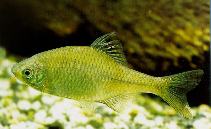
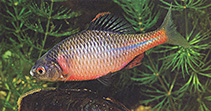
Rhodeus amarus, European bitterling : aquarium, bait

Rhodeus amarus (Bloch, 1782)

European bitterling
Uploaden van uw Foto's en video's
Afbeeldingen | video's | Postzegels, munten, diversen. | Google afbeelding

Classificatie / Namen Lokale namen | Synoniemen | Catalog of Fishes(Genus, Soort(en)) | ITIS | CoL | WoRMS | Cloffa

> Cypriniformes (Carps) > Acheilognathidae (Bitterlings)
Etymology: Rhodeus: Greek, rhodeos, a,-on = rose (Ref. 45335).
More on author: Bloch.

Milieu: milieu / Klimaatzone / Diepte / verspreidingsgebied Ecologie

; zoet water benthopelagisch; diepte 0 - ? m. Temperate; 60°N - 40°N

Verspreiding Gebieden | FAO regio's | Ecosystemen | Voorkomen | Verspreidingskaart | Introducties | Faunafri

Europe: central and eastern Europe and northern Asia Minor (Ref. 57778). Basins of North, southern Baltic, Black, western and southern Caspian and Aegean Seas (from Maritza to Struma drainages); Mediterranean basin, only in northern Rhône (France) and Drin drainages (Alabania, Montenegro, Macedonia). Abundant and expanding in most of its range, but locally threatened by water pollution, weed clearing, and stocking of predatory fish (Ref. 59043).

Lengte bij maturiteit / Grootte / Gewicht / Leeftijd

Maturiteit: Lm 4.4, range 3 - 6 cm
Max length : 11.2 cm TL mannelijk / geslacht onbekend; (Ref. 88166); common length : 5.0 cm TL mannelijk / geslacht onbekend; (Ref. 556); max. gerapporteerde leeftijd: 5 Jaren (Ref. 9696)

Korte beschrijving Determinatiesleutels | Morfologie | Morfometrie

Dorsale stekels (totaal) : 3; Dorsale zachte stralen (totaal) : 8 - 10; Anale stekels: 3; Anale zachte stralen: 8 - 10; Wervels: 34 - 36. Caudal fin with 19 to 20 soft rays. Differs from Rhodeus meridionalis by having sub-inferior mouth (vs. terminal), rostral cap covering all or at least more than half of upper lip (vs. only upper part of upper lip) (Ref. 59043).
Body shape (shape guide): fusiform / normal.

Biologie     Verklarende woordenlijst (bv. epibenthic)

Occurs most abundantly in still or slow-flowing water with dense aquatic vegetation and sand-silt bottom as lowland ponds, canals, slow-flowing rivers, backwaters and oxbows, where mussels are present (Ref. 59043). Found among plants over sand and muddy bottoms in shallow waters. Remarkable for its habit of deposing its eggs in the cavity of bivalves (Unio). Feeds mainly on plants and to a lesser degree on worms, crustaceans, and insect larvae. Formerly used for pregnancy tests: females injected with urine from pregnant women protruded their ovipositors (Ref. 6258). Live span is exceptionally up to 5 years but most individuals do not survive the year of their first reproduction and population sizes fluctuate greatly over the years (Ref. 59043).

Levenscyclus en paargedrag Maturiteit | Voortplanting | Paaien | Eieren | Fecunditeit | Larven

Spawns in clear, slow-running or still water, often with a muddy bottom. The presence of nearby freshwater mussels is of vital importance. Female deposits eggs within the valves of the mussel. Male sheds sperm into the inhalent current of the respiring mussel and thereby, fertilizes the eggs. Fry remain in the mussel until protection is not anymore required.

Hoofdreferentie Upload uw referenties | Referenties | Coördinator | Medewerkers

Kottelat, M. and J. Freyhof, 2007. Handbook of European freshwater fishes. Publications Kottelat, Cornol and Freyhof, Berlin. 646 pp. (Ref. 59043)

Status op de Rode Lijst van het IUCN (Ref. 130435: Version 2025-2 (Global))

  Niet bedreigd (LC) ; Date assessed: 01 June 2022

CITES

Not Evaluated

CMS (Ref. 116361)

Not Evaluated

Gevaar voor de mens

  Harmless


Gebruik door de mens

Visserij: van geen belang; Aquarium: Commercieel; aas: occasionally
FAO - Publication: search | FishSource |

Meer informatie

Trofische ecologie
Voedsel (prooien)
Dieetsamenstelling
Voedselconsumptie
Voedselrantsoenen
Predatoren
Ecologie
Ecologie
Populatiedynamica
Groeiparameters
Max. leeftijden / maten
Lengte-gewicht rel.
Lengte-lengte rel.
Lengtefrequenties
Massaconversie
Rekrutering
Abundantie
Levenscyclus
Voortplanting
Maturiteit
Rijpheid/kieuwen rel.
Fecunditeit
Paaien
Paaibestanden
Eieren
Ontwikkeling van de eieren
Larven
Larvale populatiedynamiek
Verspreiding
Gebieden
FAO regio's
Ecosystemen
Voorkomen
Introducties
BRUVS - Video's
Anatomie
Kieuwoppervlak
Hersenen
Otoliet
Fysiologie
Lichaamssamenstelling
Voedingsstoffen
Zuurstofverbruik
Type zwemmen
Zwemsnelheid
Visuele pigmenten
Vis geluid
Ziekten en parasieten
Toxiciteit (LC50)
Genetica
genoom
Genetica
Heterozygositeit
Erfelijkheid
Genetische diversiteit
Menselijk gerelateerd
Aquacultuursystemen
Aquacultuurprofielen
Kweeklijnen
Ciguatera gevallen
Postzegels, munten, diversen.
Outreach
Medewerkers
Referenties
Referenties

Tools

Speciale rapporten

Download XML

Internetbronnen

AFORO (otoliths) | Exoten/Invasieve soorten database | Aquatic Commons | BHL | Cloffa | Websites from users | Bekijk FishWatcher | CISTI | Catalog of Fishes: Genus, Soort(en) | DiscoverLife | DORIS | ECOTOX | FAO - Publication: search | Faunafri | Fishipedia | Fishtrace | GloBI | Google Books | Google Scholar | Google | IGFA World Record | Nationale databanken | OneZoom | Open Tree of Life | Otolith Atlas of Taiwan Fishes | Publieke aquaria | PubMed | Reef Life Survey | Socotra Atlas | TreeBase | Tree of Life | Wikipedia: ga naar, zoek | World Records Freshwater Fishing | Zoological Record

Schattingen op basis van modellen

Fylogenetische diversiteitsindex (Ref. 82804):  PD50 = 0.5000   [Uniqueness, from 0.5 = low to 2.0 = high].
Bayesian length-weight: a=0.01047 (0.00797 - 0.01375), b=3.10 (3.05 - 3.15), in cm total length, based on LWR estimates for this species (Ref. 93245).
Trofisch niveau (Ref. 69278):  3.0   ±0.34 se; based on food items.
Generation time: 4.4 ( na - na) years. Estimated as median ln(3)/K based on 1 growth studies.
Weerstandsvermogen (Ref. 120179):  laag, minimale populatieverdubbelingstijd 4,5-14 jaar (tm=2; tmax=5; Fec=40).
Kwetsbaarheid van de visserij (Ref. 59153):  Moderate vulnerability (37 of 100). 🛈