



Tải lên của bạn hình ảnh Và Video
Các tranh (Ảnh) | Video | Tem, tiền xu, v.v. | Google image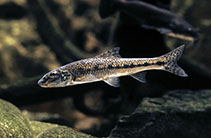 Gobio gobio
Hình ảnh của Muséum-Aquarium de Nancy/D. Terver
Các tranh (Ảnh) | Video | Tem, tiền xu, v.v. | Google image
Hình ảnh của Muséum-Aquarium de Nancy/D. Terver
Phân loại / Tên Tên thường gặp | Các synonym ( Các tên trùng) | Catalog of Fishes(Giống, Các loài) | ITIS | CoL | WoRMS | Cloffa
> Cypriniformes (Carps) > Gobionidae (Gudgeons)
Etymology: Gobio: Latin, gobius = gudgeon (Ref. 45335).
More on author: Linnaeus.
Etymology: Gobio: Latin, gobius = gudgeon (Ref. 45335).
More on author: Linnaeus.
Môi trường: môi trường / vùng khí hậu / Mức độ sâu / phạm vi phân phối Sinh thái học
; nước ngọt; thuộc về nước lợ sống nổi và đáy; pH range: 7.0 - 7.5; dH range: 10 - 20; di cư trong nước ngọt. Temperate; 2°C - 18°C (Ref. 1672); 67°N - 36°N, 10°W - 142°E
Sự phân bố Lãnh thổ | Các khu vực của FAO | Các hệ sinh thái | Những lần xuất hiện | Bản đồ điểm | Những chỉ dẫn | Faunafri
Europe: Atlantic Ocean, North and Baltic Sea basins, from Loire drainage eastward, eastern Great Britain, Rhône and Volga drainages, upper Danube and middle and upper Dniestr and Dniepr drainages; in Finland, north to about 61°N. Introduced to eastern and northern Italy, Ireland, Wales and Scotland. Eastern and southern limits unclear (Ref. 59043). Occurs as far east as Korea (Ref. 4537). Populations from the Iberian Peninsula and Adour basin in southern France refer to G. lozanoi (Ref. 57030). Populations from the Caspian basin may represent a distinct species (Ref. 59043).
Chiều dài lúc trưởng thành đầu tiên / Bộ gần gũi / Khối lượng (Trọng lượng) / Tuổi
Chín muồi sinh dục: Lm 9.3 range ? - ? cm
Max length : 21.0 cm TL con đực/không giới tính; (Ref. 88166); common length : 12.0 cm TL con đực/không giới tính; (Ref. 6258); Khối lượng cực đại được công bố: 220.00 g (Ref. 6258); Tuổi cực đại được báo cáo: 8 các năm (Ref. 6258)
Max length : 21.0 cm TL con đực/không giới tính; (Ref. 88166); common length : 12.0 cm TL con đực/không giới tính; (Ref. 6258); Khối lượng cực đại được công bố: 220.00 g (Ref. 6258); Tuổi cực đại được báo cáo: 8 các năm (Ref. 6258)
Mô tả ngắn gọn Khóa để định loại | Hình thái học | Sinh trắc học
Các tia vây lưng cứng (tổng cộng) : 2 - 3; Các vây lưng mềm (tổng cộng) : 5 - 7; Tia cứng vây hậu môn: 2 - 3; Tia mềm vây hậu môn: 6 - 8; Động vật có xương sống: 39 - 41. Diagnosed from other congeners in Europe by the possession of the following characters: barbel reaching beyond anterior eye margin, usually to middle of eye; snout length greater than postorbital distance; head length 26-30% SL; eye diameter 5-7% SL; 1.0-1.4 times in interorbital distance in over about 6 cm SL specimens (less in smaller ones), 2.4-2.8 times in head depth; head depth 15-17% SL at nape, 43-51% HL at eye; body depth 19-23% SL; head width 14-16% SL, 49-57% HL; caudal peduncle depth 30-34% HL; breast naked between pectorals; scales between anus and anal origin 4-5; scales on lateral line usually 39-42 + 2; and scales around caudal peduncle usually 12-14 (Ref. 59043). Caudal fin with 19 rays (Ref. 2196). Scalar formula: 38-45 (Ref. 40476).
Body shape (shape guide): fusiform / normal.
Body shape (shape guide): fusiform / normal.
Occurs in nearly all types of riverine and lacustrine habitats with sand bottom. Found in small mountain streams, large lowland rivers and large lakes (Ref. 59043). Inhabits fast flowing rivers with sand or gravel bottom but may also occur in still waters. Forms schools. Feeds on insect larvae, mollusks, and crustaceans. Normally active during the day but if they are disturbed, in particular, by predators, they can defer their activity to periods when light intensity is weak. Capable of emitting squeaking sounds. These vocalizations, which is a means by which fish communicate with each other, vary with the degree of activity and the temperature and are independent of the season of reproduction (Ref. 30578). Breeds in shallow water over stones, sand or plant material. Eggs are released above substrate and drift with current, sinking to bottom and sticking to substrate. Larvae and juveniles occur on the bottom and prefer detritus-rich sandy habitats and low current (Ref. 59043).
Vòng đời và hành vi giao phối Chín muồi sinh dục | Sự tái sinh sản | Đẻ trứng | Các trứng | Sự sinh sản | Ấu trùng
Spawns once a year for several years in low productivity streams, but exhibits multiple spawning within a season in high productivity environments (Ref. 40290, 40756). Releases eggs above substrate which drift with current, sink to the bottom and stick to substrate. Larvae and juveniles occur on the bottom and prefer detritus-rich sandy habitats and low current (Ref. 59043).
Tài liệu tham khảo chính
Tải lên tài liệu tham khảo của bạn | Các tài liệu tham khảo | Người điều phối | Người cộng tác
Kottelat, M. and J. Freyhof, 2007. Handbook of European freshwater fishes. Publications Kottelat, Cornol and Freyhof, Berlin. 646 pp. (Ref. 59043)
Tình trạng Sách đỏ IUCN (Ref. 130435: Version 2025-2 (Global))
Least Concern (LC) ; Date assessed: 18 January 2023
CITES
Not Evaluated
Mối đe dọa đối với con người
Harmless
Sử dụng của con người
Các nghề cá: tính thương mại; Bể nuôi cá: Tính thương mại; mồi: usually
FAO - Publication: search | FishSource |
Thêm thông tin
Sinh thái dinh dưỡng
Thức ăn (con mồi)
Thành phần thức ăn
Thành phần thức ăn
Khẩu phần ăn
Các động vật ăn mồi
Thức ăn (con mồi)
Thành phần thức ăn
Thành phần thức ăn
Khẩu phần ăn
Các động vật ăn mồi
Vòng đời
Sự tái sinh sản
Chín muồi sinh dục
Độ trưởng thành/Mang liên quan
Sự sinh sản
Đẻ trứng
Tập hợp sinh sản
Các trứng
Sự phát triển của trứng
Ấu trùng
Sự biến động ấu trùng
Sự tái sinh sản
Chín muồi sinh dục
Độ trưởng thành/Mang liên quan
Sự sinh sản
Đẻ trứng
Tập hợp sinh sản
Các trứng
Sự phát triển của trứng
Ấu trùng
Sự biến động ấu trùng
Sự phân bố
Lãnh thổ
Các khu vực của FAO
Các hệ sinh thái
Những lần xuất hiện
Những chỉ dẫn
BRUVS - Video
Lãnh thổ
Các khu vực của FAO
Các hệ sinh thái
Những lần xuất hiện
Những chỉ dẫn
BRUVS - Video
Sinh lý học
Thành phần cơ thể
Chất dinh dưỡng
Thành phần ô-xy
Kiểu bơi
Tốc độ bơi
Sắc tố thị giác
Tiếng cá
Bệnh tật & Ký sinh trùng
Độc tính (LC50)
Thành phần cơ thể
Chất dinh dưỡng
Thành phần ô-xy
Kiểu bơi
Tốc độ bơi
Sắc tố thị giác
Tiếng cá
Bệnh tật & Ký sinh trùng
Độc tính (LC50)
Liên quan đến con người
Hệ thống nuôi trồng thủy sản
Các tổng quan nuôi trồng thủy sản
Các giống
Các trường hợp ngộ độc Ciguatera
Tem, tiền xu, v.v.
Hệ thống nuôi trồng thủy sản
Các tổng quan nuôi trồng thủy sản
Các giống
Các trường hợp ngộ độc Ciguatera
Tem, tiền xu, v.v.
Các công cụ
Trắc nghiệm sinh học | Sách điện tử | Hướng dẫn hiện trường | Khóa để định loại | Tần suất chiều dài Wizard | Công cụ của vòng đời | Bản đồ điểm |
Bắt-MSY |
Báo cáo đặc biệt
Kiểm tra bảo trì bể cá | Kiểm tra các tờ thông tin về loài | Kiểm tra các tờ thông tin về nuôi trồng thủy sản
Tải xuống XML
Các nguồn internet
AFORO (otoliths) | Alien/Invasive Species database | Aquatic Commons | BHL | Cloffa | Websites from users | Check FishWatcher | CISTI | Catalog of Fishes: Giống, Các loài | DiscoverLife | DORIS | ECOTOX | FAO - Publication: search | Faunafri | Fishipedia | Fishtrace | GloBI | Google Books | Google Scholar | Google | IGFA World Record | Các cơ sở dữ liệu quốc gia | OneZoom | Open Tree of Life | Otolith Atlas of Taiwan Fishes | Bể cá công cộng | PubMed | Reef Life Survey | Socotra Atlas | TreeBase | Cây Đời sống | Wikipedia: Go, tìm | World Records Freshwater Fishing | Tạp chí Zoological Record
Ước tính dựa trên mô hình
Chỉ số đa dạng phát sinh loài (Tài liệu tham khảo 82804): PD50 = 0.5000 [Uniqueness, from 0.5 = low to 2.0 = high].
Bayesian length-weight: a=0.00708 (0.00614 - 0.00817), b=3.12 (3.08 - 3.16), in cm total length, based on LWR estimates for this species (Ref. 93245).
Mức dinh dưỡng (Tài liệu tham khảo 69278): 3.1 ±0.38 se; based on food items.
Thích nghi nhanh (Tài liệu tham khảo 120179): Trung bình, thời gian nhân đôi của chủng quần tối thiểu là 1.4 - 4.4 năm (tm=1-3; tmax=8; Fec=1,000-3,000).