



Carregue seu(sua) Fotos e vídeos
Fotos | vídeos | Selos, moedas, diversos. | Imagem do Google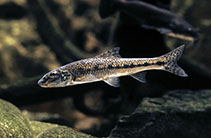 Gobio gobio
Foto de Muséum-Aquarium de Nancy/D. Terver
Fotos | vídeos | Selos, moedas, diversos. | Imagem do Google
Foto de Muséum-Aquarium de Nancy/D. Terver
Classificação / Nomes Nomes comuns | Sinônimos | Catalog of Fishes(Gênero, Espécies) | ITIS | CoL | WoRMS | Cloffa
> Cypriniformes (Carps) > Gobionidae (Gudgeons)
Etymology: Gobio: Latin, gobius = gudgeon (Ref. 45335).
More on author: Linnaeus.
Etymology: Gobio: Latin, gobius = gudgeon (Ref. 45335).
More on author: Linnaeus.
Meio ambiente: milieu / Zona climática / intervalo de profundidade / faixa de distribuição Ecologia
; Água doce; estuarina bentopelágico; pH range: 7.0 - 7.5; dH range: 10 - 20; potamódromo. Temperate; 2°C - 18°C (Ref. 1672); 67°N - 36°N, 10°W - 142°E
Distribuição Territórios | Áreas da FAO | Ecossistemas | Ocorrências | Mapa de pontos | Introduções | Faunafri
Europe: Atlantic Ocean, North and Baltic Sea basins, from Loire drainage eastward, eastern Great Britain, Rhône and Volga drainages, upper Danube and middle and upper Dniestr and Dniepr drainages; in Finland, north to about 61°N. Introduced to eastern and northern Italy, Ireland, Wales and Scotland. Eastern and southern limits unclear (Ref. 59043). Occurs as far east as Korea (Ref. 4537). Populations from the Iberian Peninsula and Adour basin in southern France refer to G. lozanoi (Ref. 57030). Populations from the Caspian basin may represent a distinct species (Ref. 59043).
Comprimento de primeira maturação / Tamanho / Peso / Idade
Maturidade: Lm 9.3 range ? - ? cm
Max length : 21.0 cm TL macho/indeterminado; (Ref. 88166); common length : 12.0 cm TL macho/indeterminado; (Ref. 6258); peso máx. publicado: 220.00 g (Ref. 6258); idade máx. registrada: 8 anos (Ref. 6258)
Max length : 21.0 cm TL macho/indeterminado; (Ref. 88166); common length : 12.0 cm TL macho/indeterminado; (Ref. 6258); peso máx. publicado: 220.00 g (Ref. 6258); idade máx. registrada: 8 anos (Ref. 6258)
Descrição suscinta Chaves de identificação | Morfologia | Morfometria
Espinhos dorsais (total) : 2 - 3; Raios dorsais (total) : 5 - 7; Espinhos anais: 2 - 3; Raios anais : 6 - 8; Vértebras: 39 - 41. Diagnosed from other congeners in Europe by the possession of the following characters: barbel reaching beyond anterior eye margin, usually to middle of eye; snout length greater than postorbital distance; head length 26-30% SL; eye diameter 5-7% SL; 1.0-1.4 times in interorbital distance in over about 6 cm SL specimens (less in smaller ones), 2.4-2.8 times in head depth; head depth 15-17% SL at nape, 43-51% HL at eye; body depth 19-23% SL; head width 14-16% SL, 49-57% HL; caudal peduncle depth 30-34% HL; breast naked between pectorals; scales between anus and anal origin 4-5; scales on lateral line usually 39-42 + 2; and scales around caudal peduncle usually 12-14 (Ref. 59043). Caudal fin with 19 rays (Ref. 2196). Scalar formula: 38-45 (Ref. 40476).
Body shape (shape guide): fusiform / normal.
Body shape (shape guide): fusiform / normal.
Occurs in nearly all types of riverine and lacustrine habitats with sand bottom. Found in small mountain streams, large lowland rivers and large lakes (Ref. 59043). Inhabits fast flowing rivers with sand or gravel bottom but may also occur in still waters. Forms schools. Feeds on insect larvae, mollusks, and crustaceans. Normally active during the day but if they are disturbed, in particular, by predators, they can defer their activity to periods when light intensity is weak. Capable of emitting squeaking sounds. These vocalizations, which is a means by which fish communicate with each other, vary with the degree of activity and the temperature and are independent of the season of reproduction (Ref. 30578). Breeds in shallow water over stones, sand or plant material. Eggs are released above substrate and drift with current, sinking to bottom and sticking to substrate. Larvae and juveniles occur on the bottom and prefer detritus-rich sandy habitats and low current (Ref. 59043).
Ciclo de vida ou comportamento de acasalamento Maturidade | Reprodução | Desova | Ovos | Fecundidade | Larvas
Spawns once a year for several years in low productivity streams, but exhibits multiple spawning within a season in high productivity environments (Ref. 40290, 40756). Releases eggs above substrate which drift with current, sink to the bottom and stick to substrate. Larvae and juveniles occur on the bottom and prefer detritus-rich sandy habitats and low current (Ref. 59043).
Referência principal
Carregar suas referências | Referências | Coordenador | Colaboradores
Kottelat, M. and J. Freyhof, 2007. Handbook of European freshwater fishes. Publications Kottelat, Cornol and Freyhof, Berlin. 646 pp. (Ref. 59043)
Status na Lista Vermelha da UICN (Ref. 130435: Version 2025-2 (Global))
Segura ou pouco preocupante (LC) ; Date assessed: 18 January 2023
CITES
Not Evaluated
Ameaça para os humanos
Harmless
Uso pelos humanos
Pescarias: espécies comerciais; Aquário: Espécies comerciais; isca: usually
FAO - Publication: search | FishSource |
Mais informação
Ecologia Trófica
Itens alimentares (presas)
Composição da dieta
Consumo alimentar
Rações alimentares
Predadores
Itens alimentares (presas)
Composição da dieta
Consumo alimentar
Rações alimentares
Predadores
Ciclo de vida
Reprodução
Maturidade
Maturidade/Rel. das guelras
Fecundidade
Desova
Agregações de desova
Ovos
Desenvolvimento dos ovos
Larvas
Dinâmica larval
Reprodução
Maturidade
Maturidade/Rel. das guelras
Fecundidade
Desova
Agregações de desova
Ovos
Desenvolvimento dos ovos
Larvas
Dinâmica larval
Fisiologia
Composição corporal
Nutrientes
Consumo de oxigênio
Tipo de natação
Velocidade de natação
Pigmentos visuais
Som de peixe
Doenças e Parasitas
Toxicidade (LC50s)
Composição corporal
Nutrientes
Consumo de oxigênio
Tipo de natação
Velocidade de natação
Pigmentos visuais
Som de peixe
Doenças e Parasitas
Toxicidade (LC50s)
Relacionado a humanos
Sistemas de aquicultura
Perfis para aquacultura
Estirpes
Casos de Ciguatera
Selos, moedas, diversos.
Sistemas de aquicultura
Perfis para aquacultura
Estirpes
Casos de Ciguatera
Selos, moedas, diversos.
Ferramentas
Questionário orgânico | Livro eletrônico | Guia de campo | Chaves de identificação | Ferramenta auxiliar de frequências de comprimento | Ferramenta sobre a história de vida | Mapa de pontos |
Catch-MSY |
Relatórios especiais
Checar Manutenção em Aquário | Checar Planilhas de Fatos sobre as Espécies | Checar Planilhas de Fatos sobre Aquicultura
Baixar XML
Fontes da internet
AFORO (otoliths) | Banco de dados para Espécies Aliens/Invasivas | Aquatic Commons | BHL | Cloffa | Websites from users | Checar Observador de Peixes (FishWatcher) | CISTI | Catalog of Fishes: Gênero, Espécies | DiscoverLife | DORIS | ECOTOX | FAO - Publication: search | Faunafri | Fishipedia | Fishtrace | GloBI | Google Books | Google Scholar | Google | IGFA World Record | Bases de dados nacionais | OneZoom | Open Tree of Life | Otolith Atlas of Taiwan Fishes | Aquários públicos | PubMed | Reef Life Survey | Socotra Atlas | TreeBase | Árvore da vida | Wikipedia: Ir para, procura | World Records Freshwater Fishing | Registro zoológico
Estimativas baseadas em modelos
Índice de diversidade filogenética (Ref. 82804): PD50 = 0.5000 [Uniqueness, from 0.5 = low to 2.0 = high].
Bayesian length-weight: a=0.00708 (0.00614 - 0.00817), b=3.12 (3.08 - 3.16), in cm total length, based on LWR estimates for this species (Ref. 93245).
Nível Trófico (Ref. 69278): 3.1 ±0.38 se; based on food items.
Resiliência (Ref. 120179): médio(a), tempo mínimo de duplicação da população 1,4 - 4,4 anos (tm=1-3; tmax=8; Fec=1,000-3,000).