Pagrus major, Red seabream : fisheries, aquaculture, gamefish, aquarium

Pagrus major (Temminck & Schlegel, 1843)

Red seabream
เพิ่มการสังเกตของคุณใน Fish Watcher
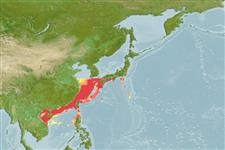
Native range | All suitable habitat | Point map | Year 2050
This map was computer-generated and has not yet been reviewed.
Pagrus major   AquaMaps   Data sources: GBIF OBIS
อัพโหลดของคุณ ภาพถ่าย และ วิดีโอ
รูปภาพหลายรูป | แสตมป์ เหรียญ อื่นๆ | Google image

การจำแนกประเภท / ชื่อ ชื่อสามัญ | ชื่อพ้อง | Catalog of Fishes(สกุล, ชนิด) | ITIS | CoL | WoRMS | Cloffa

> Eupercaria/misc (Various families in series Eupercaria) > Sparidae (Porgies)
Etymology: Pagrus: Greek, pagros = a fish, Dentex, sp. (Ref. 45335).
More on authors: Temminck & Schlegel.

สิ่งแวดล้อม : สิ่งแวดล้อม / เขตภูมิอากาศ / ระดับความลึก / ระยะการกระจายสินค้า นิเวศวิทยา

เกี่ยวกับทะเล,น้ำเค็ม สัตว์น้ำหน้าดิน; สัตว์น้ำที่อาศัยและอพยพภายในทะเลเท่านั้น (Ref. 51243); ระดับความลึก 10 - 200 m (Ref. 41299). Subtropical; 34°N - 15°N

การแพร่กระจาย อาณาเขต | พื้นที่จำแนกตาม FAO | ระบบนิเวศหลายระบบ | การปรากฏขึ้น,การเกิดขึ้น,พบ | ตำแหน่งบนแผนที่ | การแนะนำ | Faunafri

Northwest Pacific: northeastern part of South China Sea (Philippines excluded) northward to Japan.

ความยาวเมื่อครบกำหนดครั้งแรก / ขนาด / น้ำหนัก / อายุ

วัยเจริญพันธุ์: Lm 34.3  range ? - ? cm
Max length : 100.0 cm SL เพศผู้/กระเทย; (Ref. 559); common length : 30.0 cm TL เพศผู้/กระเทย; (Ref. 2115); น้ำหนักสูงสุดที่มีการรายงาน: 9.7 kg (Ref. 40637); อายุสูงสุดที่ได้รายงาน: 26 ปี (Ref. 56606)

คำอธิบายสั้นๆ เครื่องมือที่ใช้ในการแยกชนิดสัตว์,สิ่งมีชีวิตออกจากกัน | สัณฐานวิทยา | ความยาวต่างๆ

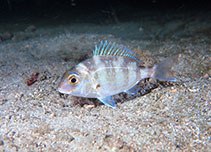
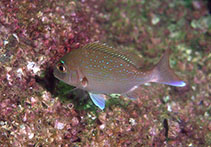
เงี่ยงครีบหลัง (รวม) : 12; ก้านครีบอ่อนที่หาง (รวม) : 10; เงี่ยงครีบก้น: 3; ก้านครีบอ่อนที่ก้น: 8. Body with many bluish dots when fresh. Shallow body, body depth 2 or more in SL. Transverse scales 6.5-7.5. All spines of dorsal fin tough and not elongated. Posterior margin of caudal fin black, lower margin white (Ref. 42199).
Body shape (shape guide): fusiform / normal; Cross section: oval.

ชีววิทยา     ภาคผนวก (เช่น epibenthic)

Occurs from 10 to 50 m depths, often on rough grounds, but also on softer bottoms. Also inhabits reefs (Ref. 9988). Adults migrate into shallower parts of their depth range to spawn in late spring and summer; juveniles occur mainly in the shallower areas. It is a popular food fish throughout its range. It is high-priced in Japan and used in various occasions such as wedding and festival. Feeds on benthic invertebrates, including echinoderms, worms, mollusks and crustaceans; also on fishes. Marketed live, fresh and frozen; eaten steamed, pan-fried, broiled, boiled and baked (Ref. 9988). Cultivated in cages (Ref. 9988). Used in Chinese medicine (Ref. 12166).

วงจรชีวิตและพฤติกรรมการผสมพันธุ์ วัยเจริญพันธุ์ | การสืบพันธุ์ | การวางไข่ | เซลสืบพันธ์ของเพศเมีย(ไข่) | ความดกของไข่ | ตัวอ่อน

Conflicting descriptions of the reproductive style of this species have been reported, e.g., Ref. 34228 describe this species as being a gonochorist (Ref. 28504). After clarificatory analyses on the protogynous characteristics of this species, gonochorism is confirmed (Ref. 103751).

อ้างอิงหลัก อัพโหลดข้อมูลอ้างอิงของคุณ | อ้างอิง | ผู้ประสานงาน | ผู้ร่วมมือ

Eggleston, D., 1974. Sparidae. In W. Fischer and P.J.P. Whitehead (eds.) FAO species identification sheets for fishery purposes. Eastern Indian Ocean (Fishing Area 57) and Western Central Pacific (Fishing Area 71), Volume 4. FAO, Rome. (Ref. 2115)

สถานะบัญชีแดงของ IUCN (Ref. 130435: Version 2025-2 (Global))

  Least Concern (LC) ; Date assessed: 03 December 2009

CITES

Not Evaluated

CMS (Ref. 116361)

Not Evaluated

ภัยคุกคามต่อมนุษย์

  Harmless


การใช้ของมนุษย์

การประมง: เน้นการพาณิชย์; การเพาะเลี้ยงสัตว์น้ำ: การค้า; การตกปลาเป็นกีฬา: ใช่; สถานที่แสดงสัตว์และพืชน้ำ: สถานแสดงสัตว์น้ำของรัฐ

ข้อมูลเพิ่มเติม

นิเวศวิทยาเขตร้อน
รายการอาหาร (เหยื่อ)
องค์ประอบของอาหาร
การบริโภคอาหาร
การจัดสรรอาหาร
ผู้ล่า
นิเวศวิทยา
นิเวศวิทยา
วงจรชีวิต
การสืบพันธุ์
วัยเจริญพันธุ์
ความสมบูรณ์พันธุ์/เหงือกที่เกี่ยวข้อง
ความดกของไข่
การวางไข่
การรวมตัวของสปอน
เซลสืบพันธ์ของเพศเมีย(ไข่)
การพัฒนาไข่
ตัวอ่อน
พลวัตของสัตว์น้ำวัยอ่อน
กายวิภาคศาสตร์
พื้นที่เหงือก
สมอง
หินโสต
สรีรวิทยา
องค์ประกอบของร่างกาย
สารอาหาร
การใช้ออกซิเจน
ประเภทการว่ายน้ำ
ระดับความเร็วในการว่ายน้ำ
เม็ดสีที่มองเห็นได้
เสียงปลา
โรคและปรสิต
ความเป็นพิษ (LC50s)
เกี่ยวข้องกับมนุษย์
ระบบการเพาะเลี้ยงสัตว์น้ำ
ประวัติการเพาะเลี้ยงสัตว์น้ำ
สายพันธุ์
กรณีซิเกวเทอรา
แสตมป์ เหรียญ อื่นๆ
การเข้าถึง
ผู้ร่วมมือ
อ้างอิง
อ้างอิง

เครื่องมือ

รายงานพิเศษ

ดาวน์โหลด XML

แหล่งที่มาจากอินเตอร์เน็ต

การประมาณค่าตามแบบจำลอง

อุณหภูมิที่ต้องการ (อ้างอิง 123201): 17 - 24.4, mean 21.8 °C (based on 143 cells).
ดัชนีความหลากหลายทางวิวัฒนาการ (อ้างอิง 82804):  PD50 = 0.5156   [Uniqueness, from 0.5 = low to 2.0 = high].
Bayesian length-weight: a=0.01288 (0.01143 - 0.01452), b=3.03 (3.00 - 3.06), in cm total length, based on LWR estimates for this species (Ref. 93245).
ระดับชั้นอาหาร (อ้างอิง 69278):  4.5   ±0.7 se; based on diet studies.
ความสามารถในการกลับคืนสู่ปกติ (อ้างอิง 120179):  ต่ำ, เวลาต่ำสุดที่จะทำให้ประชากรเพิ่มขึ้นเป็น 2 เท่าใช้เวลา 4.5 - 14 ปี (Preliminary K or Fecundity.).
Prior r = 0.22, 95% CL = 0.15 - 0.33, Based on 1 full stock assessment.
ความเสี่ยงต่อการตกปลา (Ref. 59153):  High vulnerability (58 of 100). 🛈
หมวดหมู่ราคา (Ref. 80766):   High.
สารอาหาร (Ref. 124155):  Calcium = 48.2 [26.4, 91.9] mg/100g; Iron = 1.48 [0.51, 3.85] mg/100g; Protein = 20.6 [18.9, 22.2] %; Omega3 = 0.328 [0.152, 0.664] g/100g; Selenium = 33.6 [15.5, 66.8] μg/100g; VitaminA = 13.5 [4.1, 42.2] μg/100g; Zinc = 0.433 [0.220, 0.895] mg/100g (wet weight);