



Clarias anguillaris (Linnaeus, 1758)
Mudfish
Envoyez vos Photos et vidéos
Images | Images Google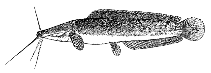 Clarias anguillaris
Photo de Teugels, G.
Images | Images Google
Photo de Teugels, G.
Classification / Noms Noms communs | Synonymes | Catalog of Fishes(Genre, Espèce) | ITIS | CoL | WoRMS | Cloffa
> Siluriformes (Catfishes) > Clariidae (Airbreathing catfishes)
Etymology: Clarias: Greek, chlaros = lively, in reference to the ability of the fish to live for a long time out of water.
More on author: Linnaeus.
Etymology: Clarias: Greek, chlaros = lively, in reference to the ability of the fish to live for a long time out of water.
More on author: Linnaeus.
Environnement : milieu / zone climatique / profondeur / gamme de distribution Écologie
Distribution Territoires | Zones FAO | Écosystèmes | Occurrences | Carte par point | Introductions | Faunafri
Africa: lower and middle Nile; Chad system including the Logone and the Shari rivers; Niger and Benoue river systems; coastal rivers of Benin, Togo, Ghana and Côte d'Ivoire; Gambia and lower Senegal rivers; Volta system; relict populations occur in Mauritania and southern Algeria (Ref. 248). Also in the lower Cross in Nigeria (Ref. 81644). Trade restricted in FRG.
Taille / Poids / Âge
Maturité: Lm ? range ? - ? cm
Max length : 100.0 cm TL mâle / non sexé; (Ref. 3799); poids max. publié: 7.0 kg (Ref. 3799)
Max length : 100.0 cm TL mâle / non sexé; (Ref. 3799); poids max. publié: 7.0 kg (Ref. 3799)
Description synthétique Clés d'identification | Morphologie | Morphométrie
Épines dorsales (Total) : 0; Rayons mous dorsaux (Total) : 60 - 82; Rayons mous anaux: 42 - 61. Diagnosis: 16-50 gill rakers on first gill arch (much more reduced compared to Clarias gariepinus)(Ref. 57129, 81644), subject to geographical variations (Ref. 57129). Head oval-shaped to rectangular in dorsal outline; snout broadly rounded; eyes rather lateral in position and, together with relatively broad head, make for a relatively large interorbital distance; number of gill rakers on first branchial arch subject to much variation, 16-40, rarely exceeding 40; dorsal fin base situated close to occipital process; dorsal fin always terminates before caudal fin base, distance between both small; anal fin originates closer to caudal fin base than to tip of snout, nearly reaching caudal fin but never confluent; pelvic fin base slightly closer to tip of snout than to caudal fin base, reaching base of first anal fin rays; pectoral fin extend from operculum to base of first dorsal fin rays (Ref. 248). Pectoral spine slightly curved and robust (Ref. 248), serrated only on its outer side (Ref. 248, 81644), number of serrations increases with increasing standard length (Ref. 248). Lateral line appears as a small, white line running from posterior end of head to middle of caudal fin base (Ref. 248). Openings of secondary sensory canals (flank neuromasts) clearly marked, showing a regular pattern (Ref. 248, 81644).
Body shape (shape guide): elongated; Cross section: oval.
Body shape (shape guide): elongated; Cross section: oval.
Facultative air-breathing (Ref. 126274); Very common in inundated areas. Bury themselves in the mud when the pools are drying up. Feed mainly on fish and mollusks; also crustaceans, diatoms, detritus and bottom organisms (Ref. 248). Omnivorous and reproduction takes place in the rainy saison (Ref. 78218). Max. size for West Africa and Lower Guinea: 650mm TL (Ref. 57129, 81644).
Cycle de vie et comportement reproducteur Maturité | Reproduction | Frai | Œufs | Fécondité | Larves
Breeding season varies among localities, apparently timed to the rainy season.
Référence principale
Téléchargez vos références | Références | Coordinateur | Collaborateurs
Teugels, G.G., 1986. A systematic revision of the African species of the genus Clarias (Pisces; Clariidae). Ann. Mus. R. Afr. Centr., Sci. Zool., 247:199 p. (Ref. 248)
Statut dans la liste rouge de l'IUCN (Ref. 130435: Version 2025-2 (Global))
Préoccupation mineure (LC) ; Date assessed: 28 April 2019
CITES
Not Evaluated
Menace pour l'homme
Harmless
Utilisations par l'homme
Pêcheries: intérêt commercial mineur; Aquaculture: commercial
FAO - Systèmes d'aquaculture: production searchpêcheries: Résumé espèce, landings search; Publication: search | FishSource |
Plus d'informations
Écologie trophique
Aliments (proies)
Composition du régime alimentaire
Consommation alimentaire
Rations alimentaires
Prédateurs
Aliments (proies)
Composition du régime alimentaire
Consommation alimentaire
Rations alimentaires
Prédateurs
Dynamique des populations
Paramètres de croissance
Âges / tailles maximales
Longueur-poids rel.
Rel. longueur-longueur.
Fréquences de longueurs
Conversion de masse
Recrutement
Abondance
Paramètres de croissance
Âges / tailles maximales
Longueur-poids rel.
Rel. longueur-longueur.
Fréquences de longueurs
Conversion de masse
Recrutement
Abondance
Cycle de vie
Reproduction
Maturité
Maturité/épines rel.
Fécondité
Frai
Agrégats de frai
Œufs
Développement de l'œuf
Larves
Dynamique des populations larvaires
Reproduction
Maturité
Maturité/épines rel.
Fécondité
Frai
Agrégats de frai
Œufs
Développement de l'œuf
Larves
Dynamique des populations larvaires
Anatomie
Surface branchiale
Cerveau
Otolithe
Surface branchiale
Cerveau
Otolithe
Physiologie
Composition corporelle
Nutriments
Consommation d'oxygène
Type de natation
Vitesse de nage
Pigments visuels
Son de poisson
Maladies et parasites
Toxicité (CL50)
Composition corporelle
Nutriments
Consommation d'oxygène
Type de natation
Vitesse de nage
Pigments visuels
Son de poisson
Maladies et parasites
Toxicité (CL50)
Liées à l'homme
Systèmes d'aquaculture
Profils d'aquaculture
Souches
Cas de ciguatera
Timbres, pièces de monnaie, divers
Systèmes d'aquaculture
Profils d'aquaculture
Souches
Cas de ciguatera
Timbres, pièces de monnaie, divers
Outils
E-book | Guide de terrain | Clés d'identification | Générateur de fréquences de longueur | Outil de dynamique de population | Carte par point |
Capture-MSY |
Articles particuliers
Télécharger en XML
Sources Internet
AFORO (otoliths) | Aquatic Commons | BHL | Cloffa | Websites from users | FishWatcher | CISTI | Catalog of Fishes: Genre, Espèce | DiscoverLife | ECOTOX | FAO - Systèmes d'aquaculture: production searchpêcheries: Résumé espèce, landings search; Publication: search | Faunafri | Fishipedia | Fishtrace | GloBI | Google Books | Google Scholar | Google | IGFA World Record | OneZoom | Open Tree of Life | OsteoBase: skull, spine | Otolith Atlas of Taiwan Fishes | PubMed | Reef Life Survey | Socotra Atlas | TreeBase | Arbre de Vie | Wikipedia: aller à, chercher | | Zoological Record
Estimations basées sur des modèles
|
Indice de diversité phylogénétique (Réf. 82804) |
PD50 = 0.5000 [Uniqueness, from 0.5 = low to 2.0 = high]. |
| Bayesian length-weight | a=0.00813 (0.00658 - 0.01004), b=2.97 (2.92 - 3.02), in cm total length, based on LWR estimates for this species (Ref. 93245). |
|
Niveau trophique (Réf. 69278) |
3.4 ±0.51 se; based on food items. |
|
Résilience (Réf. 120179) |
Milieu, temps minimum de doublement de population : 1,4 à 4,4 années (Assuming tm=2-4; Fec < 10,000). |
|
Vulnérabilité de la pêche (Ref. 59153) |
Moderate to high vulnerability (54 of 100). 🛈 |
|
Catégorie de prix (Ref. 80766) |
Unknown. |
|
Nutriments (Ref. 124155) |
Calcium = 18.9 [9.6, 92.2] mg/100g; Iron = 1.21 [0.68, 2.07] mg/100g; Protein = 16.9 [15.9, 18.0] %; Omega3 = 0.207 [0.067, 0.587] g/100g; Selenium = 151 [51, 382] μg/100g; VitaminA = 24.3 [8.1, 69.9] μg/100g; Zinc = 0.721 [0.509, 1.023] mg/100g (wet weight); |