



Clarias anguillaris (Linnaeus, 1758)
Mudfish
Uploaden van uw Foto's en video's
Afbeeldingen | Google afbeelding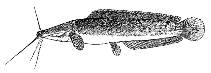 Clarias anguillaris
Afbeelding van Teugels, G.
Afbeeldingen | Google afbeelding
Afbeelding van Teugels, G.
Classificatie / Namen Lokale namen | Synoniemen | Catalog of Fishes(Genus, Soort(en)) | ITIS | CoL | WoRMS | Cloffa
> Siluriformes (Catfishes) > Clariidae (Airbreathing catfishes)
Etymology: Clarias: Greek, chlaros = lively, in reference to the ability of the fish to live for a long time out of water.
More on author: Linnaeus.
Etymology: Clarias: Greek, chlaros = lively, in reference to the ability of the fish to live for a long time out of water.
More on author: Linnaeus.
Milieu: milieu / Klimaatzone / Diepte / verspreidingsgebied Ecologie
Verspreiding Gebieden | FAO regio's | Ecosystemen | Voorkomen | Verspreidingskaart | Introducties | Faunafri
Africa: lower and middle Nile; Chad system including the Logone and the Shari rivers; Niger and Benoue river systems; coastal rivers of Benin, Togo, Ghana and Côte d'Ivoire; Gambia and lower Senegal rivers; Volta system; relict populations occur in Mauritania and southern Algeria (Ref. 248). Also in the lower Cross in Nigeria (Ref. 81644). Trade restricted in FRG.
Grootte / Gewicht / Leeftijd
Maturiteit: Lm ? range ? - ? cm
Max length : 100.0 cm TL mannelijk / geslacht onbekend; (Ref. 3799); max. gepubliceerd gewicht: 7.0 kg (Ref. 3799)
Max length : 100.0 cm TL mannelijk / geslacht onbekend; (Ref. 3799); max. gepubliceerd gewicht: 7.0 kg (Ref. 3799)
Korte beschrijving Determinatiesleutels | Morfologie | Morfometrie
Dorsale stekels (totaal) : 0; Dorsale zachte stralen (totaal) : 60 - 82; Anale zachte stralen: 42 - 61. Diagnosis: 16-50 gill rakers on first gill arch (much more reduced compared to Clarias gariepinus)(Ref. 57129, 81644), subject to geographical variations (Ref. 57129). Head oval-shaped to rectangular in dorsal outline; snout broadly rounded; eyes rather lateral in position and, together with relatively broad head, make for a relatively large interorbital distance; number of gill rakers on first branchial arch subject to much variation, 16-40, rarely exceeding 40; dorsal fin base situated close to occipital process; dorsal fin always terminates before caudal fin base, distance between both small; anal fin originates closer to caudal fin base than to tip of snout, nearly reaching caudal fin but never confluent; pelvic fin base slightly closer to tip of snout than to caudal fin base, reaching base of first anal fin rays; pectoral fin extend from operculum to base of first dorsal fin rays (Ref. 248). Pectoral spine slightly curved and robust (Ref. 248), serrated only on its outer side (Ref. 248, 81644), number of serrations increases with increasing standard length (Ref. 248). Lateral line appears as a small, white line running from posterior end of head to middle of caudal fin base (Ref. 248). Openings of secondary sensory canals (flank neuromasts) clearly marked, showing a regular pattern (Ref. 248, 81644).
Body shape (shape guide): elongated; Cross section: oval.
Body shape (shape guide): elongated; Cross section: oval.
Facultative air-breathing (Ref. 126274); Very common in inundated areas. Bury themselves in the mud when the pools are drying up. Feed mainly on fish and mollusks; also crustaceans, diatoms, detritus and bottom organisms (Ref. 248). Omnivorous and reproduction takes place in the rainy saison (Ref. 78218). Max. size for West Africa and Lower Guinea: 650mm TL (Ref. 57129, 81644).
Levenscyclus en paargedrag Maturiteit | Voortplanting | Paaien | Eieren | Fecunditeit | Larven
Breeding season varies among localities, apparently timed to the rainy season.
Hoofdreferentie
Upload uw referenties | Referenties | Coördinator | Medewerkers
Teugels, G.G., 1986. A systematic revision of the African species of the genus Clarias (Pisces; Clariidae). Ann. Mus. R. Afr. Centr., Sci. Zool., 247:199 p. (Ref. 248)
Status op de Rode Lijst van het IUCN (Ref. 130435: Version 2025-2 (Global))
Niet bedreigd (LC) ; Date assessed: 28 April 2019
CITES
Not Evaluated
Gevaar voor de mens
Harmless
Gebruik door de mens
Visserij: van minder commercieel belang; Aquacultuur: commercieel
FAO - Aquacultuursystemen: productie; visserij: aanvoer, soortsprofiel; Publication: search | FishSource |
Meer informatie
Trofische ecologie
Voedsel (prooien)
Dieetsamenstelling
Voedselconsumptie
Voedselrantsoenen
Predatoren
Voedsel (prooien)
Dieetsamenstelling
Voedselconsumptie
Voedselrantsoenen
Predatoren
Populatiedynamica
Groeiparameters
Max. leeftijden / maten
Lengte-gewicht rel.
Lengte-lengte rel.
Lengtefrequenties
Massaconversie
Rekrutering
Abundantie
Groeiparameters
Max. leeftijden / maten
Lengte-gewicht rel.
Lengte-lengte rel.
Lengtefrequenties
Massaconversie
Rekrutering
Abundantie
Levenscyclus
Voortplanting
Maturiteit
Rijpheid/kieuwen rel.
Fecunditeit
Paaien
Paaibestanden
Eieren
Ontwikkeling van de eieren
Larven
Larvale populatiedynamiek
Voortplanting
Maturiteit
Rijpheid/kieuwen rel.
Fecunditeit
Paaien
Paaibestanden
Eieren
Ontwikkeling van de eieren
Larven
Larvale populatiedynamiek
Anatomie
Kieuwoppervlak
Hersenen
Otoliet
Kieuwoppervlak
Hersenen
Otoliet
Fysiologie
Lichaamssamenstelling
Voedingsstoffen
Zuurstofverbruik
Type zwemmen
Zwemsnelheid
Visuele pigmenten
Vis geluid
Ziekten en parasieten
Toxiciteit (LC50)
Lichaamssamenstelling
Voedingsstoffen
Zuurstofverbruik
Type zwemmen
Zwemsnelheid
Visuele pigmenten
Vis geluid
Ziekten en parasieten
Toxiciteit (LC50)
Menselijk gerelateerd
Aquacultuursystemen
Aquacultuurprofielen
Kweeklijnen
Ciguatera gevallen
Postzegels, munten, diversen.
Aquacultuursystemen
Aquacultuurprofielen
Kweeklijnen
Ciguatera gevallen
Postzegels, munten, diversen.
Tools
E-boek | Veldgids | Determinatiesleutels | Lengtefrequentie Tool | Levenscyclus tool | Verspreidingskaart |
Vangst-MSY |
Speciale rapporten
Bekijk gegevens voor het houden in een aquarium | Bekijk Fact Sheets voor de soort | Bekijk Aquacultuur Fact Sheets
Download XML
Internetbronnen
AFORO (otoliths) | Aquatic Commons | BHL | Cloffa | Websites from users | Bekijk FishWatcher | CISTI | Catalog of Fishes: Genus, Soort(en) | DiscoverLife | ECOTOX | FAO - Aquacultuursystemen: productie; visserij: aanvoer, soortsprofiel; Publication: search | Faunafri | Fishipedia | Fishtrace | GloBI | Google Books | Google Scholar | Google | IGFA World Record | OneZoom | Open Tree of Life | OsteoBase: skull, spine | Otolith Atlas of Taiwan Fishes | PubMed | Reef Life Survey | Socotra Atlas | TreeBase | Tree of Life | Wikipedia: ga naar, zoek | World Records Freshwater Fishing | Zoological Record
Schattingen op basis van modellen
Fylogenetische diversiteitsindex (Ref. 82804): PD50 = 0.5000 [Uniqueness, from 0.5 = low to 2.0 = high].
Bayesian length-weight: a=0.00813 (0.00659 - 0.01003), b=2.97 (2.92 - 3.02), in cm total length, based on LWR estimates for this species (Ref. 93245).
Trofisch niveau (Ref. 69278): 3.4 ±0.51 se; based on food items.
Weerstandsvermogen (Ref. 120179): Gemiddeld, minimale populatieverdubbelingstijd 1,4-4,4 jaar (Assuming tm=2-4; Fec < 10,000).
Voedingsstoffen (Ref. 124155): Calcium = 18.9 [9.6, 92.2] mg/100g; Iron = 1.21 [0.68, 2.07] mg/100g; Protein = 16.9 [15.9, 18.0] %; Omega3 = 0.207 [0.067, 0.587] g/100g; Selenium = 151 [51, 382] μg/100g; VitaminA = 24.3 [8.1, 69.9] μg/100g; Zinc = 0.721 [0.509, 1.023] mg/100g (wet weight);