



Загрузить свой Фото и Видео
изображения | Марки, монеты и прочее. | Изображение на Google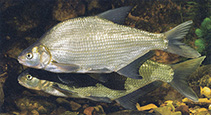 Abramis brama
Изображение сделано Hartl, A.
изображения | Марки, монеты и прочее. | Изображение на Google
Изображение сделано Hartl, A.
Классификация / Имена народные названия | синонимы | Catalog of Fishes(род, виды) | ITIS | CoL | WoRMS | Cloffa
> Cypriniformes (Carps) > Leuciscidae (Minnows) > Leuciscinae
Etymology: Abramis: Greek, abramis, -idos = a fish, grey mullet (Ref. 45335).
More on author: Linnaeus.
Etymology: Abramis: Greek, abramis, -idos = a fish, grey mullet (Ref. 45335).
More on author: Linnaeus.
Окружающая среда: среда / климатическая зона / пределы глубины / диапазон распространения экология
; пресноводный; солоноватоводный донно-пелагический; pH range: 7.0 - 7.5; dH range: 15 - ?; мигрирует в реке (Ref. 51243); пределы глубины 1 - ? m (Ref. 9696). Temperate; 10°C - 24°C (Ref. 2059); 75°N - 40°N, 11°W - 73°E
распространение Территории | регионы FAO | Экосистемы | места находок | карта точек | интродукции | Faunafri
Europe and Asia: most European drainages from Adour (France) to Pechora (White Sea basin); Aegean Sea basin, in Lake Volvi and Struma and Maritza drainages. Naturally absent from Iberian Peninsula, Adriatic basin, Italy, Scotland, Scandinavia north of Bergen (Norway) and 67°N (Finland). Locally introduced in Ireland, Spain and northeastern Italy. In Asia, from Marmara basin (Turkey) and eastward to Aral basin. Introduced in Lake Baikal and upper Ob and Yenisei drainages.
Длина при первой зрелости / Размер / Вес / Возраст
половая зрелость: Lm ? range ? - ? cm
Max length : 82.0 cm TL самец/пол неопределен; (Ref. 6114); common length : 25.0 cm TL самец/пол неопределен; (Ref. 3561); наибольший вес (опубликованные данные): 6.0 kg (Ref. 4699); наибольший возраст (опубликованны данные): 23 годы (Ref. 796)
Max length : 82.0 cm TL самец/пол неопределен; (Ref. 6114); common length : 25.0 cm TL самец/пол неопределен; (Ref. 3561); наибольший вес (опубликованные данные): 6.0 kg (Ref. 4699); наибольший возраст (опубликованны данные): 23 годы (Ref. 796)
Краткое описание определительные ключи | морфология | морфометрия
колючие лучи спинного плавника (общее число) : 3; членистые (мягкие) лучи спинного плавника (общее число) : 9 - 10; колючие лучи анального плавника: 3; членистые (мягкие) лучи анального плавника: 23 - 30; позвонки: 43 - 45. The only species of the genus which can be diagnosed from other species of Ballerus, Blicca and Vimba by the following characters: mouth sub-inferior, which can be extended as a tube; lateral line with 51-60 scales; anal fin with 30½ branched rays; eye diameter about 2/3 of snout length in individuals larger than 10 cm SL; pharyngeal teeth 5-5; and base of paired fins hyaline or grey (Ref. 59043). Caudal fin with 19 rays (Ref. 2196). Tall, laterally compressed body. Fins darker in adults. Anal fin base twice as long as the dorsal fin (Ref. 35388).
Body shape (shape guide): fusiform / normal.
Body shape (shape guide): fusiform / normal.
Adults inhabit a wide variety of lakes and large to medium sized rivers. Most abundant in backwaters, lower parts of slow-flowing rivers, brackish estuaries and warm and shallow lakes (Ref. 59043). Adults occur usually in still and slow-running waters where they travel in large shoals (Ref. 9696). Larvae and juveniles live in still water bodies, feeding on plankton. One to two years old juveniles move from backwaters to river to feed. In the absence of opportunity to leave backwaters, juveniles may adapt but have a slower growth and attain maturity at a smaller size. They also drift to brackishwater estuaries to forage when water level of flooded areas drops in lower reaches of large rivers. Foraging juveniles in brackish waters stay in lower parts of rivers to overwinter in freshwater (Ref. 59043). Feed on insects, particularly chironomids, small crustaceans, mollusks and plants. Larger specimens may feed on small fish. Juveniles feed on zooplankton (Ref. 30578). Able to shift to particle feeding or even filter feeding at high zooplankton abundance. Usually spawn in backwaters, floodplains or lakes shores with dense vegetation (Ref. 59043). Can survive out of the water for extended periods (Ref. 9988). The flesh is bony, insipid and soft (Ref. 30578). Marketed fresh or frozen. Eaten steamed, broiled, fried and baked (Ref. 9988).
Жизненный цикл и брачное поведение половая зрелость | размножение | нерест | икра | Плодовитость | личинки
Undergo upriver migration (100 km in Dniepr) to spawn. Many populations start spawning migration in autumn ( especially semi-anadromours forms), slow down during winter and continue in spring. Males often defend spawning territories along shorelines. Eggs are sticky and eggs size increases with age of female. Frequently forms fertile hybrids with Rutilus rutilus (Ref. 59043).
Основная ссылка
Загрузите свои рекомендации | ссылки | координатор | соавторы
Kottelat, M. and J. Freyhof, 2007. Handbook of European freshwater fishes. Publications Kottelat, Cornol and Freyhof, Berlin. 646 pp. (Ref. 59043)
Статус Красного Списка МСОП (Ref. 130435: Version 2025-2 (Global))
Не вызывающий беспокойства (LC) ; Date assessed: 05 December 2023
CITES
Not Evaluated
Угроза для людей
Harmless
Использование человеком
рыболовство: важный объект промысла; аквакультура (рыбоводство): коммерческий; объект спортивного рыболовства: да; наживка: usually
FAO - Системы аквакультуры: Производство; рыболовство: посадки, Видовой профиль; Publication: search | FishSource |
дополнительная информация
Трофическая экология
Пищевые предметы (добыча)
состав пищи
потребление пищи
Продовольственные пайки
хищники
Пищевые предметы (добыча)
состав пищи
потребление пищи
Продовольственные пайки
хищники
Динамика численности населения
Параметры роста
Макс. возраст / размер
Отношение длины к весу.
Отношение длины к длине.
Размерный состав
Преобразование массы
пополнение
численность
Параметры роста
Макс. возраст / размер
Отношение длины к весу.
Отношение длины к длине.
Размерный состав
Преобразование массы
пополнение
численность
Жизненный цикл
размножение
половая зрелость
Зрелость/Жиры относительно.
Плодовитость
нерест
Нерестовые скопления
икра
Развитие икры
личинки
динамика численности личинок
размножение
половая зрелость
Зрелость/Жиры относительно.
Плодовитость
нерест
Нерестовые скопления
икра
Развитие икры
личинки
динамика численности личинок
Анатомия
жаберная область
Мозг
Отолит
жаберная область
Мозг
Отолит
Физиология
Состав тела
Питательные вещества
Потребление кислорода
Тип плавания
Скорость плавания
Зрительные пигменты
Звук рыбы
Болезни и паразиты
Токсичность (LC50s)
Состав тела
Питательные вещества
Потребление кислорода
Тип плавания
Скорость плавания
Зрительные пигменты
Звук рыбы
Болезни и паразиты
Токсичность (LC50s)
Связанные с человеком
Системы аквакультуры
особенности рыбоводства
степень растяжения
Случаи заболевания сигуатерой
Марки, монеты и прочее.
Системы аквакультуры
особенности рыбоводства
степень растяжения
Случаи заболевания сигуатерой
Марки, монеты и прочее.
инструменты
Органическая викторина | Электронная книга | полевой определитель | определительные ключи | Длина-Частота | онтогенез | карта точек |
Catch-MSY |
Специальные отчеты
Проверить содержание в аквариумах | Проверить опубликованные видовые данные | Проверить опубликованные данные по аквакультуре
Скачать в формате XML
ресурсы в Интернет
AFORO (otoliths) | Alien/Invasive Species database | Aquatic Commons | BHL | Cloffa | Websites from users | Проверить FishWatcher | CISTI | Catalog of Fishes: род, виды | DiscoverLife | DORIS | ECOTOX | FAO - Системы аквакультуры: Производство; рыболовство: посадки, Видовой профиль; Publication: search | Faunafri | Fishipedia | Fishtrace | GloBI | Google Books | Google Scholar | Google | IGFA World Record | национальные базы данных | OneZoom | Open Tree of Life | Otolith Atlas of Taiwan Fishes | общественные аквариумы | PubMed | Reef Life Survey | Socotra Atlas | TreeBase | Tree of Life | Wikipedia: Вперёд, поиск | World Records Freshwater Fishing | Зоологическая летопись
Оценки, основанные на моделях
Индекс филогенетического разнообразия (ссылка 82804): PD50 = 1.0000 [Uniqueness, from 0.5 = low to 2.0 = high].
Bayesian length-weight: a=0.00776 (0.00709 - 0.00850), b=3.14 (3.11 - 3.17), in cm total length, based on LWR estimates for this species (Ref. 93245).
Трофический уровень (ссылка 69278): 3.1 ±0.1 se; based on diet studies.
Generation time: 9.0 (7.2 - 10.8) years. Estimated as median ln(3)/K based on 50 growth studies.
устойчивость к внешним воздействиям (ссылка 120179): низкий, минимальное время удвоения популяции 4.5-14 лет (K=0.06-0.17; tm=3-5; tmax=17; Fec=90,000-340,000).
Питательные вещества (Ref. 124155): Calcium = 19.3 [11.8, 39.1] mg/100g; Iron = 0.257 [0.166, 0.467] mg/100g; Protein = 18.6 [17.2, 19.9] %; Omega3 = 0.628 [0.335, 1.215] g/100g; Selenium = 12.2 [6.5, 22.9] μg/100g; VitaminA = 18.5 [7.7, 48.4] μg/100g; Zinc = 0.412 [0.333, 0.737] mg/100g (wet weight); based on nutrient studies.