



Ajouter votre observation dans Fish Watcher
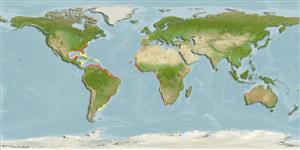
| Native range | All suitable habitat | Point map | Year 2050 |
|
| This map was computer-generated and has not yet been reviewed. |
| Gymnura micrura AquaMaps Data sources: GBIF OBIS |
Classification / Noms Noms communs | Synonymes | Catalog of Fishes(Genre, Espèce) | ITIS | CoL | WoRMS | Cloffa
Élasmobranches (requins et raies) (sharks and rays) > Myliobatiformes (Stingrays) > Gymnuridae (Butterfly rays)
Etymology: Gymnura: Greek, gymnos = naked + Greek, oura = tail (Ref. 45335).
More on authors: Bloch & Schneider.
Etymology: Gymnura: Greek, gymnos = naked + Greek, oura = tail (Ref. 45335).
More on authors: Bloch & Schneider.
Taxonomic Remarks
Species complex include Gymnura lessae and
Gymnura sereti; distribution of and both species were included for Gymnura micrura. Distribution will be corrected.
Environnement : milieu / zone climatique / profondeur / gamme de distribution Écologie
marin; saumâtre démersal; profondeur ? - 55 m (Ref. 27549). Deep-water
Distribution Territoires | Zones FAO | Écosystèmes | Occurrences | Carte par point | Introductions | Faunafri
Southwestern Atlantic: Venezuela, including Trinidad and Tobago, to Brazil (Rio de Janeiro).
Longueur à la première maturité / Taille / Poids / Âge
Maturité: Lm 35.0, range 34 - 50 cm
Max length : 137 cm WD mâle / non sexé; (Ref. 4439); common length : 90.0 cm WD mâle / non sexé; (Ref. 5217); poids max. publié: 0.00 g
Max length : 137 cm WD mâle / non sexé; (Ref. 4439); common length : 90.0 cm WD mâle / non sexé; (Ref. 5217); poids max. publié: 0.00 g
Description synthétique Clés d'identification | Morphologie | Morphométrie
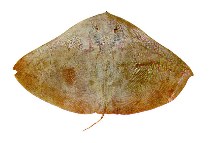
Broad, diamond-shaped ray with a very short tail lacking a dorsal spine (Ref. 26938). Snout protruding. Front edges of disk concave. Tail with low dorsal and ventral finfolds and 3 - 4 dark crossbars (Ref. 7251). Upper surface gray, brown, light green or purple with round spots. Lower surface white (Ref. 6902).
Body shape (shape guide): other.
Body shape (shape guide): other.
Prefers neritic waters of the continental shelf and
usually found on soft bottoms. May enter brackish
estuaries or hyper-saline lagoons (Ref. 5217). Feeds on
fish and shrimps (Ref. 28587); other crustaceans and clams
(Ref. 27549). Ovoviviparous (Ref. 50449). Generally
marketed salted (Ref. 5217).
Cycle de vie et comportement reproducteur Maturité | Reproduction | Frai | Œufs | Fécondité | Larves
Exhibit ovoviparity (aplacental viviparity), with embryos feeding initially on yolk, then receiving additional nourishment from the mother by indirect absorption of uterine fluid enriched with mucus, fat or protein through specialised structures (Ref. 50449). Distinct pairing with embrace (Ref. 205).
Référence principale
Téléchargez vos références | Références | Coordinateur : McEachran, John | Collaborateurs
Yokota, L. and M.R. de Carvalho, 2017. Taxonomic and morphological revision of butterfly rays of Gymnura micrura (Bloch & Schneider, 1801) species complex, with the description of two new species (Myliobatiformes: Gymnuridae). Zootaxa 4332(1):1-74. (Ref. 116399)
Statut dans la liste rouge de l'IUCN (Ref. 130435: Version 2025-2 (Global))
Quasi-menacé (NT) (A2d); Date assessed: 19 September 2020
CITES
Not Evaluated
Menace pour l'homme
Harmless
Utilisations par l'homme
Pêcheries: intérêt commercial mineur
FAO - Publication: search | FishSource | Sea Around Us
Plus d'informations
Écologie trophique
Aliments (proies)
Composition du régime alimentaire
Consommation alimentaire
Rations alimentaires
Prédateurs
Aliments (proies)
Composition du régime alimentaire
Consommation alimentaire
Rations alimentaires
Prédateurs
Dynamique des populations
Paramètres de croissance
Âges / tailles maximales
Longueur-poids rel.
Rel. longueur-longueur.
Fréquences de longueurs
Conversion de masse
Recrutement
Abondance
Paramètres de croissance
Âges / tailles maximales
Longueur-poids rel.
Rel. longueur-longueur.
Fréquences de longueurs
Conversion de masse
Recrutement
Abondance
Cycle de vie
Reproduction
Maturité
Maturité/épines rel.
Fécondité
Frai
Agrégats de frai
Œufs
Développement de l'œuf
Larves
Dynamique des populations larvaires
Reproduction
Maturité
Maturité/épines rel.
Fécondité
Frai
Agrégats de frai
Œufs
Développement de l'œuf
Larves
Dynamique des populations larvaires
Anatomie
Surface branchiale
Cerveau
Otolithe
Surface branchiale
Cerveau
Otolithe
Physiologie
Composition corporelle
Nutriments
Consommation d'oxygène
Type de natation
Vitesse de nage
Pigments visuels
Son de poisson
Maladies et parasites
Toxicité (CL50)
Composition corporelle
Nutriments
Consommation d'oxygène
Type de natation
Vitesse de nage
Pigments visuels
Son de poisson
Maladies et parasites
Toxicité (CL50)
Liées à l'homme
Systèmes d'aquaculture
Profils d'aquaculture
Souches
Cas de ciguatera
Timbres, pièces de monnaie, divers
Systèmes d'aquaculture
Profils d'aquaculture
Souches
Cas de ciguatera
Timbres, pièces de monnaie, divers
Outils
E-book | Guide de terrain | Clés d'identification | Générateur de fréquences de longueur | Outil de dynamique de population | Carte par point |
Capture-MSY |
Articles particuliers
Télécharger en XML
Sources Internet
AFORO (otoliths) | Aquatic Commons | BHL | Cloffa | Websites from users | FishWatcher | CISTI | Catalog of Fishes: Genre, Espèce | DiscoverLife | ECOTOX | FAO - Publication: search | Faunafri | Fishipedia | Fishtrace | GloBI | Google Books | Google Scholar | Google | IGFA World Record | OceanAdapt | OneZoom | Open Tree of Life | Otolith Atlas of Taiwan Fishes | PubMed | Reef Life Survey | Socotra Atlas | TreeBase | Arbre de Vie | Wikipedia: aller à, chercher | World Records Freshwater Fishing | Zoological Record
Estimations basées sur des modèles
Température préférée (Réf. 123201): 21.8 - 27.9, mean 25 °C (based on 544 cells).
Indice de diversité phylogénétique (Réf. 82804): PD50 = 0.5000 [Uniqueness, from 0.5 = low to 2.0 = high].
Bayesian length-weight: a=0.00537 (0.00331 - 0.00870), b=3.09 (2.94 - 3.24), in cm total length, based on LWR estimates for this species & (Sub)family-body (Ref. 93245).
Niveau trophique (Réf. 69278): 3.6 ±0.53 se; based on food items.
Résilience (Réf. 120179): Très faible, temps minimum de doublement de population supérieur à 14 ans (Fec=3).
Nutriments (Ref. 124155): Calcium = 7.1 [1.0, 38.4] mg/100g; Iron = 0.314 [0.067, 0.935] mg/100g; Protein = 21.9 [18.4, 24.9] %; Omega3 = 0.234 [0.058, 0.711] g/100g; Selenium = 8.65 [2.29, 27.32] μg/100g; VitaminA = 6.06 [1.19, 29.85] μg/100g; Zinc = 0.395 [0.196, 0.738] mg/100g (wet weight);