



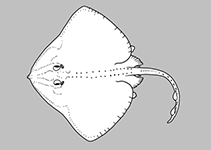
分類 / 名前 共通名の | 類義語 | Catalog of Fishes(部類, 種) | ITIS | CoL | WoRMS | Cloffa
板鰓亜鋼(サメとエイ類) (sharks and rays) > Rajiformes (Skates and rays) > Arhynchobatidae (Softnose skates)
Etymology: simoterus: Name probably derived from the comparative tense of the Greek σιμóς, meaning 'pug-nosed', referring to its rounded snout (Ref. 89865).
Etymology: simoterus: Name probably derived from the comparative tense of the Greek σιμóς, meaning 'pug-nosed', referring to its rounded snout (Ref. 89865).
環境:環境 / 気候帯 / 深さの範囲 / 分布範囲 生態学
海 底生の; 深さの範囲 96 - 540 m (Ref. 89865). Temperate
分布 領土 | 国連食糧農業機関の区域 | エコシステム | 事件 | 目的のマップ | 導入 | Faunafri
Northwest Pacific: off northern Japan.
サイズ / 重さ / 年齢
簡単な記述 検索表 | 形態学 | 形態計測学
This species is distinguished from all other members of the subgenus Arctoraja by having a complete row of dorsal thorns, narrow interdorsal space, high count of precaudal vertebrae, and COI haplotype. It is further distinguished from B. parmifera by its narrower interdorsal space 0.5-1.0% TL (vs. 1.0-3.9% TL), number of precaudal and caudal vertebrae 41 and 90 (vs. 32-40 and 82-89), tail thorns 22-28 (vs. 15-23), larger orbit 4.3-5.3% TL (vs. 2.6-4.8% TL), 3 postdorsal foramina slightly smaller posteriorly, posteriormost postventral foramina 4 times larger than preceding 6 foramina (vs. anterior- and posterior-most postdorsal and postventral foramina of the scapulacoracoid larger than 3 intervening foramina), distal projection of the ventral marginal directed distally (vs. distolaterally), ventral terminal lanceolate (vs. tear-drop shaped), dorsal and ventral marginals extending farther distally to distal tip of dorsal terminal 3 (vs. extending to about a quarter the length of dorsal terminal 2); from B. panthera by its narrow interdorsal space width (vs. 1.4-3.1% TL); anterior portion of body shorter and narrower (vs. longer and wider); tail shorter (vs. longer); posterior fontanelle narrowly elongate (vs. pear-shaped); internal carotid foramina widely separated (vs. foramina in a single median pit), foramen of scapulocoracoid all large (vs. anterior postdorsal foramen large, others much smaller), ventral terminal lanceolate (vs. tear-drop shaped); from the incompletely thorned B. smirnovi by its higher number of vertebrae 131 (vs. 118-127), more precaudal vertebrae 41 (vs. 31-38), smaller mouth size 8.1-9.1% TL (vs. 8.3-11.6% TL), neurocranium with 2 fontanelles (vs. 1), internal carotid foramina widely separated (vs. close together in a single pit), scapulocoracoid with 3 foramina, more posterior each slightly smaller (vs. 5 foramina, anterior- and posteriormost larger than three intermediates), and pelvic girdle with two obturator foramina widely spaced (vs. close together) (Ref. 89865).
Body shape (shape guide): other.
Body shape (shape guide): other.
Oviparous. Distinct pairing with embrace. Young may tend to follow large objects, such as their mother (Ref. 205). Eggs are oblong capsules with stiff pointed horns at the corners deposited in sandy or muddy flats (Ref. 205). Egg capsules are 12.0 cm long and 9.0 cm wide (Ref. 41253).
ライフサイクルと交尾行動 成熟 | 繁殖 | 放精 | 卵 | 生産力 | 幼生
Oviparous, paired eggs are laid. Embryos feed solely on yolk (Ref. 50449). Distinct pairing with embrace. Young may tend to follow large objects, such as their mother (Ref. 205). Eggs have horn-like projections on the shell (Ref. 205).
主な参考文献
参考文献のアップロード | 参考文献 | コーディネーター : McEachran, John | 協力者
McEachran, J.D. and K.A. Dunn, 1998. Phylogenetic analysis of skates, a morphologically conservative clade of elasmobranchs (Chondrichthyes: Rajidae). Copeia 1998(2):271-290. (Ref. 27314)
CITES
Not Evaluated
人間に対する脅威
Harmless
人間の用途
FAO - Publication: search | FishSource |
より多くの情報
養殖生態
食料品(獲物)
餌の構成
摂食量
食料配給
捕食動物
食料品(獲物)
餌の構成
摂食量
食料配給
捕食動物
生態学
生態学
生態学
人口動態
成長のパラメーター
最大年齢/サイズ
長さ-重量比。
長短関係。
体長組成
質量変換
補充
豊度
成長のパラメーター
最大年齢/サイズ
長さ-重量比。
長短関係。
体長組成
質量変換
補充
豊度
解剖学
カマ
脳
オトリス
カマ
脳
オトリス
生理学
体組成
栄養素
酸素消費
水泳タイプ
泳ぐ速さ
視覚色素
フィッシュ・サウンド
病気と寄生虫
毒性(LC50)
体組成
栄養素
酸素消費
水泳タイプ
泳ぐ速さ
視覚色素
フィッシュ・サウンド
病気と寄生虫
毒性(LC50)
遺伝子の
ゲノム
遺伝子の
ヘテロ接合性
遺伝
遺伝的多様性
ゲノム
遺伝子の
ヘテロ接合性
遺伝
遺伝的多様性
用具
特記事項
XMLをダウンロードして下さい
インターネットの情報源
AFORO (otoliths) | Aquatic Commons | BHL | Cloffa | Websites from users | Check FishWatcher | CISTI | Catalog of Fishes: 部類, 種 | DiscoverLife | ECOTOX | FAO - Publication: search | Faunafri | Fishipedia | Fishtrace | GloBI | Google Books | Google Scholar | Google | IGFA World Record | OneZoom | Open Tree of Life | Otolith Atlas of Taiwan Fishes | PubMed | Reef Life Survey | Socotra Atlas | TreeBase | 生命の木 | Wikipedia: 行く, 検索する | World Records Freshwater Fishing | 動物に関する記録
モデルに基づく推定値
好ましい温度 (参照 123201): 1 - 17.6, mean 11.8 °C (based on 33 cells).
系統多様性指数 (参照 82804): PD50 = 0.6250 [Uniqueness, from 0.5 = low to 2.0 = high].
Bayesian length-weight: a=0.00550 (0.00279 - 0.01081), b=3.11 (2.94 - 3.28), in cm total length, based on LWR estimates for this (Sub)family-body shape (Ref. 93245).
栄養段階 (参照 69278): 3.9 ±0.7 se; based on size and trophs of closest relatives
回復力 (参照 120179): 低い, 4.5年~14年の倍増期間の最小個体群 (Fec assumed to be <100).