



Adicionar sua observação em Fish Watcher
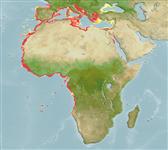
| Native range | All suitable habitat | Point map | Year 2050 |
|
| This map was computer-generated and has not yet been reviewed. |
| Torpedo torpedo AquaMaps Data sources: GBIF OBIS |
Classificação / Nomes Nomes comuns | Sinônimos | Catalog of Fishes(Gênero, Espécies) | ITIS | CoL | WoRMS | Cloffa
Elasmobranchii (tubarões e raias) (sharks and rays) > Torpediniformes (Electric rays) > Torpedinidae (Electric rays)
Etymology: Torpedo: Latin, torpere = be sluggish (Ref. 45335).
More on author: Linnaeus.
Etymology: Torpedo: Latin, torpere = be sluggish (Ref. 45335).
More on author: Linnaeus.
Meio ambiente: milieu / Zona climática / intervalo de profundidade / faixa de distribuição Ecologia
marinhas demersal; intervalo de profundidade 2 - 400 m (Ref. 4430), usually ? - 70 m (Ref. 27000). Deep-water; 48°N - 18°S, 19°W - 38°E (Ref. 114953)
Distribuição Territórios | Áreas da FAO | Ecossistemas | Ocorrências | Mapa de pontos | Introduções | Faunafri
Eastern Atlantic: southern Bay of Biscay and throughout the Mediterranean to Angola. Most common in tropical waters.
Tamanho / Peso / Idade
Maturidade: Lm ? range ? - ? cm
Max length : 60.0 cm TL macho/indeterminado; (Ref. 13417); 41.0 cm TL (female); common length : 30.0 cm TL macho/indeterminado; (Ref. 13417); common length :39 cm TL (female)
Max length : 60.0 cm TL macho/indeterminado; (Ref. 13417); 41.0 cm TL (female); common length : 30.0 cm TL macho/indeterminado; (Ref. 13417); common length :39 cm TL (female)
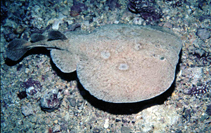
Found on soft bottoms, usually inshore but occasionally deeper. Feeds on small fishes and also benthic invertebrates. Ovoviviparous, with 3-21 in a litter (Ref. 12951, Ref. 114953). Size at birth 9 cm (Ref. 12951). Capable of inflicting a severe shock of up to 200 volts.
Ciclo de vida ou comportamento de acasalamento Maturidade | Reprodução | Desova | Ovos | Fecundidade | Larvas
Exhibit ovoviparity (aplacental viviparity), with embryos feeding initially on yolk, then receiving additional nourishment from the mother by indirect absorption of uterine fluid enriched with mucus, fat or protein through specialised structures (Ref. 50449).
Referência principal
Carregar suas referências | Referências | Coordenador : Carvalho, Marcelo | Colaboradores
Bauchot, M.-L., 1987. Raies et autres batoides. p. 845-886. In W. Fischer, M.L. Bauchot and M. Schneider (eds.) Fiches FAO d'identificationpour les besoins de la pêche. (rev. 1). Mèditerranée et mer Noire. Zone de pêche 37. Vol. II. Commission des Communautés Européennes and FAO, Rome. (Ref. 3261)
Status na Lista Vermelha da UICN (Ref. 130435: Version 2025-2 (Global))
Vulnerável (VU) (A2bd); Date assessed: 04 August 2020
CITES
Not Evaluated
Ameaça para os humanos
Other (Ref. 4690)
Uso pelos humanos
Pescarias: sem interesse; Aquário: Aquários públicos
FAO - Publication: search | FishSource |
Mais informação
Ecologia Trófica
Itens alimentares (presas)
Composição da dieta
Consumo alimentar
Rações alimentares
Predadores
Itens alimentares (presas)
Composição da dieta
Consumo alimentar
Rações alimentares
Predadores
Dinâmica populacional
Parâmetros de crescimento
Idade máxima / tamanhos
Relação comprimento-peso.
Relação comprimento-comprimento.
Frequências de comprimento
Conversão de massa
Recrutamento
Abundância
Parâmetros de crescimento
Idade máxima / tamanhos
Relação comprimento-peso.
Relação comprimento-comprimento.
Frequências de comprimento
Conversão de massa
Recrutamento
Abundância
Ciclo de vida
Reprodução
Maturidade
Maturidade/Rel. das guelras
Fecundidade
Desova
Agregações de desova
Ovos
Desenvolvimento dos ovos
Larvas
Dinâmica larval
Reprodução
Maturidade
Maturidade/Rel. das guelras
Fecundidade
Desova
Agregações de desova
Ovos
Desenvolvimento dos ovos
Larvas
Dinâmica larval
Fisiologia
Composição corporal
Nutrientes
Consumo de oxigênio
Tipo de natação
Velocidade de natação
Pigmentos visuais
Som de peixe
Doenças e Parasitas
Toxicidade (LC50s)
Composição corporal
Nutrientes
Consumo de oxigênio
Tipo de natação
Velocidade de natação
Pigmentos visuais
Som de peixe
Doenças e Parasitas
Toxicidade (LC50s)
Relacionado a humanos
Sistemas de aquicultura
Perfis para aquacultura
Estirpes
Casos de Ciguatera
Selos, moedas, diversos.
Sistemas de aquicultura
Perfis para aquacultura
Estirpes
Casos de Ciguatera
Selos, moedas, diversos.
Ferramentas
Livro eletrônico | Guia de campo | Ferramenta auxiliar de frequências de comprimento | Ferramenta sobre a história de vida | Mapa de pontos |
Catch-MSY |
Relatórios especiais
Checar Manutenção em Aquário | Checar Planilhas de Fatos sobre as Espécies | Checar Planilhas de Fatos sobre Aquicultura
Baixar XML
Fontes da internet
AFORO (otoliths) | Aquatic Commons | BHL | Cloffa | Websites from users | Checar Observador de Peixes (FishWatcher) | CISTI | Catalog of Fishes: Gênero, Espécies | DiscoverLife | DORIS | ECOTOX | FAO - Publication: search | Faunafri | Fishipedia | Fishtrace | GloBI | Google Books | Google Scholar | Google | IGFA World Record | Bases de dados nacionais | OneZoom | Open Tree of Life | Otolith Atlas of Taiwan Fishes | Aquários públicos | PubMed | Reef Life Survey | Socotra Atlas | TreeBase | Árvore da vida | Wikipedia: Ir para, procura | World Records Freshwater Fishing | Registro zoológico
Estimativas baseadas em modelos
Temperatura preferida (Ref. 123201): 13 - 20.9, mean 15.6 °C (based on 78 cells).
Índice de diversidade filogenética (Ref. 82804): PD50 = 0.5005 [Uniqueness, from 0.5 = low to 2.0 = high].
Bayesian length-weight: a=0.01549 (0.01193 - 0.02010), b=2.95 (2.87 - 3.03), in cm total length, based on LWR estimates for this species (Ref. 93245).
Nível Trófico (Ref. 69278): 4.5 ±0.0 se; based on diet studies.
Generation time: 10.0 ( na - na) years. Estimated as median ln(3)/K based on 1 growth studies.
Resiliência (Ref. 120179): Baixo, tempo mínimo de duplicação da população 4,5 - 14 anos (K=0.11).
Nutrientes (Ref. 124155): Calcium = 9.24 [1.57, 48.04] mg/100g; Iron = 0.362 [0.085, 1.136] mg/100g; Protein = 17.3 [12.8, 20.6] %; Omega3 = 0.419 [0.157, 0.972] g/100g; Selenium = 9.34 [2.94, 27.66] μg/100g; VitaminA = 20 [4, 94] μg/100g; Zinc = 0.311 [0.151, 0.581] mg/100g (wet weight);