



Oreochromis karongae (Trewavas, 1941)
Karonga tilapia
Sube tu fotos y Vídeos
Imágenes | Google image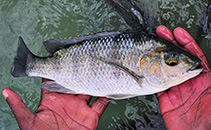 Oreochromis karongae
Foto de Ueberschär, B.
Imágenes | Google image
Foto de Ueberschär, B.
Clasificación / Nombres Nombres comunes | Sinónimos | Catalog of Fishes(Género, Especie) | ITIS | CoL | WoRMS | Cloffa
> Cichliformes (Cichlids, convict blennies) > Cichlidae (Cichlids) > Pseudocrenilabrinae
Etymology: Oreochromis: Latin, aurum = gold + Greek, chromis = a fish, perhaps a perch (Ref. 45335).
More on author: Trewavas.
Etymology: Oreochromis: Latin, aurum = gold + Greek, chromis = a fish, perhaps a perch (Ref. 45335).
More on author: Trewavas.
Taxonomic Remarks
Turner and Robinson (1991) (Ref. 55079) conclude that Oreochromis saka is a junior synonym of O. karongae (also Ref. 6150), although Turner et al. (1989) (Ref. 40180) reported O. squamipinnis to be most similar to O. saka and O. karongae the most divergent (Ref. 55954).
Entorno: milieu / zona climática / rango de profundidad / gama de distribución Ecología
; agua dulce bentopelágico; rango de profundidad 0 - 50 m (Ref. 118638), usually 0 - 10 m (Ref. 5595). Tropical; 22°C - 28°C; 8°S - 15°S
Distribución Territorios | Áreas FAO | Ecosistemas | Ocurrencias, apariciones | Mapa de puntos | Introducciones | Faunafri
Africa: Lake Malawi and its catchment (Ref. 2, 5166, 118630, 118638), including crater lake Itamba and Ikapu (Ref. 118638).
Longitud en la primera madurez / Tamaño / Peso / Edad
Madurez: Lm 28.9, range 20 - 38 cm
Max length : 42.0 cm TL macho / no sexado; (Ref. 6150); 38.0 cm SL (female)
Max length : 42.0 cm TL macho / no sexado; (Ref. 6150); 38.0 cm SL (female)
Descripción breve Claves de identificación | Morfología | Morfometría
Espinas dorsales (total) : 15 - 17; Radios blandos dorsales (total) : 10 - 12; Espinas anales: 3; Radios blandos anales: 8 - 10; Vértebra: 30 - 32. Diagnosis: A heavily-built large tilapia species with a wide rounded head and short jaws; individuals vary a lot in dentition, with some having very wide bands of jaw teeth (Ref. 118638). Head length 30.8-36.0% of standard length; lower pharyngeal with large toothed area with straight or slightly convex sides; median length of pharyngeal bone 1.14-1.32 times its width and 38.2-42.2% of head length; blade 1.0-1.7 times median length of toothed area; length of lower jaw 28.4-34.5% of head length; teeth of jaws in 4-6 rows (Ref. 2). Females and juveniles with greyish-brown bodies and 4-5 vertical bars (Ref. 118638). Males are black with a white margin to the dorsal and tailfins; the genital tassel can be long and branched and pinkish to bright yellow (Ref. 2, 118638). It is one of the 'chambo' group Oreochromis from the Lake Malawi catchment; females and non-territorial males cannot be reliably distinguished from those of Oreochromis squamipinnis; females and non-territorial males from Lake Ikapu are a bright golden colour (Ref. 118638).
Body shape (shape guide): fusiform / normal; Cross section: compressed.
Body shape (shape guide): fusiform / normal; Cross section: compressed.
It is found in all kinds of habitats; it has been observed in shallow vegetated bays, in intermediate habitats, over sand, and in purely rocky biotopes (Ref. 5595). At most locations it is found at shallow levels, rarely deeper than 10 metres (Ref. 5595), but it can be present from the surface waters to depths of 40-50m (Ref. 118638). It feeds on phytoplankton and on diatom sediment on the sand; the so-called 'multitooth' morph at Cape Maclear grazes from rocks and might harvest the loose aufwuchs (Ref. 5595). A maternal mouthbrooder; males defend territories from shallow water down to at least 28m; males dig pits, which are sometimes huge craters with a small raised platform of fine sand (Ref. 118638). It is an important component of the fisheries catch in Lake Malawi (Ref. 118638). The IUCN conservation status is rated as endangered, based on declining fishery catches due to overfishing (Ref. 118638).
Ciclo vital y comportamiento de apareamiento Madurez | Reproducción | Puesta | Huevos | Fecundidad | Larva
A maternal mouthbrooder; males defend territories from shallow water down to at least 28m; males dig pits, which are sometimes huge craters with a small raised platform of fine sand (Ref. 118638). Breeding period extends over several months as noted in Lake Malombe, at present one of the main breeding areas for this species (Ref. 6150). Males build nests on a variety of substrata and at depths of 0.5m to at least 28m; nests generally 0.3-1.9m diameter, with dimensions correlated to male size (Ref. 55079). Nest with a characteristic spawning cone in its center (Ref. 5595). Courtship appears to occur mainly in the early morning (Ref. 40193, 55079), and consist of leading, followed by tilting and head-down quivering if the female follows the male to the nest (Ref. 40193). A female with 324 young of 15mm long in the mouth has been caught (Ref. 2781). Females keep guarding their fry until they are about 24 mm (Ref. 2781, 6150).
Referencia principal
Suba sus referencias | Referencias | Coordinador : Kullander, Sven O. | Colaboradores
Trewavas, E. and G.G. Teugels, 1991. Oreochromis. p. 307-346. In J. Daget, J.-P. Gosse, G.G. Teugels and D.F.E. Thys van den Audenaerde (eds.) Checklist of the freshwater fishes of Africa (CLOFFA). ISNB, Brussels; MRAC, Tervuren; and ORSTOM, Paris. Vol. 4. (Ref. 5166)
Situación en la Lista Roja de la UICN (Ref. 130435: Version 2025-2 (Global))
Critically Endangered (CR) (A2d); Date assessed: 22 May 2018
CITES
Not Evaluated
Amenaza para el ser humano
Harmless
Usos humanos
Pesquerías: comercial
FAO - Publication: search | FishSource |
Más información
Ecología Trófica
Alimentos (presas)
Composición de la dieta
consumo de alimento
Raciones de comida
Despredadores
Alimentos (presas)
Composición de la dieta
consumo de alimento
Raciones de comida
Despredadores
Dinámica de la población
Coeficiente del crecimiento para
Edades / tallas máximas
Longitud-peso rel.
Longitud-longitud rel.
Longitud-frecuencias
Conversión de masas
Reclutamiento
Abundancia
Coeficiente del crecimiento para
Edades / tallas máximas
Longitud-peso rel.
Longitud-longitud rel.
Longitud-frecuencias
Conversión de masas
Reclutamiento
Abundancia
Ciclo de vida
Reproducción
Madurez
Madurez/Gills rel.
Fecundidad
Puesta
Agregaciones de desove
Huevos
Desarrollo de los huevos
Larva
Dinámica larvaria
Reproducción
Madurez
Madurez/Gills rel.
Fecundidad
Puesta
Agregaciones de desove
Huevos
Desarrollo de los huevos
Larva
Dinámica larvaria
Distribución
Territorios
Áreas FAO
Ecosistemas
Ocurrencias, apariciones
Introducciones
BRUVS - Vídeos
Territorios
Áreas FAO
Ecosistemas
Ocurrencias, apariciones
Introducciones
BRUVS - Vídeos
Anatomía
Superficie branquial
Cerebro
Otolito
Superficie branquial
Cerebro
Otolito
Fisiología
Composición corporal
Nutrientes
Consumo del oxígeno
Tipo de natación
Velocidad de natación
Pigmentos visuales
Sonido de peces
Enfermedades y parásitos
Toxicidad (CL50)
Composición corporal
Nutrientes
Consumo del oxígeno
Tipo de natación
Velocidad de natación
Pigmentos visuales
Sonido de peces
Enfermedades y parásitos
Toxicidad (CL50)
Genética
Genoma
Genética
Heterocigosidad
heritabilidad
Diversidad genética
Genoma
Genética
Heterocigosidad
heritabilidad
Diversidad genética
Relacionados con el ser humano
Sistemas de acuicultura
Perfiles de acuicultura
Razas
Ciguatera cases
Sellos, monedas, varios
Sistemas de acuicultura
Perfiles de acuicultura
Razas
Ciguatera cases
Sellos, monedas, varios
Herramientas
Libro electrónico | Guía de campo | Asistente para frecuencias de tallas | Herramienta de ciclo de vida | Mapa de puntos |
Catch-MSY |
Informes especiales
Comprobar el mantenimiento del acuario | Buscar fichas sobre especies | Consulte las hojas informativas sobre acuicultura
Descargar XML
Fuentes de Internet
AFORO (otoliths) | Alien/Invasive Species database | Aquatic Commons | BHL | Cloffa | Websites from users | Check FishWatcher | CISTI | Catalog of Fishes: Género, Especie | DiscoverLife | ECOTOX | FAO - Publication: search | Faunafri | Fishipedia | Fishtrace | GloBI | Google Books | Google Scholar | Google | IGFA World Record | OneZoom | Open Tree of Life | Otolith Atlas of Taiwan Fishes | PubMed | Reef Life Survey | Socotra Atlas | TreeBase | Árbol de la vida | Wikipedia: Go, búsqueda | World Records Freshwater Fishing | Expediente Zoológico
Estimaciones basadas en modelos
Índice de diversidad filogenética (Referencia 82804): PD50 = 0.5000 [Uniqueness, from 0.5 = low to 2.0 = high].
Bayesian length-weight: a=0.01202 (0.00690 - 0.02094), b=2.97 (2.83 - 3.11), in cm total length, based on LWR estimates for this species & Genus-body shape (Ref. 93245).
Nivel trófico (Referencia 69278): 2.0 ±0.00 se; based on food items.
Resiliencia (Referencia 120179): Medio, población duplicada en un tiempo mínimo de 1.4-4.4 años (K=0.24-0.56).
Nutrientes (Ref. 124155): Calcium = 14 [6, 73] mg/100g; Iron = 1.21 [0.54, 2.88] mg/100g; Protein = 17.9 [16.2, 19.7] %; Omega3 = 0.387 [0.134, 1.079] g/100g; Selenium = 85 [31, 197] μg/100g; VitaminA = 19.7 [4.5, 81.8] μg/100g; Zinc = 2.06 [1.13, 4.89] mg/100g (wet weight);