



Oreochromis karongae (Trewavas, 1941)
Karonga tilapia
Uploaden van uw Foto's en video's
Afbeeldingen | Google afbeelding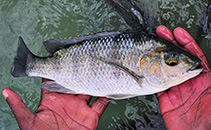 Oreochromis karongae
Afbeelding van Ueberschär, B.
Afbeeldingen | Google afbeelding
Afbeelding van Ueberschär, B.
Classificatie / Namen Lokale namen | Synoniemen | Catalog of Fishes(Genus, Soort(en)) | ITIS | CoL | WoRMS | Cloffa
> Cichliformes (Cichlids, convict blennies) > Cichlidae (Cichlids) > Pseudocrenilabrinae
Etymology: Oreochromis: Latin, aurum = gold + Greek, chromis = a fish, perhaps a perch (Ref. 45335).
More on author: Trewavas.
Etymology: Oreochromis: Latin, aurum = gold + Greek, chromis = a fish, perhaps a perch (Ref. 45335).
More on author: Trewavas.
Taxonomic Remarks
Turner and Robinson (1991) (Ref. 55079) conclude that Oreochromis saka is a junior synonym of O. karongae (also Ref. 6150), although Turner et al. (1989) (Ref. 40180) reported O. squamipinnis to be most similar to O. saka and O. karongae the most divergent (Ref. 55954).
Milieu: milieu / Klimaatzone / Diepte / verspreidingsgebied Ecologie
; zoet water benthopelagisch; diepte 0 - 50 m (Ref. 118638), usually 0 - 10 m (Ref. 5595). Tropical; 22°C - 28°C; 8°S - 15°S
Verspreiding Gebieden | FAO regio's | Ecosystemen | Voorkomen | Verspreidingskaart | Introducties | Faunafri
Africa: Lake Malawi and its catchment (Ref. 2, 5166, 118630, 118638), including crater lake Itamba and Ikapu (Ref. 118638).
Lengte bij maturiteit / Grootte / Gewicht / Leeftijd
Maturiteit: Lm 28.9, range 20 - 38 cm
Max length : 42.0 cm TL mannelijk / geslacht onbekend; (Ref. 6150); 38.0 cm SL (female)
Max length : 42.0 cm TL mannelijk / geslacht onbekend; (Ref. 6150); 38.0 cm SL (female)
Korte beschrijving Determinatiesleutels | Morfologie | Morfometrie
Dorsale stekels (totaal) : 15 - 17; Dorsale zachte stralen (totaal) : 10 - 12; Anale stekels: 3; Anale zachte stralen: 8 - 10; Wervels: 30 - 32. Diagnosis: A heavily-built large tilapia species with a wide rounded head and short jaws; individuals vary a lot in dentition, with some having very wide bands of jaw teeth (Ref. 118638). Head length 30.8-36.0% of standard length; lower pharyngeal with large toothed area with straight or slightly convex sides; median length of pharyngeal bone 1.14-1.32 times its width and 38.2-42.2% of head length; blade 1.0-1.7 times median length of toothed area; length of lower jaw 28.4-34.5% of head length; teeth of jaws in 4-6 rows (Ref. 2). Females and juveniles with greyish-brown bodies and 4-5 vertical bars (Ref. 118638). Males are black with a white margin to the dorsal and tailfins; the genital tassel can be long and branched and pinkish to bright yellow (Ref. 2, 118638). It is one of the 'chambo' group Oreochromis from the Lake Malawi catchment; females and non-territorial males cannot be reliably distinguished from those of Oreochromis squamipinnis; females and non-territorial males from Lake Ikapu are a bright golden colour (Ref. 118638).
Body shape (shape guide): fusiform / normal; Cross section: compressed.
Body shape (shape guide): fusiform / normal; Cross section: compressed.
It is found in all kinds of habitats; it has been observed in shallow vegetated bays, in intermediate habitats, over sand, and in purely rocky biotopes (Ref. 5595). At most locations it is found at shallow levels, rarely deeper than 10 metres (Ref. 5595), but it can be present from the surface waters to depths of 40-50m (Ref. 118638). It feeds on phytoplankton and on diatom sediment on the sand; the so-called 'multitooth' morph at Cape Maclear grazes from rocks and might harvest the loose aufwuchs (Ref. 5595). A maternal mouthbrooder; males defend territories from shallow water down to at least 28m; males dig pits, which are sometimes huge craters with a small raised platform of fine sand (Ref. 118638). It is an important component of the fisheries catch in Lake Malawi (Ref. 118638). The IUCN conservation status is rated as endangered, based on declining fishery catches due to overfishing (Ref. 118638).
Levenscyclus en paargedrag Maturiteit | Voortplanting | Paaien | Eieren | Fecunditeit | Larven
A maternal mouthbrooder; males defend territories from shallow water down to at least 28m; males dig pits, which are sometimes huge craters with a small raised platform of fine sand (Ref. 118638). Breeding period extends over several months as noted in Lake Malombe, at present one of the main breeding areas for this species (Ref. 6150). Males build nests on a variety of substrata and at depths of 0.5m to at least 28m; nests generally 0.3-1.9m diameter, with dimensions correlated to male size (Ref. 55079). Nest with a characteristic spawning cone in its center (Ref. 5595). Courtship appears to occur mainly in the early morning (Ref. 40193, 55079), and consist of leading, followed by tilting and head-down quivering if the female follows the male to the nest (Ref. 40193). A female with 324 young of 15mm long in the mouth has been caught (Ref. 2781). Females keep guarding their fry until they are about 24 mm (Ref. 2781, 6150).
Hoofdreferentie
Upload uw referenties | Referenties | Coördinator : Kullander, Sven O. | Medewerkers
Trewavas, E. and G.G. Teugels, 1991. Oreochromis. p. 307-346. In J. Daget, J.-P. Gosse, G.G. Teugels and D.F.E. Thys van den Audenaerde (eds.) Checklist of the freshwater fishes of Africa (CLOFFA). ISNB, Brussels; MRAC, Tervuren; and ORSTOM, Paris. Vol. 4. (Ref. 5166)
Status op de Rode Lijst van het IUCN (Ref. 130435: Version 2025-2 (Global))
Ernstig bedreigd (CR) (A2d); Date assessed: 22 May 2018
CITES
Not Evaluated
Gevaar voor de mens
Harmless
Gebruik door de mens
Visserij: commercieel
FAO - Publication: search | FishSource |
Meer informatie
Trofische ecologie
Voedsel (prooien)
Dieetsamenstelling
Voedselconsumptie
Voedselrantsoenen
Predatoren
Voedsel (prooien)
Dieetsamenstelling
Voedselconsumptie
Voedselrantsoenen
Predatoren
Populatiedynamica
Groeiparameters
Max. leeftijden / maten
Lengte-gewicht rel.
Lengte-lengte rel.
Lengtefrequenties
Massaconversie
Rekrutering
Abundantie
Groeiparameters
Max. leeftijden / maten
Lengte-gewicht rel.
Lengte-lengte rel.
Lengtefrequenties
Massaconversie
Rekrutering
Abundantie
Levenscyclus
Voortplanting
Maturiteit
Rijpheid/kieuwen rel.
Fecunditeit
Paaien
Paaibestanden
Eieren
Ontwikkeling van de eieren
Larven
Larvale populatiedynamiek
Voortplanting
Maturiteit
Rijpheid/kieuwen rel.
Fecunditeit
Paaien
Paaibestanden
Eieren
Ontwikkeling van de eieren
Larven
Larvale populatiedynamiek
Anatomie
Kieuwoppervlak
Hersenen
Otoliet
Kieuwoppervlak
Hersenen
Otoliet
Fysiologie
Lichaamssamenstelling
Voedingsstoffen
Zuurstofverbruik
Type zwemmen
Zwemsnelheid
Visuele pigmenten
Vis geluid
Ziekten en parasieten
Toxiciteit (LC50)
Lichaamssamenstelling
Voedingsstoffen
Zuurstofverbruik
Type zwemmen
Zwemsnelheid
Visuele pigmenten
Vis geluid
Ziekten en parasieten
Toxiciteit (LC50)
Genetica
genoom
Genetica
Heterozygositeit
Erfelijkheid
Genetische diversiteit
genoom
Genetica
Heterozygositeit
Erfelijkheid
Genetische diversiteit
Menselijk gerelateerd
Aquacultuursystemen
Aquacultuurprofielen
Kweeklijnen
Ciguatera gevallen
Postzegels, munten, diversen.
Aquacultuursystemen
Aquacultuurprofielen
Kweeklijnen
Ciguatera gevallen
Postzegels, munten, diversen.
Tools
Speciale rapporten
Bekijk gegevens voor het houden in een aquarium | Bekijk Fact Sheets voor de soort | Bekijk Aquacultuur Fact Sheets
Download XML
Internetbronnen
AFORO (otoliths) | Exoten/Invasieve soorten database | Aquatic Commons | BHL | Cloffa | Websites from users | Bekijk FishWatcher | CISTI | Catalog of Fishes: Genus, Soort(en) | DiscoverLife | ECOTOX | FAO - Publication: search | Faunafri | Fishipedia | Fishtrace | GloBI | Google Books | Google Scholar | Google | IGFA World Record | OneZoom | Open Tree of Life | Otolith Atlas of Taiwan Fishes | PubMed | Reef Life Survey | Socotra Atlas | TreeBase | Tree of Life | Wikipedia: ga naar, zoek | World Records Freshwater Fishing | Zoological Record
Schattingen op basis van modellen
Fylogenetische diversiteitsindex (Ref. 82804): PD50 = 0.5000 [Uniqueness, from 0.5 = low to 2.0 = high].
Bayesian length-weight: a=0.01202 (0.00690 - 0.02094), b=2.97 (2.83 - 3.11), in cm total length, based on LWR estimates for this species & Genus-body shape (Ref. 93245).
Trofisch niveau (Ref. 69278): 2.0 ±0.00 se; based on food items.
Weerstandsvermogen (Ref. 120179): Gemiddeld, minimale populatieverdubbelingstijd 1,4-4,4 jaar (K=0.24-0.56).
Voedingsstoffen (Ref. 124155): Calcium = 14 [6, 73] mg/100g; Iron = 1.21 [0.54, 2.88] mg/100g; Protein = 17.9 [16.2, 19.7] %; Omega3 = 0.387 [0.134, 1.079] g/100g; Selenium = 85 [31, 197] μg/100g; VitaminA = 19.7 [4.5, 81.8] μg/100g; Zinc = 2.06 [1.13, 4.89] mg/100g (wet weight);