This website uses cookies to enhance your browsing experience and ensure the functionality of our site. For more detailed information about the types of cookies we use and how we protect your privacy, please visit our Privacy Information page.
×
Cookie Settings
This website uses different types of cookies to enhance your experience. Please select your preferences below:
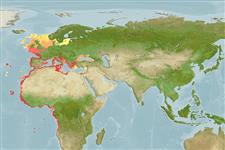
Eastern Atlantic: Norway to Angola, including the Canary Islands, Cape Verde, and the Sao Tome-Principe Islands. Common from Bay of Biscay to Gibraltar (Ref. 4781). Also found in the Mediterranean and the Black Sea.
Längd vid första mognad / Storlek / Vikt / Ålder
Könsmognad: Lm13.6 range ? - ? cm Max length : 40.0 cm TL hane/ej könsbestämd; (Ref. 115876); common length : 20.0 cm TL hane/ej könsbestämd; (Ref. 3397); publicerad maxvikt: 455.00 g (Ref. 115876); rapporterad maxålder: 11 år (Ref. 58974)
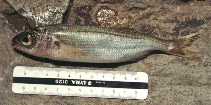
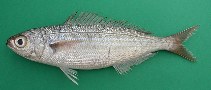
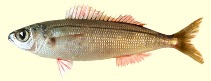
Taggstrålar i ryggfenan (totalt) : 13 - 15; Mjukstrålar i ryggfenan (totalt) : 12 - 16; Taggstrålar i analfenan: 3; Mjukstrålar i analfenan: 14 - 16. Body slender, with 3 - 5 weak, golden longitudinal stripes and a black spot at the pectoral fin base (Ref. 35388). Body shape (shape guide): fusiform / normal.
Found on the shelf or coastal pelagic on various bottoms (sand, mud, rocks and seaweeds). Gregarious, ascending to the surface mainly at night. Omnivorous, feeding mainly on crustaceans, also planktophagous. Hermaphroditic, generally protogynous. Also caught in pelagic trawls (Ref. 9987). Utilized fresh and frozen; consumed pan-fried, broiled and baked (Ref. 9987).
Conflicting descriptions of the reproductive style of this species have been reported, Ref. 34225 describe this species as being a gonochorist (Ref. 28504). Also Ref. 32206, 103751.
Bauchot, M.-L. and J.-C. Hureau, 1990. Sparidae. p. 790-812. In J.C. Quero, J.C. Hureau, C. Karrer, A. Post and L. Saldanha (eds.) Check-list of the fishes of the eastern tropical Atlantic (CLOFETA). JNICT, Lisbon; SEI, Paris; and UNESCO, Paris. Vol. 2. (Ref. 3688)
Status på IUCN:s rödlista (Ref. 130435: Version 2025-2 (Global))