



Lethrinus xanthochilus Klunzinger, 1870
Yellowlip emperor
Adicionar as suas observações no Fish Watcher
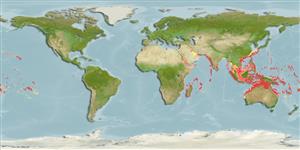
| Native range | All suitable habitat | Point map | Year 2050 |
|
| This map was computer-generated and has not yet been reviewed. |
| Lethrinus xanthochilus AquaMaps Data sources: GBIF OBIS |
Adicionar o seu Fotografias e vídeos
Fotografias | vídeos | Imagem do Google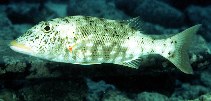 Lethrinus xanthochilus
Fotografia de Randall, J.E.
Fotografias | vídeos | Imagem do Google
Fotografia de Randall, J.E.
Classificação / Nomes Nomes comuns | Sinónimos | Catalog of Fishes(Género, Espécies) | ITIS | CoL | WoRMS | Cloffa
> Eupercaria/misc (Various families in series Eupercaria) > Lethrinidae (Emperors or scavengers) > Lethrininae
Etymology: Lethrinus: Greek, lethrinia, a fish pertaining to genus Pagellus.
More on author: Klunzinger.
Etymology: Lethrinus: Greek, lethrinia, a fish pertaining to genus Pagellus.
More on author: Klunzinger.
Ambiente: milieu / zona climática / intervalo de profundidade / gama de distribuição Ecologia
marinhas associadas(os) a recifes; não migratória; intervalo de profundidade 0 - 150 m (Ref. 2295). Tropical; 31°N - 28°S, 30°E - 134°W
Distribuição Territórios | Áreas FAO | Ecossistemas | Ocorrências | Mapa dos pontos | Introduções | Faunafri
Indo-Pacific: Red Sea, East Africa and the central Indian Ocean to the Marquesas Islands, north to the Ryukyu Islands.
Tamanho / Peso / Idade
Maturidade: Lm ? range ? - ? cm
Max length : 70.0 cm FL macho/indeterminado; (Ref. 40637); common length : 59.0 cm SL macho/indeterminado; (Ref. 37816); peso máx. Publicado: 5.4 kg (Ref. 40637)
Max length : 70.0 cm FL macho/indeterminado; (Ref. 40637); common length : 59.0 cm SL macho/indeterminado; (Ref. 37816); peso máx. Publicado: 5.4 kg (Ref. 40637)
Descrição breve Chaves de identificação | Morfologia | Morfometria
Espinhos dorsais (total) : 10; Raios dorsais moles (total) : 9; Espinhos anais: 3; Raios anais moles: 8. This species is distinguished by the following characters: body moderately elongate, its depth 2.8-3.5 times in standard length; head length 1-1.2 times in body depth, 2.6-3 times in SL, dorsal profile near eye convex; snout length about 1.7-2.5 times in HL, measured without the lip the snout is 0.8-0.9 times in cheek height, its dorsal profile nearly straight, snout angle relative to upper jaw between 45° and 60°; interorbital space distinctly concave; posterior nostril a longitudinal or vertical oblong opening, closer to orbit than anterior nostril; eye situated close to dorsal profile, its length 2.8-5.1 times in HL; cheek height 2.3-3.4 times in HL; lateral teeth in jaws conical; outer surface of maxilla smooth; D X, 9 with the third dorsal-fin spine the longest, its length 2-2.8 times in body depth; A III, 8 with the first soft ray usually the longest, its length approximately equal to or shorter than length of base of soft-rayed portion of anal fin and 1.3-1.7 times in length of entire anal-fin base; pectoral-fin rays 13; pelvic-fin membranes between rays closest to body with dense melanophores; cheek without scales; 47-48 lateral-line scales; 4 ½ scale rows between lateral line and base of middle dorsal-fin spines; 15-16 scale rows in transverse series between origin of anal fin and lateral line; usually 15 rows in lower series of scales around caudal peduncle; 5-8 scales in supratemporal patch; inner surface of pectoral fins without scales; posterior angle of operculum fully scaly. Colour of body yellowish grey with scattered irregular dark spots; lips yellowish, upper lip more intense; a red spot at upper base of pectoral fins; fins bluish grey and mottled, bases of fins lighter and edges of dorsal and caudal fins reddish (Ref. 114226).
Body shape (shape guide): fusiform / normal; Cross section: oval.
Body shape (shape guide): fusiform / normal; Cross section: oval.
Occurs in small groups over seagrass beds, sand and rubble areas of coral reefs, deep channels, and lagoons. Usually found in shallow water to depths of 150 m. Usually seen solitary but sometimes swims in small groups. Juveniles in seagrass beds (Ref. 48635). Feeds mainly on crustaceans, fishes, and echinoderms. Caught mostly with handline, traps,
and trawl (Ref. 114226). Minimum depth reported taken from Ref. 128797.
Ciclo de vida e comportamento de acasalamento Maturidade | Reprodução | Desova | Ovos | Fecundidade | Larvas
Referência principal
Carregar as suas referências | Referências | Coordenador | Colaboradores
Carpenter, K.E. and G.R. Allen, 1989. FAO Species Catalogue. Vol. 9. Emperor fishes and large-eye breams of the world (family Lethrinidae). An annotated and illustrated catalogue of lethrinid species known to date. FAO Fish. Synop. 125(9):118 p. Rome: FAO. (Ref. 2295)
Categoria na Lista Vermelha da IUCN (Ref. 130435: Version 2025-2 (Global))
Preocupação menor (LC) ; Date assessed: 09 March 2015
CITES
Not Evaluated
Ameaça para o homem
Reports of ciguatera poisoning (Ref. 130160)
Utilização humana
Pescarias: espécies comerciais; peixe desportivo: sim
FAO - pescarias: desembarques; Publication: search | FishSource | Sea Around Us
Mais informação
Ecologia Trófica
Produtos alimentares (presas)
Composição da dieta
Consumo alimentar
Rações alimentares
Predadores
Produtos alimentares (presas)
Composição da dieta
Consumo alimentar
Rações alimentares
Predadores
Dinâmica das populações
Parâmetros de crescimento
Idades / tamanhos máximos
Comprimento-peso rel.
Comprimento-comprimento rel.
Frequência de comprimento
Conversão de massa
Recrutamento
Abundância
Parâmetros de crescimento
Idades / tamanhos máximos
Comprimento-peso rel.
Comprimento-comprimento rel.
Frequência de comprimento
Conversão de massa
Recrutamento
Abundância
Ciclo de vida
Reprodução
Maturidade
Maturidade/Rel. das guelras
Fecundidade
Desova
Agregações de desova
Ovos
Desenvolvimento dos ovos
Larvas
Dinâmica larvar
Reprodução
Maturidade
Maturidade/Rel. das guelras
Fecundidade
Desova
Agregações de desova
Ovos
Desenvolvimento dos ovos
Larvas
Dinâmica larvar
Fisiologia
Composição corporal
Nutrientes
Consumo de oxigénio
Tipo de natação
Velocidade de natação
Pigmentos visuais
Som de peixe
Doenças e Parasitas
Toxicidade (LC50s)
Composição corporal
Nutrientes
Consumo de oxigénio
Tipo de natação
Velocidade de natação
Pigmentos visuais
Som de peixe
Doenças e Parasitas
Toxicidade (LC50s)
Genética
genoma
Genética
Heterozigotia
Hereditariedade
Diversidade genética
genoma
Genética
Heterozigotia
Hereditariedade
Diversidade genética
Relacionado com o ser humano
Sistemas de aquacultura
Perfis para aquacultura
Estirpes
Casos de Ciguatera
Selos, moedas, diversos.
Sistemas de aquacultura
Perfis para aquacultura
Estirpes
Casos de Ciguatera
Selos, moedas, diversos.
Ferramentas
Questionário orgânico | E-book | Guia de campo | Chaves de identificação | Ferramenta auxiliar de frequências de comprimento | Ferramenta sobre a história de vida | Mapa dos pontos |
Captura-MSY |
Relatórios especiais
Descarregue XML
Fontes da internet
AFORO (otoliths) | Aquatic Commons | BHL | Cloffa | Websites from users | Consultar FishWatcher | CISTI | Catalog of Fishes: Género, Espécies | DiscoverLife | ECOTOX | FAO - pescarias: desembarques; Publication: search | Faunafri | Fishipedia | Fishtrace | GloBI | Google Books | Google Scholar | Google | IGFA World Record | Bases de dados nacionais | OneZoom | Open Tree of Life | Otolith Atlas of Taiwan Fishes | PubMed | Reef Life Survey | Socotra Atlas | TreeBase | Árvore da vida | Wikipedia: ir para, procurar | World Records Freshwater Fishing | Zoobank | Registo zoológico
Estimativas baseadas em modelos
Temperatura preferida (Ref. 123201): 24.5 - 29, mean 27.9 °C (based on 1520 cells).
Índice de diversidade filogenética (Ref. 82804): PD50 = 0.5000 [Uniqueness, from 0.5 = low to 2.0 = high].
Bayesian length-weight: a=0.01514 (0.01006 - 0.02277), b=2.96 (2.84 - 3.08), in cm total length, based on LWR estimates for this species & Genus-body shape (Ref. 93245).
Nível Trófico (Ref. 69278): 3.8 ±0.0 se; based on diet studies.
Resiliência (Ref. 120179): Baixo, tempo mínimo de duplicação da população 4,5 - 14 anos (K=0.14-0.30).
Prior r = 0.33, 95% CL = 0.22 - 0.49, Based on 2 data-limited stock assessments.
Nutrientes (Ref. 124155): Calcium = 30.6 [21.9, 41.4] mg/100g; Iron = 0.718 [0.493, 0.992] mg/100g; Protein = 20.2 [17.5, 22.3] %; Omega3 = 0.133 [0.100, 0.174] g/100g; Selenium = 55.2 [30.8, 81.2] μg/100g; VitaminA = 28.6 [6.3, 148.6] μg/100g; Zinc = 1.88 [1.47, 2.31] mg/100g (wet weight); based on nutrient studies.