Lutjanus synagris, Lane snapper : fisheries, gamefish, aquarium

Lutjanus synagris (Linnaeus, 1758)

Lane snapper
Waarneming toevoegen in Fish Watcher
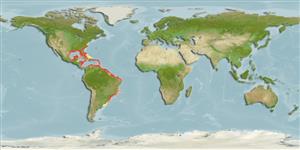
Native range | All suitable habitat | Point map | Year 2050
This map was computer-generated and has not yet been reviewed.
Lutjanus synagris   AquaMaps   Data sources: GBIF OBIS
Uploaden van uw Foto's en video's
Afbeeldingen | video's | Geluiden | Google afbeelding

Classificatie / Namen Lokale namen | Synoniemen | Catalog of Fishes(Genus, Soort(en)) | ITIS | CoL | WoRMS | Cloffa

> Eupercaria/misc (Various families in series Eupercaria) > Lutjanidae (Snappers) > Lutjaninae
Etymology: Lutjanus: Malay, ikan lutjan, name of a fish.
More on author: Linnaeus.

Milieu: milieu / Klimaatzone / Diepte / verspreidingsgebied Ecologie

marien rifbewoner; diepte 10 - 400 m (Ref. 9626), usually 21 - 70 m (Ref. 9626). Subtropical; 38°N - 38°S, 98°W - 31°W (Ref. 55253)

Verspreiding Gebieden | FAO regio's | Ecosystemen | Voorkomen | Verspreidingskaart | Introducties | Faunafri

Western Atlantic: Bermuda (Anderson, pers. comm.) and North Carolina, USA to southeastern Brazil, including Gulf of Mexico and Caribbean Sea (Ref. 9626). Most abundant around the Antilles, on the Campeche Bank, off Panama and the northern coast of South America. Lutjanus ambiguus (Poey, 1860), an intergeneric hybrid with Ocyurus chrysurus (Bloch) as demonstrated by Loftus (1992: Ref. 33006), followed by McEachran &. Fechhelm (2005: Ref. 78464).

Lengte bij maturiteit / Grootte / Gewicht / Leeftijd

Maturiteit: Lm 23.4, range 16 - 21.5 cm
Max length : 60.0 cm TL mannelijk / geslacht onbekend; (Ref. 40637); common length : 25.0 cm TL mannelijk / geslacht onbekend; (Ref. 55); max. gepubliceerd gewicht: 3.5 kg (Ref. 40637); max. gerapporteerde leeftijd: 10 Jaren (Ref. 3090)

Korte beschrijving Determinatiesleutels | Morfologie | Morfometrie

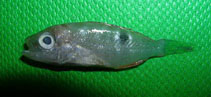
Dorsale stekels (totaal) : 10; Dorsale zachte stralen (totaal) : 12 - 13; Anale stekels: 3; Anale zachte stralen: 8 - 9. Preopercular notch and knob weak. Pectoral fins short, not reaching level of anus. Scale rows on back rising obliquely above lateral line. Back and upper side pink to reddish, with a green tinge and diffused darker vertical bars. The lower sides and belly silvery with a yellow tinge. A series of 8 - 10 horizontal yellow or golden stripes on sides. A diffused black spot mainly above the lateral line and below the anterior portion of the soft dorsal-fin rays.
Body shape (shape guide): fusiform / normal; Cross section: oval.

Biologie     Verklarende woordenlijst (bv. epibenthic)

Adults are found over all types of bottom, but mainly around coral reefs and on vegetated sandy areas. In turbid as well as clear water (Ref. 9710). They often form large aggregations, especially during the breeding season. Feed at night on small fishes, bottom-living crabs, shrimps, worms, gastropods and cephalopods. Good food fish, it is marketed fresh.

Levenscyclus en paargedrag Maturiteit | Voortplanting | Paaien | Eieren | Fecunditeit | Larven

Often form large aggregations, especially during the breeding season.

Hoofdreferentie Upload uw referenties | Referenties | Coördinator | Medewerkers

Allen, G.R., 1985. FAO Species Catalogue. Vol. 6. Snappers of the world. An annotated and illustrated catalogue of lutjanid species known to date. FAO Fish. Synop. 125(6):208 p. Rome: FAO. (Ref. 55)

Status op de Rode Lijst van het IUCN (Ref. 130435: Version 2025-2 (Global))

  Gevoelig (NT) ; Date assessed: 10 October 2015

CITES

Not Evaluated

CMS (Ref. 116361)

Not Evaluated

Gevaar voor de mens

  Reports of ciguatera poisoning (Ref. 30303)


Gebruik door de mens

Visserij: commercieel; sportvis: ja; Aquarium: Publieke aquaria
FAO - visserij: aanvoer; Publication: search | FishSource | Sea Around Us

Meer informatie

Levenscyclus
Voortplanting
Maturiteit
Rijpheid/kieuwen rel.
Fecunditeit
Paaien
Paaibestanden
Eieren
Ontwikkeling van de eieren
Larven
Larvale populatiedynamiek
Verspreiding
Gebieden
FAO regio's
Ecosystemen
Voorkomen
Introducties
BRUVS - Video's
Anatomie
Kieuwoppervlak
Hersenen
Otoliet
Fysiologie
Lichaamssamenstelling
Voedingsstoffen
Zuurstofverbruik
Type zwemmen
Zwemsnelheid
Visuele pigmenten
Vis geluid
Ziekten en parasieten
Toxiciteit (LC50)
Genetica
genoom
Genetica
Heterozygositeit
Erfelijkheid
Genetische diversiteit
Menselijk gerelateerd
Aquacultuursystemen
Aquacultuurprofielen
Kweeklijnen
Ciguatera gevallen
Postzegels, munten, diversen.
Outreach
Medewerkers
Referenties
Referenties

Tools

Speciale rapporten

Download XML

Internetbronnen

Schattingen op basis van modellen

Gewenste temperatuur (Ref. 123201): 19.7 - 27.5, mean 24.7 °C (based on 260 cells).
Fylogenetische diversiteitsindex (Ref. 82804):  PD50 = 0.5000   [Uniqueness, from 0.5 = low to 2.0 = high].
Bayesian length-weight: a=0.01514 (0.01371 - 0.01671), b=2.96 (2.94 - 2.98), in cm total length, based on LWR estimates for this species (Ref. 93245).
Trofisch niveau (Ref. 69278):  3.8   ±0.2 se; based on diet studies.
Generation time: 5.0 (4.3 - 5.5) years. Estimated as median ln(3)/K based on 26 growth studies.
Weerstandsvermogen (Ref. 120179):  laag, minimale populatieverdubbelingstijd 4,5-14 jaar (K=0.13-0.26; tm=2; tmax=19; Fec>10,000).
Prior r = 0.87, 95% CL = 0.57 - 1.30, Based on 6 data-limited stock assessments.
Kwetsbaarheid van de visserij (Ref. 59153):  Moderate vulnerability (37 of 100). 🛈
Kwetsbaarheid voor het klimaat (Ref. 125649):  High to very high vulnerability (74 of 100). 🛈
Prijsklasse (Ref. 80766):   Medium.
Voedingsstoffen (Ref. 124155):  Calcium = 18.2 [9.6, 27.7] mg/100g; Iron = 0.312 [0.183, 0.527] mg/100g; Protein = 19.1 [17.6, 20.5] %; Omega3 = 0.23 [0.14, 0.37] g/100g; Selenium = 43.6 [23.5, 75.3] μg/100g; VitaminA = 70.1 [12.9, 318.5] μg/100g; Zinc = 0.272 [0.198, 0.406] mg/100g (wet weight); based on nutrient studies.