



Beobachtung melden im Fish Watcher
| Native range | All suitable habitat | Point map | Year 2050 |

|
| This map was computer-generated and has not yet been reviewed. |
| Elops saurus AquaMaps Data sources: GBIF OBIS |
Hochladen Photos und videos
Bilder | videos | Google Bild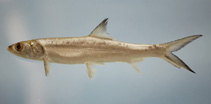 Elops saurus
Photo von NOAA\NMFS\Mississippi Laboratory
Bilder | videos | Google Bild
Photo von NOAA\NMFS\Mississippi Laboratory
Klassifizierung / Names Namen | Synonyme | Catalog of Fishes(Gattung, Arten) | ITIS | CoL | WoRMS | Cloffa
> Elopiformes (Tarpons and tenpounders) > Elopidae (Tenpounders)
Etymology: Elops: Greek, ellops = a kind of serpent (Ref. 45335).
More on author: Linnaeus.
Etymology: Elops: Greek, ellops = a kind of serpent (Ref. 45335).
More on author: Linnaeus.
Umwelt: Milieu / Klimazone / Tiefenbereich / Verbreitungsgebiet Ökologie
seewasser; brackwasser demersal; pH range: 0.0 - 10.4; anadrom (Ref. 126106); tiefenbereich 0 - 50 m (Ref. 13325). Subtropical; 11°C - 34°C (Ref. 127853); 29°N - 17°S
Verbreitung Territorien | FAO Gebiete | Ökosysteme | Vorkommen | Punkt Karte | Einführungen | Faunafri
Western Atlantic: Cape Cod (USA), Bermuda, and northern Gulf of Mexico to southern Brazil. Questionable occurrence records in the China (Ref. 52360), Taiwan (47843), and Vietnam (Ref. 9706, 46452).
Länge bei der ersten Reifung / Größe / Gewicht / Alter
Geschlechtsreife: Lm ? range ? - ? cm
Max length : 100.0 cm TL Männchen/unbestimmt; (Ref. 26340); common length : 60.0 cm TL Männchen/unbestimmt; (Ref. 3718); max. veröff. Gewicht: 10.1 kg (Ref. 4699)
Max length : 100.0 cm TL Männchen/unbestimmt; (Ref. 26340); common length : 60.0 cm TL Männchen/unbestimmt; (Ref. 3718); max. veröff. Gewicht: 10.1 kg (Ref. 4699)
Kurzbeschreibung Bestimmungsschlüssel | Morphologie | Morphometrie
Rückenflossenstacheln (insgesamt) : 0; Rückenflossenweichstrahlen (insgesamt) : 25 - 29; Afterflossenstacheln: 0; Afterflossenweichstrahlen: 16 - 19; Wirbelzahl: 73 - 85. Scales small, more than 100 in lateral line. Gular plate narrow (Ref. 26938). Silvery overall, with bluish on upper surface (Ref. 7251). Branchiostegal rays: 26-33 (Ref. 4639).
Body shape (shape guide): elongated; Cross section: compressed.
Body shape (shape guide): elongated; Cross section: compressed.
Adults occur in shallow neritic areas, over muddy bottoms (Ref. 5217). Also found in brackish estuaries and juveniles are common in lagoons and hyper-saline bays (Ref. 5217). They form large schools close to the shore (Ref. 9987). Feed mainly on crustaceans and small fishes. Spawn in the open sea (Ref. 5217). Larval development is represented by profound changes in body form accompanied by 2 periods of length increase, interspaced by a period of length decrease (Ref. 4639). Noted for their habit of skipping along the surface of the water and for jumping after being hooked (Ref. 5521). Marketed fresh, salted and frozen but considered a second rate food fish (Ref. 3718). Rhynchobothrium bulbifer found in the viscera of the adult (Ref. 37032).
Lebenszyklus und Paarungsverhalten Geschlechtsreife | Fortpflanzung | Ablaichen | Eier | Fruchtbarkeit | Larven
Spawns offshore, the larvae drifting towards the coast where they shelter and grow (Ref. 9987). Leptocephalus larvae are found in salinities as low as 0.0+ to 0.8 ppt (Ref. 75142).
Hauptreferenz
Laden Sie Ihre Referenzen hoch | Referenzen | Koordinator | Partner
Robins, C.R. and G.C. Ray, 1986. A field guide to Atlantic coast fishes of North America. Houghton Mifflin Company, Boston, U.S.A. 354 p. (Ref. 7251)
IUCN Rote Liste Status (Ref. 130435: Version 2025-2 (Global))
nicht bedroht (LC) ; Date assessed: 30 March 2011
CITES
Not Evaluated
Bedrohung für Menschen
Harmless
Nutzung durch Menschen
Fischereien: weniger kommerziell; Sportfisch: ja; Köder: usually
FAO - Fischereien: landungen; Publication: search | FishSource | Das Meer um uns herum
Mehr Information
Trophische Ökologie
Lebensmittel (Beutetiere)
Nahrungszusammensetzung
Nahrungsaufnahme
Lebensmittelrationen
Räuber
Lebensmittel (Beutetiere)
Nahrungszusammensetzung
Nahrungsaufnahme
Lebensmittelrationen
Räuber
Populationsdynamik
Wachstumsparameter
Max. Alter/Größen
Länge-Gewicht-Rel.
Länge-Länge-Verhältnis.
Längenhäufigkeiten
Massenkonvertierung
Rekrutierung
Dichte
Wachstumsparameter
Max. Alter/Größen
Länge-Gewicht-Rel.
Länge-Länge-Verhältnis.
Längenhäufigkeiten
Massenkonvertierung
Rekrutierung
Dichte
Lebenszyklus
Fortpflanzung
Geschlechtsreife
Reifung/Kiemen rel.
Fruchtbarkeit
Ablaichen
Laichaggregationen
Eier
Eientwicklung
Larven
Larven Pop.Dyn.
Fortpflanzung
Geschlechtsreife
Reifung/Kiemen rel.
Fruchtbarkeit
Ablaichen
Laichaggregationen
Eier
Eientwicklung
Larven
Larven Pop.Dyn.
Anatomie
Kiemenoberfläche
Gehirn
Otolith
Kiemenoberfläche
Gehirn
Otolith
Physiologie
Körperliche Zusammensetzung
Nährstoffe
Sauerstoffverbrauch
Schwimmart
Schwimmgeschwindigkeit
Visuelle Pigmente
Fischgeräusche
Krankheiten und Parasiten
Toxizität (LC50s)
Körperliche Zusammensetzung
Nährstoffe
Sauerstoffverbrauch
Schwimmart
Schwimmgeschwindigkeit
Visuelle Pigmente
Fischgeräusche
Krankheiten und Parasiten
Toxizität (LC50s)
Menschenbezogen
Aquakultur-Systeme
Aquakultur Profile
Zuchtlinien
Ciguatera-Fälle
Briefmarken, Münzen, Verschiedenes.
Aquakultur-Systeme
Aquakultur Profile
Zuchtlinien
Ciguatera-Fälle
Briefmarken, Münzen, Verschiedenes.
Tools
Zusatzinformationen
Download XML
Zusammenfassung | Punktdaten | Namen | Photos
Internet Quellen
AFORO (otoliths) | Aquatic Commons | BHL | Cloffa | Websites from users | FishWatcher Einträge suchen | CISTI | Catalog of Fishes: Gattung, Arten | DiscoverLife | ECOTOX | FAO - Fischereien: landungen; Publication: search | Faunafri | Fishipedia | Fishtrace | GloBI | GoMexSI (interaction data) | Google Books | Google Scholar | Google | IGFA World Record | Nationale Datenbanken | OneZoom | Open Tree of Life | Otolith Atlas of Taiwan Fishes | Öffentliche Aquarien | PubMed | Reef Life Survey | Socotra Atlas | TreeBase | Tree of Life | Wikipedia: Gehe zu, Suchen | World Records Freshwater Fishing | Zoobank | Zoologischer Rekord
Schätzungen auf der Grundlage von Modellen
Bevorzugte Temperatur (Ref. 123201): 25 - 29.1, mean 28 °C (based on 1142 cells).
Phylogenetischer Diversitätsindex (Ref. 82804): PD50 = 0.5176 [Uniqueness, from 0.5 = low to 2.0 = high].
Bayesian length-weight: a=0.00631 (0.00473 - 0.00842), b=2.94 (2.86 - 3.02), in cm total length, based on LWR estimates for this species (Ref. 93245).
Trophische Ebene (Ref. 69278): 3.5 ±0.3 se; based on diet studies.
Widerstandsfähigkeit (Ref. 120179): mittel, Verdopplung der Population dauert 1,4 - 4,4 Jahre. (K=0.22-0.3; tm=2).
Nährstoffe (Ref. 124155): Calcium = 22.2 [10.7, 44.5] mg/100g; Iron = 0.569 [0.300, 0.970] mg/100g; Protein = 17.7 [15.5, 20.7] %; Omega3 = 0.15 [0.08, 0.27] g/100g; Selenium = 20.8 [10.2, 44.4] μg/100g; VitaminA = 34.3 [11.0, 111.0] μg/100g; Zinc = 0.654 [0.437, 1.015] mg/100g (wet weight); based on nutrient studies.