



Myliobatis hamlyni Ogilby, 1911
Purple eagle ray
Sube tu fotos y Vídeos
Imágenes | Google image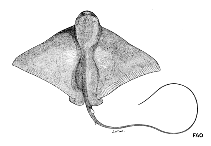 Myliobatis hamlyni
Foto de FAO
Imágenes | Google image
Foto de FAO
Clasificación / Nombres Nombres comunes | Sinónimos | Catalog of Fishes(Género, Especie) | ITIS | CoL | WoRMS | Cloffa
Elasmobranquios (tiburones y rayas) (sharks and rays) > Myliobatiformes (Stingrays) > Myliobatidae (Eagle and manta rays)
Etymology: Myliobatis: Greek, mylo = mill + Greek, + Greek, batis,-idos = a ray (Raja sp.) (Ref. 45335).
Eponymy: Dr Ronald Hamlyn-Harris (1874–1953) was an English-born entomologist. [...] (Ref. 128868), visit book page.
More on author: Ogilby.
Etymology: Myliobatis: Greek, mylo = mill + Greek, + Greek, batis,-idos = a ray (Raja sp.) (Ref. 45335).
Eponymy: Dr Ronald Hamlyn-Harris (1874–1953) was an English-born entomologist. [...] (Ref. 128868), visit book page.
More on author: Ogilby.
Entorno: milieu / zona climática / rango de profundidad / gama de distribución Ecología
marino bentopelágico; rango de profundidad 200 - ? m (Ref. 6871). Deep-water; 17°S - 26°S
Distribución Territorios | Áreas FAO | Ecosistemas | Ocurrencias, apariciones | Mapa de puntos | Introducciones | Faunafri
Indo-West Pacific: patchy distribution, Austalia, Indonesia, the Philippines, Taiwan and Japan.
Longitud en la primera madurez / Tamaño / Peso / Edad
Descripción breve Claves de identificación | Morfología | Morfometría
Vértebra: 114 - 119. This medium-sized Myliobatis species (attaining at least 114.2 cm DW) is distinguished by the following set of characters: dorsal surface uniformly purplish brown to greenish brown, without dark spots or blotches; tail with a distinct, low ventral skin fold; stinging spine(s) are relatively long (longest spine 13.1-15.9% DW); adult males with interorbital space moderately concave; anterior margins of pectoral fin is straight to slightly convex; cranial fontanelle (visible in dorsal view without dissection) is relatively wide with slightly convex lateral margins; claspers of adult males 5.5-5.7% DW; predorsal length 63.6-68.6% DW; each jaw with 7 rows of teeth, with a broad median row flanked by three smaller rows on each side; pectoral-fin radials 85-92 (excluding rostral propterygial radials anterior of eyes); total vertebral centra (including synarcual) 114-119; males mature at about 65.0 cm DW (Ref. 132213).
Cross section: flattened.
Cross section: flattened.
Common inshore and offshore, demersal in intertidal habitats to depths of at least 220 m (Ref. 58048); also in coral reefs (Ref. 58534). Diet unknown, but presumably consists primarily of bivalves and other bottom-dwelling invertebrates. Caught occasionally by inshore, demersal longline fisheries. Utilized for its meat and cartilage (Ref. 58048). Ovoviviparous (Ref. 50449).
Ciclo vital y comportamiento de apareamiento Madurez | Reproducción | Puesta | Huevos | Fecundidad | Larva
Exhibit ovoviparity (aplacental viviparity), with embryos feeding initially on yolk, then receiving additional nourishment from the mother by indirect absorption of uterine fluid enriched with mucus, fat or protein through specialised structures (Ref. 50449).
Referencia principal
Suba sus referencias | Referencias | Coordinador : McEachran, John | Colaboradores
White, W.T., J. Kawauchi, S. Corrigan, E. Rochel and G.J.P. Naylor, 2015. Redescription of the eagle rays Myliobatis hamlyni Ogilby, 1911 and M. tobijei Bleeker, 1854 (Myliobatiformes: Myliobatidae) from the east Indo-West Pacific. Zootaxa 3948(3):521-548. (Ref. 132213)
Situación en la Lista Roja de la UICN (Ref. 130435: Version 2025-2 (Global))
Near Threatened (NT) ; Date assessed: 17 February 2015
CITES
Not Evaluated
Amenaza para el ser humano
Harmless
Usos humanos
Pesquerías: comercial
FAO - Publication: search | FishSource |
Más información
Ecología Trófica
Alimentos (presas)
Composición de la dieta
consumo de alimento
Raciones de comida
Despredadores
Alimentos (presas)
Composición de la dieta
consumo de alimento
Raciones de comida
Despredadores
Ecología
Ecología
Ecología
Dinámica de la población
Coeficiente del crecimiento para
Edades / tallas máximas
Longitud-peso rel.
Longitud-longitud rel.
Longitud-frecuencias
Conversión de masas
Reclutamiento
Abundancia
Coeficiente del crecimiento para
Edades / tallas máximas
Longitud-peso rel.
Longitud-longitud rel.
Longitud-frecuencias
Conversión de masas
Reclutamiento
Abundancia
Ciclo de vida
Reproducción
Madurez
Madurez/Gills rel.
Fecundidad
Puesta
Agregaciones de desove
Huevos
Desarrollo de los huevos
Larva
Dinámica larvaria
Reproducción
Madurez
Madurez/Gills rel.
Fecundidad
Puesta
Agregaciones de desove
Huevos
Desarrollo de los huevos
Larva
Dinámica larvaria
Distribución
Territorios
Áreas FAO
Ecosistemas
Ocurrencias, apariciones
Introducciones
BRUVS - Vídeos
Territorios
Áreas FAO
Ecosistemas
Ocurrencias, apariciones
Introducciones
BRUVS - Vídeos
Anatomía
Superficie branquial
Cerebro
Otolito
Superficie branquial
Cerebro
Otolito
Fisiología
Composición corporal
Nutrientes
Consumo del oxígeno
Tipo de natación
Velocidad de natación
Pigmentos visuales
Sonido de peces
Enfermedades y parásitos
Toxicidad (CL50)
Composición corporal
Nutrientes
Consumo del oxígeno
Tipo de natación
Velocidad de natación
Pigmentos visuales
Sonido de peces
Enfermedades y parásitos
Toxicidad (CL50)
Genética
Genoma
Genética
Heterocigosidad
heritabilidad
Diversidad genética
Genoma
Genética
Heterocigosidad
heritabilidad
Diversidad genética
Relacionados con el ser humano
Sistemas de acuicultura
Perfiles de acuicultura
Razas
Ciguatera cases
Sellos, monedas, varios
Sistemas de acuicultura
Perfiles de acuicultura
Razas
Ciguatera cases
Sellos, monedas, varios
Herramientas
Libro electrónico | Guía de campo | Claves de identificación | Asistente para frecuencias de tallas | Herramienta de ciclo de vida | Mapa de puntos |
Catch-MSY |
Informes especiales
Comprobar el mantenimiento del acuario | Buscar fichas sobre especies | Consulte las hojas informativas sobre acuicultura
Descargar XML
Fuentes de Internet
AFORO (otoliths) | Aquatic Commons | BHL | Cloffa | Websites from users | Check FishWatcher | CISTI | Catalog of Fishes: Género, Especie | DiscoverLife | ECOTOX | FAO - Publication: search | Faunafri | Fishipedia | Fishtrace | GloBI | Google Books | Google Scholar | Google | IGFA World Record | Bases de datos nacionales | OneZoom | Open Tree of Life | Otolith Atlas of Taiwan Fishes | PubMed | Reef Life Survey | Socotra Atlas | TreeBase | Árbol de la vida | Wikipedia: Go, búsqueda | World Records Freshwater Fishing | Zoobank | Expediente Zoológico
Estimaciones basadas en modelos
Índice de diversidad filogenética (Referencia 82804): PD50 = 0.5002 [Uniqueness, from 0.5 = low to 2.0 = high].
Bayesian length-weight: a=0.00389 (0.00124 - 0.01219), b=3.08 (2.83 - 3.33), in cm total length, based on LWR estimates for this (Sub)family-body shape (Ref. 93245).
Nivel trófico (Referencia 69278): 3.4 ±0.4 se; based on size and trophs of closest relatives
Resiliencia (Referencia 120179): Bajo, población duplicada en un tiempo mínimo de 4.5-14 años (Fec assumed to be <100).