



Spratelloides delicatulus (Bennett, 1832)
Delicate round herring
Ajouter votre observation dans Fish Watcher
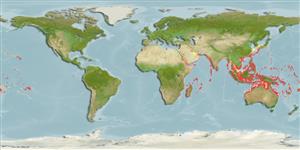
| Native range | All suitable habitat | Point map | Year 2050 |
|
| This map was computer-generated and has not yet been reviewed. |
| Spratelloides delicatulus AquaMaps Data sources: GBIF OBIS |
Envoyez vos Photos et vidéos
Images | Images Google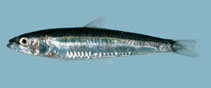 Spratelloides delicatulus
Photo de Winterbottom, R.
Images | Images Google
Photo de Winterbottom, R.
Classification / Noms Noms communs | Synonymes | Catalog of Fishes(Genre, Espèce) | ITIS | CoL | WoRMS | Cloffa
> Clupeiformes (Herrings) > Spratelloididae (Small round herrings)
Etymology: Spratelloides: Old German, sprotte (1611) = a small fish, Clupea sp. + Greek, suffix, oides = similar to (Ref. 45335).
More on author: Bennett.
Etymology: Spratelloides: Old German, sprotte (1611) = a small fish, Clupea sp. + Greek, suffix, oides = similar to (Ref. 45335).
More on author: Bennett.
Taxonomic Remarks
The species in the genera Spratelloides Bleeker, 1851 and Jenkinsia Jordan & Evermann, 1896 should most probably be assigned to a separated family from Clupeidae and Dussumieriidae (Lavoué, pers. comm., July 2013). See a preliminary analysis in Lavoué et al. (2013: Ref. 93878).
Environnement : milieu / zone climatique / profondeur / gamme de distribution Écologie
Distribution Territoires | Zones FAO | Écosystèmes | Occurrences | Carte par point | Introductions | Faunafri
Indo-Pacific: Red Sea and East Africa to the Society Islands (but not the Tuamoto and Marquesas islands), north to southern Japan, south to northern Australia. Single specimen from eastern Mediterranean (Tel-Aviv, Israel).
Longueur à la première maturité / Taille / Poids / Âge
Description synthétique Clés d'identification | Morphologie | Morphométrie
Épines dorsales (Total) : 0; Rayons mous dorsaux (Total) : 11 - 13; Épines anales: 0; Rayons mous anaux: 10 - 11. No bright silver along band flanks, maxilla toothless; pre-maxillae triangular, 2 supra-maxillae, second supra-maxilla paddle-shaped and symmetrical; vertical striate on scales meeting at center, posterior margin of scales smooth, pre-dorsal scales 8 to 13; W-shaped pelvic scute, few branchiostegal rays (6 or 7).
Body shape (shape guide): fusiform / normal; Cross section: oval.
Body shape (shape guide): fusiform / normal; Cross section: oval.
Pelagic (Ref. 68964). Usually an inshore schooling species, inhabiting relatively clear coastal waters, lagoons, and along reef margins. Feeds near surface on plankton. Found in large schools (Ref. 9710). Pelagic (Ref. 58302). Marketed fresh or dried-salted (Ref. 5213) and used as tuna baitfish.
Cycle de vie et comportement reproducteur Maturité | Reproduction | Frai | Œufs | Fécondité | Larves
Oviparous (Ref. 205).
Référence principale
Téléchargez vos références | Références | Coordinateur | Collaborateurs
Whitehead, P.J.P., 1985. FAO Species Catalogue. Vol. 7. Clupeoid fishes of the world (suborder Clupeoidei). An annotated and illustrated catalogue of the herrings, sardines, pilchards, sprats, shads, anchovies and wolf-herrings. FAO Fish. Synop. 125(7/1):1-303. Rome: FAO. (Ref. 188)
Statut dans la liste rouge de l'IUCN (Ref. 130435: Version 2025-2 (Global))
Préoccupation mineure (LC) ; Date assessed: 28 February 2017
CITES
Not Evaluated
Menace pour l'homme
Harmless
Utilisations par l'homme
Pêcheries: intérêt commercial mineur; appât: usually
FAO - Publication: search | FishSource | Sea Around Us
Plus d'informations
Écologie trophique
Aliments (proies)
Composition du régime alimentaire
Consommation alimentaire
Rations alimentaires
Prédateurs
Aliments (proies)
Composition du régime alimentaire
Consommation alimentaire
Rations alimentaires
Prédateurs
Dynamique des populations
Paramètres de croissance
Âges / tailles maximales
Longueur-poids rel.
Rel. longueur-longueur.
Fréquences de longueurs
Conversion de masse
Recrutement
Abondance
Paramètres de croissance
Âges / tailles maximales
Longueur-poids rel.
Rel. longueur-longueur.
Fréquences de longueurs
Conversion de masse
Recrutement
Abondance
Cycle de vie
Reproduction
Maturité
Maturité/épines rel.
Fécondité
Frai
Agrégats de frai
Œufs
Développement de l'œuf
Larves
Dynamique des populations larvaires
Reproduction
Maturité
Maturité/épines rel.
Fécondité
Frai
Agrégats de frai
Œufs
Développement de l'œuf
Larves
Dynamique des populations larvaires
Physiologie
Composition corporelle
Nutriments
Consommation d'oxygène
Type de natation
Vitesse de nage
Pigments visuels
Son de poisson
Maladies et parasites
Toxicité (CL50)
Composition corporelle
Nutriments
Consommation d'oxygène
Type de natation
Vitesse de nage
Pigments visuels
Son de poisson
Maladies et parasites
Toxicité (CL50)
Génétique
génôme
Génétique
Hétérozygotie
Héritabilité
Diversité génétique
génôme
Génétique
Hétérozygotie
Héritabilité
Diversité génétique
Liées à l'homme
Systèmes d'aquaculture
Profils d'aquaculture
Souches
Cas de ciguatera
Timbres, pièces de monnaie, divers
Systèmes d'aquaculture
Profils d'aquaculture
Souches
Cas de ciguatera
Timbres, pièces de monnaie, divers
Outils
E-book | Guide de terrain | Clés d'identification | Générateur de fréquences de longueur | Outil de dynamique de population | Carte par point |
Capture-MSY |
Articles particuliers
Télécharger en XML
Sources Internet
AFORO (otoliths) | Alien/Invasive Species database | Aquatic Commons | BHL | Cloffa | Websites from users | FishWatcher | CISTI | Catalog of Fishes: Genre, Espèce | DiscoverLife | ECOTOX | FAO - Publication: search | Faunafri | Fishipedia | Fishtrace | GloBI | Google Books | Google Scholar | Google | IGFA World Record | Bases de données nationales | OneZoom | Open Tree of Life | Otolith Atlas of Taiwan Fishes | PubMed | Reef Life Survey | Socotra Atlas | TreeBase | Arbre de Vie | Wikipedia: aller à, chercher | World Records Freshwater Fishing | Zoological Record
Estimations basées sur des modèles
Température préférée (Réf. 123201): 24.7 - 29.1, mean 28.1 °C (based on 1228 cells).
Indice de diversité phylogénétique (Réf. 82804): PD50 = 0.5664 [Uniqueness, from 0.5 = low to 2.0 = high].
Bayesian length-weight: a=0.00479 (0.00289 - 0.00793), b=3.17 (3.03 - 3.31), in cm total length, based on LWR estimates for this species & (Sub)family-body (Ref. 93245).
Niveau trophique (Réf. 69278): 3.1 ±0.0 se; based on diet studies.
Generation time: 0.4 ( na - na) years. Estimated as median ln(3)/K based on 1 growth studies.
Résilience (Réf. 120179): Haut, temps minimum de doublement de population inférieur à 15 mois (K=2.7-12.2; Fec=524; tm=0.14).
Nutriments (Ref. 124155): Calcium = 347 [102, 2,847] mg/100g; Iron = 4.79 [1.15, 18.89] mg/100g; Protein = 19.7 [16.9, 22.4] %; Omega3 = 0.179 [0.029, 1.111] g/100g; Selenium = 223 [24, 1,690] μg/100g; VitaminA = 19 [2, 208] μg/100g; Zinc = 6.8 [2.2, 18.3] mg/100g (wet weight);