This website uses cookies to enhance your browsing experience and ensure the functionality of our site. For more detailed information about the types of cookies we use and how we protect your privacy, please visit our Privacy Information page.
×
Cookie Settings
This website uses different types of cookies to enhance your experience. Please select your preferences below:
Southwest Atlantic: from northern Argentina to southern Brazil.
Длина при первой зрелости / Размер / Вес / Возраст
половая зрелость: Lm46.4 range ? - ? cm Max length : 53.4 cm TL самец/пол неопределен; (Ref. 115173); 59.3 cm TL (female); common length : 50.0 cm TL самец/пол неопределен; (Ref. 6077); наибольший вес (опубликованные данные): 758.00 g (Ref. ); наибольший вес (опубликованные данные): 758.00 g
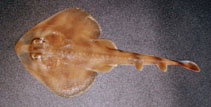
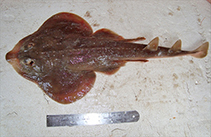
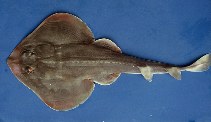
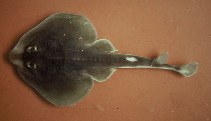
Obtuse snout, broader heart shaped disc. Olive to brownish gray above, without definite markings, dorsal and caudal darker than general ground tint, margins of pectoral and pelvic fins paler. Lower surface grayish or yellowish white, posterior corners of pectoral fins and tips of pelvic fins more or less dusky (Ref. 6902). Body shape (shape guide): other.
This benthic inshore species is found over soft bottoms to at least 50 m; feeds on benthic crustaceans and polychaetes. Gestation last about a year, produces litters of 1-8 pups in autumn (Ref. 114953). Ovoviviparous (Ref. 50449). Maturity size for males at 43-45 cm TL, females at 42-48 cm TL; birth size at 13-16 cm TL (Ref. 114953).
Exhibit ovoviparity (aplacental viviparity), with embryos feeding initially on yolk, then receiving additional nourishment from the mother by indirect absorption of uterine fluid enriched with mucus, fat or protein through specialised structures (Ref. 50449).
Compagno, L.J.V., 1999. Checklist of living elasmobranchs. p. 471-498. In W.C. Hamlett (ed.) Sharks, skates, and rays: the biology of elasmobranch fishes. Johns Hopkins University Press, Maryland. (Ref. 35766)
Статус Красного Списка МСОП (Ref. 130435: Version 2025-2 (Global))
Динамика численности населения Параметры роста Макс. возраст / размер Отношение длины к весу. Отношение длины к длине. Размерный состав Преобразование массы пополнение численность
Физиология Состав тела Питательные вещества Потребление кислорода Тип плавания Скорость плавания Зрительные пигменты Звук рыбы Болезни и паразиты Токсичность (LC50s)
Индекс филогенетического разнообразия (ссылка 82804): PD50 = 0.6289 [Uniqueness, from 0.5 = low to 2.0 = high].
Bayesian length-weight: a=0.00617 (0.00308 - 0.01235), b=2.96 (2.77 - 3.15), in cm total length, based on LWR estimates for this species & (Sub)family-body (Ref. 93245).
Трофический уровень (ссылка 69278): 3.5 ±0.6 se; based on size and trophs of closest relatives
устойчивость к внешним воздействиям (ссылка 120179): низкий, минимальное время удвоения популяции 4.5-14 лет (Fec assumed to be <100).