



Sarotherodon melanotheron Rüppell, 1852
Blackchin tilapia
アップロード 写真 そして ビデオ
画像 | グーグルの画像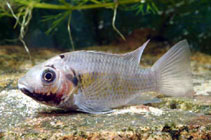 Sarotherodon melanotheron
画像によって Hippocampus-Bildarchiv
画像 | グーグルの画像
画像によって Hippocampus-Bildarchiv
分類 / 名前 共通名の | 類義語 | Catalog of Fishes(部類, 種) | ITIS | CoL | WoRMS | Cloffa
> Cichliformes (Cichlids, convict blennies) > Cichlidae (Cichlids) > Pseudocrenilabrinae
Etymology: Sarotherodon: Greek, saros, -ou = sawdust + Greek, ther = animal * Greek, odous = teeth (Ref. 45335).
More on author: Rüppell.
Etymology: Sarotherodon: Greek, saros, -ou = sawdust + Greek, ther = animal * Greek, odous = teeth (Ref. 45335).
More on author: Rüppell.
環境:環境 / 気候帯 / 深さの範囲 / 分布範囲 生態学
海; 新鮮な水; 汽水性の 底生の; pH range: 7.0 - 8.0; dH range: 9 - 19; 移住性ではない (Ref. 126106); 深さの範囲 0 - 3 m (Ref. 5723). Tropical; 27°N - 14°S, 18°W - 31°E
分布 領土 | 国連食糧農業機関の区域 | エコシステム | 事件 | 目的のマップ | 導入 | Faunafri
Africa: Lagoons and estuaries from Mauritania to Cameroon. Introduced to several countries in Asia, USA and Europe (Ref. 21). At least one country reports adverse ecological impact after introduction. Previously, three subspecies were recognized: Sarotherodon melanotheron heudelotii, Sarotherodon melanotheron leonensis and Sarotherodon melanotheron melanotheron.
初回成熟時の長さ / サイズ / 重さ / 年齢
成熟: Lm 12.1, range 13 - ? cm
Max length : 28.0 cm SL オス/雌雄の選別がない; (Ref. 31256); common length : 17.5 cm TL オス/雌雄の選別がない; (Ref. 12193)
Max length : 28.0 cm SL オス/雌雄の選別がない; (Ref. 31256); common length : 17.5 cm TL オス/雌雄の選別がない; (Ref. 12193)
簡単な記述 検索表 | 形態学 | 形態計測学
背面の脊椎 (合計) : 15 - 17; 背鰭 (合計) : 10 - 12; 肛門の骨: 3; 臀鰭: 8 - 10; 脊つい: 26 - 28. Diagnosis: length of caudal peduncle 0.6-0.9 times in its depth (Ref. 53405). Melanic areas in adult usually present on lower parts of head, on cleithrum and on apices of caudal and soft dorsal fins; occasional irregular and asymmetrical spots on flanks probably representing vertical bars; median spot or transverse bar on nape rather constant (Ref. 2).
Body shape (shape guide): short and / or deep.
Body shape (shape guide): short and / or deep.
This species can tolerate high salinity (Ref. 5723). Adults occur abundantly in mangrove areas and ventures in to both fresh, like lower reaches of streams (Ref. 5723) and salt waters in native and non-native ranges (Ref. 46816, 53405). In West Africa, they are confined to brackish lagoons and estuaries, and is abundant in the mangrove zone (Ref. 2). They form schools; is mainly nocturnal with intermittent daytime feeding. They feed on aufwuchs and detritus (Ref. 2), as well as on bivalves and zooplankton (Ref. 28587). Feeding behaviour: picking up and swallowing "bites" (no gill rakers) (Ref. 55661).
ライフサイクルと交尾行動 成熟 | 繁殖 | 放精 | 卵 | 生産力 | 幼生
Spawns in shallow water close inshore. Initiative in courtship, pit digging and mating activities are taken by the female. Eventually a male is stimulated to react in a mainly passive manner and a pair-bond is established; sexual dimorphism minimal; no T-stand by the partners during fertilization. Exhibits mouth-brooding habit (Ref. 6298). Males exclusively incubate the eggs (Ref. 2, 6309).
主な参考文献
参考文献のアップロード | 参考文献 | コーディネーター : Kullander, Sven O. | 協力者
Trewavas, E. and G.G. Teugels, 1991. Sarotherodon. p. 425-437. In J. Daget, J.-P. Gosse, G.G. Teugels and D.F.E. Thys van den Audenaerde (eds.) Check-list of the freshwater fishes of Africa (CLOFFA). ISNB, Brussels; MRAC, Tervuren; and ORSTOM, Paris. Vol. 4. (Ref. 4999)
CITES
Not Evaluated
人間に対する脅威
Potential pest
人間の用途
水産業: 商業; 水産養殖: 商業; 水族館・水槽: 商業
FAO - 養殖システム: 代謝; ; Publication: search | FishSource |
より多くの情報
解剖学
カマ
脳
オトリス
カマ
脳
オトリス
用具
オーガニック・クイズ | 電子書籍 | 野外観察図鑑 | 検索表 | 長さ-周波数ウィザード | 生活史の基盤ツール | 目的のマップ |
キャッチ-MSY |
特記事項
XMLをダウンロードして下さい
インターネットの情報源
AFORO (otoliths) | Alien/Invasive Species database | Aquatic Commons | BHL | Cloffa | Websites from users | Check FishWatcher | CISTI | Catalog of Fishes: 部類, 種 | DiscoverLife | ECOTOX | FAO - 養殖システム: 代謝; ; Publication: search | Faunafri | Fishipedia | Fishtrace | GloBI | Google Books | Google Scholar | Google | IGFA World Record | OneZoom | Open Tree of Life | Otolith Atlas of Taiwan Fishes | PubMed | Reef Life Survey | Socotra Atlas | TreeBase | 生命の木 | Wikipedia: 行く, 検索する | World Records Freshwater Fishing | Zoobank | 動物に関する記録
モデルに基づく推定値
系統多様性指数 (参照 82804): PD50 = 0.5001 [Uniqueness, from 0.5 = low to 2.0 = high].
Bayesian length-weight: a=0.01778 (0.01381 - 0.02290), b=3.00 (2.93 - 3.07), in cm total length, based on LWR estimates for this species (Ref. 93245).
栄養段階 (参照 69278): 2.2 ±0.14 se; based on food items.
Generation time: 0.8 (0.5 - 2.8) years. Estimated as median ln(3)/K based on 13 growth studies.
回復力 (参照 120179): 手段, 1.4年~4.4年の倍増期間の最小個体群 (K=0.16).
栄養素 (Ref. 124155): Calcium = 318 [152, 673] mg/100g; Iron = 1.97 [0.87, 4.12] mg/100g; Protein = 18.4 [16.8, 20.0] %; Omega3 = 0.152 [0.073, 0.347] g/100g; Selenium = 39.5 [19.2, 87.8] μg/100g; VitaminA = 6.27 [1.55, 20.48] μg/100g; Zinc = 1.94 [1.22, 3.12] mg/100g (wet weight);