Naso unicornis, Bluespine unicornfish : fisheries, gamefish, aquarium

Naso unicornis (Forsskål, 1775)

Bluespine unicornfish
เพิ่มการสังเกตของคุณใน Fish Watcher
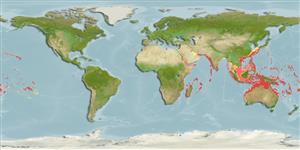
Native range | All suitable habitat | Point map | Year 2050
This map was computer-generated and has not yet been reviewed.
Naso unicornis   AquaMaps   Data sources: GBIF OBIS
อัพโหลดของคุณ ภาพถ่าย และ วิดีโอ
รูปภาพหลายรูป | วิดีโอ | Google image

การจำแนกประเภท / ชื่อ ชื่อสามัญ | ชื่อพ้อง | Catalog of Fishes(สกุล, ชนิด) | ITIS | CoL | WoRMS | Cloffa

> Acanthuriformes (Surgeonfishes) > Acanthuridae (Surgeonfishes, tangs, unicornfishes) > Nasinae
Etymology: Naso: Latin, nasus = nose (Ref. 45335).
More on author: Forsskål.

สิ่งแวดล้อม : สิ่งแวดล้อม / เขตภูมิอากาศ / ระดับความลึก / ระยะการกระจายสินค้า นิเวศวิทยา

เกี่ยวกับทะเล,น้ำเค็ม เกี่ยวกับหินโสโครก; ระดับความลึก 0 - 180 m (Ref. 89972). Tropical; 26°C - 29°C (Ref. 27115); 35°N - 33°S, 30°E - 128°W

การแพร่กระจาย อาณาเขต | พื้นที่จำแนกตาม FAO | ระบบนิเวศหลายระบบ | การปรากฏขึ้น,การเกิดขึ้น,พบ | ตำแหน่งบนแผนที่ | การแนะนำ | Faunafri

Indo-Pacific: Red Sea and East Africa (Ref. 3145) to the Hawaiian, Marquesas and Tuamoto islands, north to southern Japan, south to Lord Howe and Rapa islands. Presence in Somalia to be confirmed (Ref. 30573).

ขนาด / น้ำหนัก / อายุ

วัยเจริญพันธุ์: Lm ?  range ? - ? cm
Max length : 70.0 cm FL เพศผู้/กระเทย; (Ref. 9710); common length : 50.0 cm TL เพศผู้/กระเทย; (Ref. 3146); อายุสูงสุดที่ได้รายงาน: 55 ปี (Ref. 118238)

คำอธิบายสั้นๆ เครื่องมือที่ใช้ในการแยกชนิดสัตว์,สิ่งมีชีวิตออกจากกัน | สัณฐานวิทยา | ความยาวต่างๆ

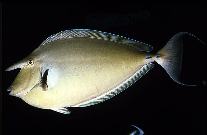
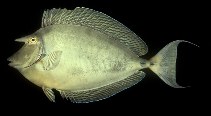
เงี่ยงครีบหลัง (รวม) : 6; ก้านครีบอ่อนที่หาง (รวม) : 27 - 30; เงี่ยงครีบก้น: 2; ก้านครีบอ่อนที่ก้น: 27 - 30. This species is characterized by the following: body depth vary from about 2.0 in SL (in subadults) to 2.4-2.6 (adults) in SL; with a tapering, bony, horn on forehead of adults projecting anteriorly at level of eye but not extending in front of mouth (horn first as a bump on forehead at a length of about 12 cm); dorsal profile from snout to horn straight, angle of about 45°; 2 peduncular plates with well-developed forward-curving knife-like spines; emarginate caudal fin when young, truncate with filamentous lobes in adult; males apparently with longer horn, larger peduncular keels and longer caudal filaments than females of the same size; body yellowish to olivaceous gray dorsally, paler ventrally, with blue peduncular plates and keel spines; lips whitish or blue; blue area is sometimes present around pectoral fin; dorsal and anal fins yellowish with narrow blue margins; caudal fin orangish basally, shading to gray, with a broad, pale greenish posterior border and caudal filaments are edged in blue; one transient color phase is a blotchy pale greenish zone below the spinous portion of dorsal fin that narrows and ends beneath the pectoral fin (Ref. 27362).
Body shape (shape guide): short and / or deep; Cross section: compressed.

ชีววิทยา     ภาคผนวก (เช่น epibenthic)

Adults inhabit channels, moats, lagoon and seaward reefs with strong surge (Ref. 48637). Benthopelagic (Ref. 58302). Typically occurring in small groups. Sometimes solitary (Ref. 90102). Juveniles in shallow protected bays and harbours (Ref. 48637). Mainly diurnal, feed on coarse leafy brown algae like Sargassum. Pair-spawning has been observed. Minimum depth reported taken from Ref. 128797.

วงจรชีวิตและพฤติกรรมการผสมพันธุ์ วัยเจริญพันธุ์ | การสืบพันธุ์ | การวางไข่ | เซลสืบพันธ์ของเพศเมีย(ไข่) | ความดกของไข่ | ตัวอ่อน

Spawn in pairs (Ref. 240).

อ้างอิงหลัก อัพโหลดข้อมูลอ้างอิงของคุณ | อ้างอิง | ผู้ประสานงาน : Randall, John E. | ผู้ร่วมมือ

Myers, R.F., 1991. Micronesian reef fishes. Second Ed. Coral Graphics, Barrigada, Guam. 298 p. (Ref. 1602)

สถานะบัญชีแดงของ IUCN (Ref. 130435: Version 2025-2 (Global))

  Least Concern (LC) ; Date assessed: 07 May 2010

CITES

Not Evaluated

CMS (Ref. 116361)

Not Evaluated

ภัยคุกคามต่อมนุษย์

  Reports of ciguatera poisoning (Ref. 4795)


การใช้ของมนุษย์

การประมง: การค้า; การตกปลาเป็นกีฬา: ใช่; สถานที่แสดงสัตว์และพืชน้ำ: การค้า
FAO - การประมง: การลงจอด; Publication: search | FishSource | ทะเลรอบๆเรา

ข้อมูลเพิ่มเติม

นิเวศวิทยาเขตร้อน
รายการอาหาร (เหยื่อ)
องค์ประอบของอาหาร
การบริโภคอาหาร
การจัดสรรอาหาร
ผู้ล่า
นิเวศวิทยา
นิเวศวิทยา
วงจรชีวิต
การสืบพันธุ์
วัยเจริญพันธุ์
ความสมบูรณ์พันธุ์/เหงือกที่เกี่ยวข้อง
ความดกของไข่
การวางไข่
การรวมตัวของสปอน
เซลสืบพันธ์ของเพศเมีย(ไข่)
การพัฒนาไข่
ตัวอ่อน
พลวัตของสัตว์น้ำวัยอ่อน
กายวิภาคศาสตร์
พื้นที่เหงือก
สมอง
หินโสต
สรีรวิทยา
องค์ประกอบของร่างกาย
สารอาหาร
การใช้ออกซิเจน
ประเภทการว่ายน้ำ
ระดับความเร็วในการว่ายน้ำ
เม็ดสีที่มองเห็นได้
เสียงปลา
โรคและปรสิต
ความเป็นพิษ (LC50s)
พันธุศาสตร์
จีโนม
พันธุศาสตร์
ความไม่สมดุลทางเชื้อชาติ
อัตราพันธุกรรม
ความหลากหลายทางพันธุกรรม
เกี่ยวข้องกับมนุษย์
ระบบการเพาะเลี้ยงสัตว์น้ำ
ประวัติการเพาะเลี้ยงสัตว์น้ำ
สายพันธุ์
กรณีซิเกวเทอรา
แสตมป์ เหรียญ อื่นๆ
การเข้าถึง
ผู้ร่วมมือ
อ้างอิง
อ้างอิง

เครื่องมือ

รายงานพิเศษ

ดาวน์โหลด XML

แหล่งที่มาจากอินเตอร์เน็ต

การประมาณค่าตามแบบจำลอง

อุณหภูมิที่ต้องการ (อ้างอิง 123201): 23.4 - 28.8, mean 27.4 °C (based on 1536 cells).
ดัชนีความหลากหลายทางวิวัฒนาการ (อ้างอิง 82804):  PD50 = 0.5000   [Uniqueness, from 0.5 = low to 2.0 = high].
Bayesian length-weight: a=0.02399 (0.01795 - 0.03206), b=2.94 (2.86 - 3.02), in cm total length, based on LWR estimates for this species (Ref. 93245).
ระดับชั้นอาหาร (อ้างอิง 69278):  2.2   ±0.11 se; based on food items.
ความสามารถในการกลับคืนสู่ปกติ (อ้างอิง 120179):  ต่ำมาก, เวลาต่ำสุดที่จะทำให้ประชากรเพิ่มขึ้นเป็น 2 เท่าใช้เวลามากกว่า 14 ปี (K=0.14; tmax=54.5).
Prior r = 0.28, 95% CL = 0.18 - 0.42, Based on 3 data-limited stock assessments.
ความเสี่ยงต่อการตกปลา (Ref. 59153):  Low to moderate vulnerability (32 of 100). 🛈
ความเสี่ยงต่อสภาพภูมิอากาศ (Ref. 125649):  Very high vulnerability (80 of 100). 🛈
หมวดหมู่ราคา (Ref. 80766):   Medium.
สารอาหาร (Ref. 124155):  Calcium = 33.3 [16.8, 58.2] mg/100g; Iron = 0.554 [0.285, 1.039] mg/100g; Protein = 18.4 [17.1, 19.7] %; Omega3 = 0.109 [0.065, 0.196] g/100g; Selenium = 58.8 [29.8, 118.5] μg/100g; VitaminA = 21.5 [5.0, 90.1] μg/100g; Zinc = 1.03 [0.66, 1.54] mg/100g (wet weight);