This website uses cookies to enhance your browsing experience and ensure the functionality of our site. For more detailed information about the types of cookies we use and how we protect your privacy, please visit our Privacy Information page.
×
Cookie Settings
This website uses different types of cookies to enhance your experience. Please select your preferences below:
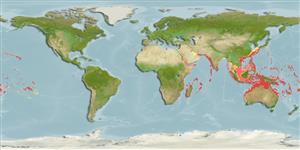
Indo-Pacific: Red Sea and East Africa (Ref. 3145) to the Hawaiian, Marquesas and Tuamoto islands, north to southern Japan, south to Lord Howe and Rapa islands. Presence in Somalia to be confirmed (Ref. 30573).
Tamaño / Peso / Edad
Madurez: Lm? range ? - ? cm Max length : 70.0 cm FL macho / no sexado; (Ref. 9710); common length : 50.0 cm TL macho / no sexado; (Ref. 3146); edad máxima reportada: 55 años (Ref. 118238)
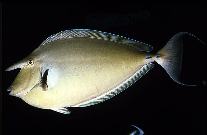
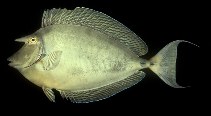
Espinas dorsales (total) : 6; Radios blandos dorsales (total) : 27 - 30; Espinas anales: 2; Radios blandos anales: 27 - 30. This species is characterized by the following: body depth vary from about 2.0 in SL (in subadults) to 2.4-2.6 (adults) in SL; with a tapering, bony, horn on forehead of adults projecting anteriorly at level of eye but not extending in front of mouth (horn first as a bump on forehead at a length of about 12 cm); dorsal profile from snout to horn straight, angle of about 45°; 2 peduncular plates with well-developed forward-curving knife-like spines; emarginate caudal fin when young, truncate with filamentous lobes in adult; males apparently with longer horn, larger peduncular keels and longer caudal filaments than females of the same size; body yellowish to olivaceous gray dorsally, paler ventrally, with blue peduncular plates and keel spines; lips whitish or blue; blue area is sometimes present around pectoral fin; dorsal and anal fins yellowish with narrow blue margins; caudal fin orangish basally, shading to gray, with a broad, pale greenish posterior border and caudal filaments are edged in blue; one transient color phase is a blotchy pale greenish zone below the spinous portion of dorsal fin that narrows and ends beneath the pectoral fin (Ref. 27362). Body shape (shape guide): short and / or deep; Cross section: compressed.
Adults inhabit channels, moats, lagoon and seaward reefs with strong surge (Ref. 48637). Benthopelagic (Ref. 58302). Typically occurring in small groups. Sometimes solitary (Ref. 90102). Juveniles in shallow protected bays and harbours (Ref. 48637). Mainly diurnal, feed on coarse leafy brown algae like Sargassum. Pair-spawning has been observed. Minimum depth reported taken from Ref. 128797.
Ciclo vital y comportamiento de apareamiento Madurez | Reproducción | Puesta | Huevos | Fecundidad | Larva
Fisiología Composición corporal Nutrientes Consumo del oxígeno Tipo de natación Velocidad de natación Pigmentos visuales Sonido de peces Enfermedades y parásitos Toxicidad (CL50)