Naso unicornis, Bluespine unicornfish : fisheries, gamefish, aquarium

Naso unicornis (Forsskål, 1775)

Bluespine unicornfish
अपना अवलोकन जोड़ें Fish Watcher
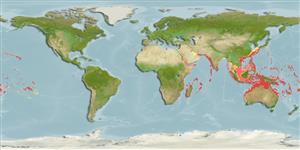
Native range | All suitable habitat | Point map | Year 2050
This map was computer-generated and has not yet been reviewed.
Naso unicornis   AquaMaps   Data sources: GBIF OBIS
अपना अपलोड करें तस्वीरें और वीडियो
तस्वीरे | वीडियो | Google image

वर्गीकरण / नाम आम नाम | उपशब्द | Catalog of Fishes(वर्ग, प्रजाति) | ITIS | CoL | WoRMS | Cloffa

> Acanthuriformes (Surgeonfishes) > Acanthuridae (Surgeonfishes, tangs, unicornfishes) > Nasinae
Etymology: Naso: Latin, nasus = nose (Ref. 45335).
More on author: Forsskål.

पर्यावरण: पर्यावरण / जलवायु क्षेत्र / गहराई सीमा / वितरण सीमा पारिस्थितिकी

समुद्री प्रवाल-भित्ति संयुक्त; गहराई सीमा 0 - 180 m (Ref. 89972). Tropical; 26°C - 29°C (Ref. 27115); 35°N - 33°S, 30°E - 128°W

वितरण प्रदेशों | ऐफ ऐ ओ क्षेत्र | पारिस्थितिकी प्रणालियों | संयोग | बिन्दु नक्शा | भूमिका | Faunafri

Indo-Pacific: Red Sea and East Africa (Ref. 3145) to the Hawaiian, Marquesas and Tuamoto islands, north to southern Japan, south to Lord Howe and Rapa islands. Presence in Somalia to be confirmed (Ref. 30573).

आकार / वज़न / आयु

परिपक्व अवधि: Lm ?  range ? - ? cm
Max length : 70.0 cm FL पुल्लिंग / अलिंग; (Ref. 9710); common length : 50.0 cm TL पुल्लिंग / अलिंग; (Ref. 3146); अधिकतम सूचित उम्र: 55 वर्षो (Ref. 118238)

संक्षिप्त वर्णन पहचान कुंजी | आकृति विज्ञान | मौरफोमैटरिक्स

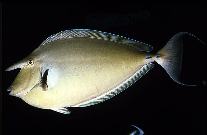
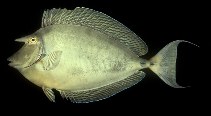
पृष्ठीय रीढ़ (सम्पूर्ण) : 6; पृष्ठीय सौफट रेज़ (सम्पूर्ण) : 27 - 30; गुदा कांटा: 2; ऐनल सौफट रेज़: 27 - 30. This species is characterized by the following: body depth vary from about 2.0 in SL (in subadults) to 2.4-2.6 (adults) in SL; with a tapering, bony, horn on forehead of adults projecting anteriorly at level of eye but not extending in front of mouth (horn first as a bump on forehead at a length of about 12 cm); dorsal profile from snout to horn straight, angle of about 45°; 2 peduncular plates with well-developed forward-curving knife-like spines; emarginate caudal fin when young, truncate with filamentous lobes in adult; males apparently with longer horn, larger peduncular keels and longer caudal filaments than females of the same size; body yellowish to olivaceous gray dorsally, paler ventrally, with blue peduncular plates and keel spines; lips whitish or blue; blue area is sometimes present around pectoral fin; dorsal and anal fins yellowish with narrow blue margins; caudal fin orangish basally, shading to gray, with a broad, pale greenish posterior border and caudal filaments are edged in blue; one transient color phase is a blotchy pale greenish zone below the spinous portion of dorsal fin that narrows and ends beneath the pectoral fin (Ref. 27362).
Body shape (shape guide): short and / or deep; Cross section: compressed.

जीवविज्ञान     शब्द संग्रह (उदाहरणार्थ epibenthic)

Adults inhabit channels, moats, lagoon and seaward reefs with strong surge (Ref. 48637). Benthopelagic (Ref. 58302). Typically occurring in small groups. Sometimes solitary (Ref. 90102). Juveniles in shallow protected bays and harbours (Ref. 48637). Mainly diurnal, feed on coarse leafy brown algae like Sargassum. Pair-spawning has been observed. Minimum depth reported taken from Ref. 128797.

जीवन चक्र और संभोग व्यवहार परिपक्व अवधि | पुनरुत्पत्ति | मछलीऔ का अंडे देना | अंडे | उपजाऊपन | लार्वा

Spawn in pairs (Ref. 240).

मुख्य संदर्भ अपने संदर्भ अपलोड करें | संदर्भ | संयोजक : Randall, John E. | सहयोगीयो

Myers, R.F., 1991. Micronesian reef fishes. Second Ed. Coral Graphics, Barrigada, Guam. 298 p. (Ref. 1602)

आईयूसीएन रेड लिस्ट स्थिति (Ref. 130435: Version 2025-2 (Global))

  Least Concern (LC) ; Date assessed: 07 May 2010

CITES

Not Evaluated

CMS (Ref. 116361)

Not Evaluated

मनुष्यों के लिए ख़तरा

  Reports of ciguatera poisoning (Ref. 4795)


मानव उपयोग

मात्स्यिकी: व्यापारिक; आखेट मत्स्य: हां; जलजीवालय: व्यापारिक
FAO - मात्स्यिकी: उतरने; Publication: search | FishSource | हमारे चारों ओर समुद्र

अधिक जानकारी

ट्रॉफिक पारिस्थितिकी
खाद्य पदार्थ (शिकार)
संघटक आहार
आहार खपत
खाद्यान्न राशन
परभक्षी
पारिस्थितिकी
पारिस्थितिकी
जनसंख्या गतिशीलता
विकास मापदंड
अधिकतम आयु/आकार
लंबाई-वजन संबंध
लंबाई-लंबाई संबंध
लंबाई-आवृत्तियाँ
सामूहिक रूपांतरण
भर्ती
बहुतायत
जीवन चक्र
पुनरुत्पत्ति
परिपक्व अवधि
परिपक्वता/गिल्स संबंध
उपजाऊपन
मछलीऔ का अंडे देना
स्पॉनिंग एकत्रीकरण
अंडे
अंडे का विकास
लार्वा
लारवल गतिकी
शरीर रचना
गिल क्षेत्र
दिमाग
ओटोलिथ
फिजियोलॉजी
शारीरिक संरचना
पोषक तत्व
प्राणवायु की खपत
तैराकी का प्रकार
तैराकी की गति
दृश्य वर्णक
मछली की आवाज
रोग एवं परजीवी
विषाक्तता (LC50s)
आनुवंशिकी
जीनोम
आनुवंशिकी
विषमयुग्मजी
हैरेटिबिलटी
आनुवंशिक विविधता
मानव संबंधी
जलकृषि प्रणालियाँ
जलीयकृषि रूपरेखाऐ
खींच
सिगुएटेरा के मामले
टिकट, सिक्के, विविध.
आउटरीच
सहयोगीयो
संदर्भ
संदर्भ

साधन

विशेष रिपोर्ट

XML डाउनलोड करें

इंटरनेट स्रोत

मॉडल पर आधारित अनुमान

पसंदीदा तापमान (संदर्भ 123201): 23.4 - 28.8, mean 27.4 °C (based on 1536 cells).
जातिवृति विविधता सूचकांक (संदर्भ 82804):  PD50 = 0.5000   [Uniqueness, from 0.5 = low to 2.0 = high].
Bayesian length-weight: a=0.02399 (0.01795 - 0.03206), b=2.94 (2.86 - 3.02), in cm total length, based on LWR estimates for this species (Ref. 93245).
ट्रॉफिक स्तर (संदर्भ 69278):  2.2   ±0.11 se; based on food items.
लौटाव (संदर्भ 120179):  बहुत नीचे, न्यूनतम जनसंख्या दुगनी समय अवलागत 14 महीने। (K=0.14; tmax=54.5).
Prior r = 0.28, 95% CL = 0.18 - 0.42, Based on 3 data-limited stock assessments.
मछली पकड़ने की भेद्यता (Ref. 59153):  Low to moderate vulnerability (32 of 100). 🛈
जलवायु भेद्यता (Ref. 125649):  Very high vulnerability (80 of 100). 🛈
मूल्य श्रेणी (Ref. 80766):   Medium.
पोषक तत्व (Ref. 124155):  Calcium = 33.3 [16.8, 58.2] mg/100g; Iron = 0.554 [0.285, 1.039] mg/100g; Protein = 18.4 [17.1, 19.7] %; Omega3 = 0.109 [0.065, 0.196] g/100g; Selenium = 58.8 [29.8, 118.5] μg/100g; VitaminA = 21.5 [5.0, 90.1] μg/100g; Zinc = 1.03 [0.66, 1.54] mg/100g (wet weight);