



Ladda upp din foton och Videor
Bilder | Frimärken, mynt, diverse. | Google image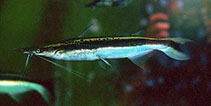 Sorubim lima
Bild av JJPhoto
Bilder | Frimärken, mynt, diverse. | Google image
Bild av JJPhoto
Klassificering / Namn Populärnamn | synonymer | Catalog of Fishes(Släkte, Arter) | ITIS | CoL | WoRMS | Cloffa
> Siluriformes (Catfishes) > Pimelodidae (Long-whiskered catfishes)
Etymology: Sorubim: Brazilian local name, sorubim (Ref. 45335); lima: Name from Latin 'lima' meaning file, referring to the ventrally exposed premaxillary tooth patch (Ref. 57983).
More on authors: Bloch & Schneider.
Etymology: Sorubim: Brazilian local name, sorubim (Ref. 45335); lima: Name from Latin 'lima' meaning file, referring to the ventrally exposed premaxillary tooth patch (Ref. 57983).
More on authors: Bloch & Schneider.
Miljö: miljö / Klimatzon / djupintervall / distributionsområde Ekologi
; sötvatten bottenlevande; pH range: 6.5 - 7.8; dH range: ? - 20; flodvandrande (Ref. 138143). Tropical; 23°C - 30°C (Ref. 1672); 8°N - 11°S
Utbredning Territorier | FAO områden | Ekosystem | Förekomster | Prickkarta | Utplanteringar | Faunafri
South America: Amazon, Orinoco, Paraná and Parnaíba River basins. Syntopic with S. elongatus in the Orinoco basin and with S. elongatus and S. maniradii in the upper Amazon drainage of Brazil, Ecuador, Peru, and Bolivia (Ref. 57983).
Längd vid första mognad / Storlek / Vikt / Ålder
Könsmognad: Lm 23.2 range ? - ? cm
Max length : 54.2 cm TL hane/ej könsbestämd; (Ref. 79585); publicerad maxvikt: 1.3 kg (Ref. 40637)
Max length : 54.2 cm TL hane/ej könsbestämd; (Ref. 79585); publicerad maxvikt: 1.3 kg (Ref. 40637)
Kort beskrivning Bestämningsnycklar | Morfologi | Morfometri
Taggstrålar i ryggfenan (totalt) : 2; Mjukstrålar i ryggfenan (totalt) : 6; Mjukstrålar i analfenan: 19 - 22. Distinguished from S. elongatus by having modally 9 pectoral rays; 21 anal-fin rays; 16 gill rakers; large vomerine tooth patches, almost always fused; a more robust, deeper head and body; body somewhat compressed laterally; mental barbels equal or anterior to gular apex. Differs from S. cuspicaudus in having rounded caudal fin lobes and more robust body; from S. trigonocephalus by premaxillary tooth patch length being 1.5 to 2.5 times its width; trenchantly differs from S. maniradii in having only 13-18 gill rakers. Additionally, other distinguishing characters include, pelvic fins that contact or nearly reach anal fin origin when depressed and presence of thin plates or ossicles (highly variable in shape) extending vertically on anterior lateral line in most large adults (Ref. 57983).
Body shape (shape guide): elongated.
Body shape (shape guide): elongated.
Adults occur in schools and are mainly nocturnal. They feed primarily on fishes and crustaceans (Ref. 9084).
Livscykel och parningsbeteende Könsmognad | Reproduktion | Lek | Ägg | Fekunditet | Larver
Verify.
Huvudreferens
Ladda upp dina referenser | referenser | Koordinator | Medarbetare
Lundberg, J.G. and M.W. Littmann, 2003. Pimelodidae (Long-whiskered catfishes). p. 432-446. In R.E. Reis, S.O. Kullander and C.J. Ferraris, Jr. (eds.) Checklist of the Freshwater Fishes of South and Central America. Porto Alegre: EDIPUCRS, Brasil. (Ref. 36506)
Status på IUCN:s rödlista (Ref. 130435: Version 2025-2 (Global))
Least Concern (LC) ; Date assessed: 07 November 2018
CITES
Not Evaluated
Hot mot människor
Harmless
Mänskliga användningsområden
Fiskeri: mindre kommeriell; Akvarium: Kommersiell
FAO - Vattenbrukssystem: produktion; ; Publication: search | FishSource |
Ytterligare information
Populationsdynamik
Tillväxtparametrar
Max. åldrar / storlekar
Längd-vikt rel.
Längd-längd rel.
Längd-frekvenser
Massakonvertering
Rekrytering
Abundans
Tillväxtparametrar
Max. åldrar / storlekar
Längd-vikt rel.
Längd-längd rel.
Längd-frekvenser
Massakonvertering
Rekrytering
Abundans
Livscykel
Reproduktion
Könsmognad
Mognad/Gills rel.
Fekunditet
Lek
Lekande aggregat
Ägg
Utveckling av ägg
Larver
Larvdynamik
Reproduktion
Könsmognad
Mognad/Gills rel.
Fekunditet
Lek
Lekande aggregat
Ägg
Utveckling av ägg
Larver
Larvdynamik
Anatomi
Gälyta
Hjärna
Otolit
Gälyta
Hjärna
Otolit
Fysiologi
Kroppssammansättning
Näringsämnen
Syreförbrukning
Typ av simning
Simhastighet
Visuella pigment
Ljud från fisk
Sjukdomar & Parasiter
Toxicitet (LC50)
Kroppssammansättning
Näringsämnen
Syreförbrukning
Typ av simning
Simhastighet
Visuella pigment
Ljud från fisk
Sjukdomar & Parasiter
Toxicitet (LC50)
Människorelaterad
Vattenbrukssystem
Vattenbruksprofiler
Avelslinjer
Ciguatera-fall
Frimärken, mynt, diverse.
Vattenbrukssystem
Vattenbruksprofiler
Avelslinjer
Ciguatera-fall
Frimärken, mynt, diverse.
Verktyg
Organisk frågesport | E-bok | Fälthandbok | Längdfördelnings-verktyg | Livshistorie-verktyg | Prickkarta |
Fångst-MSY |
Särskilda rapporter
Kontrollera för underhåll av akvarium | Kontrollera om det finns faktablad om arter | Kontrollera om det finns faktablad om vattenbruk
Ladda ner XML
Internet-källor
AFORO (otoliths) | Aquatic Commons | BHL | Cloffa | Websites from users | Check FishWatcher | CISTI | Catalog of Fishes: Släkte, Arter | DiscoverLife | ECOTOX | FAO - Vattenbrukssystem: produktion; ; Publication: search | Faunafri | Fishipedia | Fishtrace | GloBI | Google Books | Google Scholar | Google | IGFA World Record | Nationella databaser | OneZoom | Open Tree of Life | Otolith Atlas of Taiwan Fishes | Offentliga akvarier | PubMed | Reef Life Survey | Socotra Atlas | TreeBase | Tree of Life | Wikipedia: Go, sök | World Records Freshwater Fishing | Zoologiskt register
Uppskattningar baserade på modeller
Index för fylogenetisk mångfald (Ref. 82804): PD50 = 0.5312 [Uniqueness, from 0.5 = low to 2.0 = high].
Bayesian length-weight: a=0.00468 (0.00311 - 0.00702), b=3.13 (3.01 - 3.25), in cm total length, based on LWR estimates for this species & Genus-body shape (Ref. 93245).
Trofisk nivå (Ref. 69278): 4.1 ±0.71 se; based on food items.
Generation time: 4.1 ( na - na) years. Estimated as median ln(3)/K based on 1 growth studies.
Resiliens (Ref. 120179): Mellan, lägsta populationsfördubblingstid 1,4-4,4 år (K=0.27).
Näringsämnen (Ref. 124155): Calcium = 95.5 [37.7, 231.7] mg/100g; Iron = 1.28 [0.70, 2.50] mg/100g; Protein = 16.7 [14.8, 18.9] %; Omega3 = 0.307 [0.130, 0.720] g/100g; Selenium = 76.9 [33.5, 186.9] μg/100g; VitaminA = 33.4 [13.1, 77.6] μg/100g; Zinc = 1.27 [0.90, 1.77] mg/100g (wet weight); based on nutrient studies.