



Hochladen Photos und videos
Bilder | Briefmarken, Münzen, Verschiedenes. | Google Bild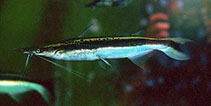 Sorubim lima
Photo von JJPhoto
Bilder | Briefmarken, Münzen, Verschiedenes. | Google Bild
Photo von JJPhoto
Klassifizierung / Names Namen | Synonyme | Catalog of Fishes(Gattung, Arten) | ITIS | CoL | WoRMS | Cloffa
> Siluriformes (Catfishes) > Pimelodidae (Long-whiskered catfishes)
Etymology: Sorubim: Brazilian local name, sorubim (Ref. 45335); lima: Name from Latin 'lima' meaning file, referring to the ventrally exposed premaxillary tooth patch (Ref. 57983).
More on authors: Bloch & Schneider.
Etymology: Sorubim: Brazilian local name, sorubim (Ref. 45335); lima: Name from Latin 'lima' meaning file, referring to the ventrally exposed premaxillary tooth patch (Ref. 57983).
More on authors: Bloch & Schneider.
Umwelt: Milieu / Klimazone / Tiefenbereich / Verbreitungsgebiet Ökologie
; süßwasser demersal; pH range: 6.5 - 7.8; dH range: ? - 20; potamodrom (Ref. 138143). Tropical; 23°C - 30°C (Ref. 1672); 8°N - 11°S
Verbreitung Territorien | FAO Gebiete | Ökosysteme | Vorkommen | Punkt Karte | Einführungen | Faunafri
South America: Amazon, Orinoco, Paraná and Parnaíba River basins. Syntopic with S. elongatus in the Orinoco basin and with S. elongatus and S. maniradii in the upper Amazon drainage of Brazil, Ecuador, Peru, and Bolivia (Ref. 57983).
Länge bei der ersten Reifung / Größe / Gewicht / Alter
Geschlechtsreife: Lm 23.2 range ? - ? cm
Max length : 54.2 cm TL Männchen/unbestimmt; (Ref. 79585); max. veröff. Gewicht: 1.3 kg (Ref. 40637)
Max length : 54.2 cm TL Männchen/unbestimmt; (Ref. 79585); max. veröff. Gewicht: 1.3 kg (Ref. 40637)
Kurzbeschreibung Bestimmungsschlüssel | Morphologie | Morphometrie
Rückenflossenstacheln (insgesamt) : 2; Rückenflossenweichstrahlen (insgesamt) : 6; Afterflossenweichstrahlen: 19 - 22. Distinguished from S. elongatus by having modally 9 pectoral rays; 21 anal-fin rays; 16 gill rakers; large vomerine tooth patches, almost always fused; a more robust, deeper head and body; body somewhat compressed laterally; mental barbels equal or anterior to gular apex. Differs from S. cuspicaudus in having rounded caudal fin lobes and more robust body; from S. trigonocephalus by premaxillary tooth patch length being 1.5 to 2.5 times its width; trenchantly differs from S. maniradii in having only 13-18 gill rakers. Additionally, other distinguishing characters include, pelvic fins that contact or nearly reach anal fin origin when depressed and presence of thin plates or ossicles (highly variable in shape) extending vertically on anterior lateral line in most large adults (Ref. 57983).
Body shape (shape guide): elongated.
Body shape (shape guide): elongated.
Adults occur in schools and are mainly nocturnal. They feed primarily on fishes and crustaceans (Ref. 9084).
Lebenszyklus und Paarungsverhalten Geschlechtsreife | Fortpflanzung | Ablaichen | Eier | Fruchtbarkeit | Larven
Verify.
Hauptreferenz
Laden Sie Ihre Referenzen hoch | Referenzen | Koordinator | Partner
Lundberg, J.G. and M.W. Littmann, 2003. Pimelodidae (Long-whiskered catfishes). p. 432-446. In R.E. Reis, S.O. Kullander and C.J. Ferraris, Jr. (eds.) Checklist of the Freshwater Fishes of South and Central America. Porto Alegre: EDIPUCRS, Brasil. (Ref. 36506)
IUCN Rote Liste Status (Ref. 130435: Version 2025-2 (Global))
nicht bedroht (LC) ; Date assessed: 07 November 2018
CITES
Not Evaluated
Bedrohung für Menschen
Harmless
Nutzung durch Menschen
Fischereien: weniger kommerziell; Aquarium: Kommerziell
FAO - Aquakultur-Systeme: produktion; ; Publication: search | FishSource |
Mehr Information
Trophische Ökologie
Lebensmittel (Beutetiere)
Nahrungszusammensetzung
Nahrungsaufnahme
Lebensmittelrationen
Räuber
Lebensmittel (Beutetiere)
Nahrungszusammensetzung
Nahrungsaufnahme
Lebensmittelrationen
Räuber
Populationsdynamik
Wachstumsparameter
Max. Alter/Größen
Länge-Gewicht-Rel.
Länge-Länge-Verhältnis.
Längenhäufigkeiten
Massenkonvertierung
Rekrutierung
Dichte
Wachstumsparameter
Max. Alter/Größen
Länge-Gewicht-Rel.
Länge-Länge-Verhältnis.
Längenhäufigkeiten
Massenkonvertierung
Rekrutierung
Dichte
Lebenszyklus
Fortpflanzung
Geschlechtsreife
Reifung/Kiemen rel.
Fruchtbarkeit
Ablaichen
Laichaggregationen
Eier
Eientwicklung
Larven
Larven Pop.Dyn.
Fortpflanzung
Geschlechtsreife
Reifung/Kiemen rel.
Fruchtbarkeit
Ablaichen
Laichaggregationen
Eier
Eientwicklung
Larven
Larven Pop.Dyn.
Anatomie
Kiemenoberfläche
Gehirn
Otolith
Kiemenoberfläche
Gehirn
Otolith
Physiologie
Körperliche Zusammensetzung
Nährstoffe
Sauerstoffverbrauch
Schwimmart
Schwimmgeschwindigkeit
Visuelle Pigmente
Fischgeräusche
Krankheiten und Parasiten
Toxizität (LC50s)
Körperliche Zusammensetzung
Nährstoffe
Sauerstoffverbrauch
Schwimmart
Schwimmgeschwindigkeit
Visuelle Pigmente
Fischgeräusche
Krankheiten und Parasiten
Toxizität (LC50s)
Menschenbezogen
Aquakultur-Systeme
Aquakultur Profile
Zuchtlinien
Ciguatera-Fälle
Briefmarken, Münzen, Verschiedenes.
Aquakultur-Systeme
Aquakultur Profile
Zuchtlinien
Ciguatera-Fälle
Briefmarken, Münzen, Verschiedenes.
Tools
Bio-Quiz | E-Book | Feldführer | Längenhäufigkeits Tool | Lebensdaten Tool | Punkt Karte |
Catch-MSY |
Zusatzinformationen
Download XML
Zusammenfassung | Punktdaten | Namen | Photos
Internet Quellen
AFORO (otoliths) | Aquatic Commons | BHL | Cloffa | Websites from users | FishWatcher Einträge suchen | CISTI | Catalog of Fishes: Gattung, Arten | DiscoverLife | ECOTOX | FAO - Aquakultur-Systeme: produktion; ; Publication: search | Faunafri | Fishipedia | Fishtrace | GloBI | Google Books | Google Scholar | Google | IGFA World Record | Nationale Datenbanken | OneZoom | Open Tree of Life | Otolith Atlas of Taiwan Fishes | Öffentliche Aquarien | PubMed | Reef Life Survey | Socotra Atlas | TreeBase | Tree of Life | Wikipedia: Gehe zu, Suchen | World Records Freshwater Fishing | Zoologischer Rekord
Schätzungen auf der Grundlage von Modellen
Phylogenetischer Diversitätsindex (Ref. 82804): PD50 = 0.5312 [Uniqueness, from 0.5 = low to 2.0 = high].
Bayesian length-weight: a=0.00468 (0.00311 - 0.00702), b=3.13 (3.01 - 3.25), in cm total length, based on LWR estimates for this species & Genus-body shape (Ref. 93245).
Trophische Ebene (Ref. 69278): 4.1 ±0.71 se; based on food items.
Generation time: 4.1 ( na - na) years. Estimated as median ln(3)/K based on 1 growth studies.
Widerstandsfähigkeit (Ref. 120179): mittel, Verdopplung der Population dauert 1,4 - 4,4 Jahre. (K=0.27).
Nährstoffe (Ref. 124155): Calcium = 95.5 [37.7, 231.7] mg/100g; Iron = 1.28 [0.70, 2.50] mg/100g; Protein = 16.7 [14.8, 18.9] %; Omega3 = 0.307 [0.130, 0.720] g/100g; Selenium = 76.9 [33.5, 186.9] μg/100g; VitaminA = 33.4 [13.1, 77.6] μg/100g; Zinc = 1.27 [0.90, 1.77] mg/100g (wet weight); based on nutrient studies.