



Carica il tuo foto e Video
Immagini | Francobolli, monete, materiale vario. | Google image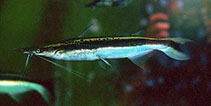 Sorubim lima
Immagine di JJPhoto
Immagini | Francobolli, monete, materiale vario. | Google image
Immagine di JJPhoto
Classificazione / Nomi Nomi Comuni | Sinonimi | Catalog of Fishes(Genere, Specie) | ITIS | CoL | WoRMS | Cloffa
> Siluriformes (Catfishes) > Pimelodidae (Long-whiskered catfishes)
Etymology: Sorubim: Brazilian local name, sorubim (Ref. 45335); lima: Name from Latin 'lima' meaning file, referring to the ventrally exposed premaxillary tooth patch (Ref. 57983).
More on authors: Bloch & Schneider.
Etymology: Sorubim: Brazilian local name, sorubim (Ref. 45335); lima: Name from Latin 'lima' meaning file, referring to the ventrally exposed premaxillary tooth patch (Ref. 57983).
More on authors: Bloch & Schneider.
Ambiente: milieu / zona climatica / distribuzione batimetrica / gamma di distribuzione Ecologia
; acqua dolce demersale; pH range: 6.5 - 7.8; dH range: ? - 20; potamodromo (Ref. 138143). Tropical; 23°C - 30°C (Ref. 1672); 8°N - 11°S
Distribuzione Territories | Aree FAO | Ecosistemi | Presenze | Mappa dei ritrovamenti | Introduzioni | Faunafri
South America: Amazon, Orinoco, Paraná and Parnaíba River basins. Syntopic with S. elongatus in the Orinoco basin and with S. elongatus and S. maniradii in the upper Amazon drainage of Brazil, Ecuador, Peru, and Bolivia (Ref. 57983).
Lunghezza alla prima maturità / Dimensione / Peso / Età
Maturità: Lm 23.2 range ? - ? cm
Max length : 54.2 cm TL maschio/sesso non determinato; (Ref. 79585); peso massimo pubblicato: 1.3 kg (Ref. 40637)
Max length : 54.2 cm TL maschio/sesso non determinato; (Ref. 79585); peso massimo pubblicato: 1.3 kg (Ref. 40637)
Breve descrizione Chiavi di identificazione | Morfologia | Morfometria
Spine dorsali (totale) : 2; Raggi dorsali molli (totale) : 6; Raggi anali molli: 19 - 22. Distinguished from S. elongatus by having modally 9 pectoral rays; 21 anal-fin rays; 16 gill rakers; large vomerine tooth patches, almost always fused; a more robust, deeper head and body; body somewhat compressed laterally; mental barbels equal or anterior to gular apex. Differs from S. cuspicaudus in having rounded caudal fin lobes and more robust body; from S. trigonocephalus by premaxillary tooth patch length being 1.5 to 2.5 times its width; trenchantly differs from S. maniradii in having only 13-18 gill rakers. Additionally, other distinguishing characters include, pelvic fins that contact or nearly reach anal fin origin when depressed and presence of thin plates or ossicles (highly variable in shape) extending vertically on anterior lateral line in most large adults (Ref. 57983).
Body shape (shape guide): elongated.
Body shape (shape guide): elongated.
Adults occur in schools and are mainly nocturnal. They feed primarily on fishes and crustaceans (Ref. 9084).
Ciclo vitale e comportamento di accoppiamento Maturità | Riproduzione | Deposizione | Uova | Fecondità | Larve
Verify.
Riferimento principale
Caricare le referenze | Bibliografia | Coordinatore | Collaboratori
Lundberg, J.G. and M.W. Littmann, 2003. Pimelodidae (Long-whiskered catfishes). p. 432-446. In R.E. Reis, S.O. Kullander and C.J. Ferraris, Jr. (eds.) Checklist of the Freshwater Fishes of South and Central America. Porto Alegre: EDIPUCRS, Brasil. (Ref. 36506)
Stato della Lista Rossa IUCN (Ref. 130435: Version 2025-2 (Global))
Least Concern (LC) ; Date assessed: 07 November 2018
CITES
Not Evaluated
Minaccia per l'uomo
Harmless
Usi umani
Pesca: scarso interesse commerciale; Acquario: Commerciale
FAO - Sistemi di acquacoltura: produzione; ; Publication: search | FishSource |
Informazioni ulteriori
Ecologia trofica
Articoli alimentari (prede)
Alimentazione
Consumo di cibo
Razioni alimentari
Predatori
Articoli alimentari (prede)
Alimentazione
Consumo di cibo
Razioni alimentari
Predatori
Dinamica della popolazione
Parametri di crescita
Età massima / dimensioni massime
Rapporto lunghezza-peso.
Lunghezza-lunghezza rel.
Lunghezza-frequenze
Conversione di massa
Reclutamento
Abbondanza
Parametri di crescita
Età massima / dimensioni massime
Rapporto lunghezza-peso.
Lunghezza-lunghezza rel.
Lunghezza-frequenze
Conversione di massa
Reclutamento
Abbondanza
Ciclo di vita
Riproduzione
Maturità
Maturità/Gli occhielli sono relativi.
Fecondità
Deposizione
Aggregazioni riproduttive
Uova
Sviluppo delle uova
Larve
Dinamica popolazioni larvali
Riproduzione
Maturità
Maturità/Gli occhielli sono relativi.
Fecondità
Deposizione
Aggregazioni riproduttive
Uova
Sviluppo delle uova
Larve
Dinamica popolazioni larvali
Anatomia
Area branchiale
Cervello
Otolite
Area branchiale
Cervello
Otolite
Fisiologia
Composizione corporea
Nutrienti
Consumo di ossigeno
Tipo di nuoto
Velocità di nuoto
Pigmenti visivi
Suono del pesce
Malattie e parassiti
Tossicità (LC50)
Composizione corporea
Nutrienti
Consumo di ossigeno
Tipo di nuoto
Velocità di nuoto
Pigmenti visivi
Suono del pesce
Malattie e parassiti
Tossicità (LC50)
Legato all'uomo
Sistemi di acquacoltura
Profili di acquacoltura
Varietà
Casi di Ciguatera
Francobolli, monete, materiale vario.
Sistemi di acquacoltura
Profili di acquacoltura
Varietà
Casi di Ciguatera
Francobolli, monete, materiale vario.
Strumenti
Quiz organico | Libro elettronico | Giuda pratica | Generatore frequenze di lunghezza | Strumento Parametri Biologici | Mappa dei ritrovamenti |
Cattura-MSY |
Rapporti speciali
Controllo della manutenzione dell'acquario | Verificare la presenza di schede informative sulle specie | Verifica delle schede informative sull'acquacoltura
Scarica XML
Fonti Internet
AFORO (otoliths) | Aquatic Commons | BHL | Cloffa | Websites from users | Check FishWatcher | CISTI | Catalog of Fishes: Genere, Specie | DiscoverLife | ECOTOX | FAO - Sistemi di acquacoltura: produzione; ; Publication: search | Faunafri | Fishipedia | Fishtrace | GloBI | Google Books | Google Scholar | Google | IGFA World Record | Database Nazionali | OneZoom | Open Tree of Life | Otolith Atlas of Taiwan Fishes | Acquari pubblici | PubMed | Reef Life Survey | Socotra Atlas | TreeBase | Tree of Life | Wikipedia: Go, ricerca | World Records Freshwater Fishing | Record zoologico
Stime basate su modelli
Indice di diversità filogenetica (Fonte Biblio. 82804): PD50 = 0.5312 [Uniqueness, from 0.5 = low to 2.0 = high].
Bayesian length-weight: a=0.00468 (0.00311 - 0.00702), b=3.13 (3.01 - 3.25), in cm total length, based on LWR estimates for this species & Genus-body shape (Ref. 93245).
Livello trofico (Fonte Biblio. 69278): 4.1 ±0.71 se; based on food items.
Generation time: 4.1 ( na - na) years. Estimated as median ln(3)/K based on 1 growth studies.
Resilienza (Fonte Biblio. 120179): Medio, tempo minimo di raddoppiamento della popolazione 1.4 - 4.4 anni (K=0.27).
Nutrienti (Ref. 124155): Calcium = 95.5 [37.7, 231.7] mg/100g; Iron = 1.28 [0.70, 2.50] mg/100g; Protein = 16.7 [14.8, 18.9] %; Omega3 = 0.307 [0.130, 0.720] g/100g; Selenium = 76.9 [33.5, 186.9] μg/100g; VitaminA = 33.4 [13.1, 77.6] μg/100g; Zinc = 1.27 [0.90, 1.77] mg/100g (wet weight); based on nutrient studies.