



Mycteroperca interstitialis (Poey, 1860)
Yellowmouth grouper
Lägg till din observation i Fish Watcher
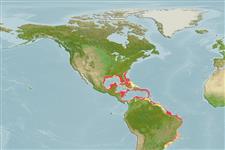
| Native range | All suitable habitat | Point map | Year 2050 |
|
| This map was computer-generated and has not yet been reviewed. |
| Mycteroperca interstitialis AquaMaps Data sources: GBIF OBIS |

Klassificering / Namn Populärnamn | synonymer | Catalog of Fishes(Släkte, Arter) | ITIS | CoL | WoRMS | Cloffa
> Perciformes/Serranoidei (Groupers) > Epinephelidae (Groupers)
Etymology: Mycteroperca: Greek, mykter, -eros = nose + Greek, perke = perch (Ref. 45335).
More on author: Poey.
Etymology: Mycteroperca: Greek, mykter, -eros = nose + Greek, perke = perch (Ref. 45335).
More on author: Poey.
Miljö: miljö / Klimatzon / djupintervall / distributionsområde Ekologi
marina revassocierade; djupintervall 2 - 150 m (Ref. 5222), usually 2 - 35 m (Ref. 40849). Subtropical; 33°N - 28°S, 98°W - 28°W (Ref. 5222)
Utbredning Territorier | FAO områden | Ekosystem | Förekomster | Prickkarta | Utplanteringar | Faunafri
Western Atlantic: Gulf of Mexico, Bermuda, Caribbean (mainly insular localities), and Brazil.
Storlek / Vikt / Ålder
Könsmognad: Lm ? range ? - ? cm
Max length : 84.0 cm TL hane/ej könsbestämd; (Ref. 40637); common length : 40.0 cm TL hane/ej könsbestämd; (Ref. 5217); publicerad maxvikt: 10.2 kg (Ref. 40637); rapporterad maxålder: 41 år (Ref. 36872)
Max length : 84.0 cm TL hane/ej könsbestämd; (Ref. 40637); common length : 40.0 cm TL hane/ej könsbestämd; (Ref. 5217); publicerad maxvikt: 10.2 kg (Ref. 40637); rapporterad maxålder: 41 år (Ref. 36872)
Kort beskrivning Bestämningsnycklar | Morfologi | Morfometri
Taggstrålar i ryggfenan (totalt) : 11; Mjukstrålar i ryggfenan (totalt) : 16 - 18; Taggstrålar i analfenan: 3; Mjukstrålar i analfenan: 10 - 12. Distinguished by the following characteristics: Tan to brown above, paler below; upper parts of head and most of body usually have small, brown, close-set spots; sometimes uniformly brown. Adults have exerted rays that are even and about equal in length; 23-27 total gill rakers (Ref. 26938); depth of body 3.0-3.4 times in SL; head length 2.8-3.0 times in SL; angular preopercle, enlarged serrae on prominent lobe at the angle and a distinct notch above the serrate lobe; greatly enlarged posterior nostrils in adults (Ref. 89707).
Body shape (shape guide): fusiform / normal; Cross section: oval.
Body shape (shape guide): fusiform / normal; Cross section: oval.
Found mainly on rocky or coral bottoms from the shoreline to at least 55 m depth; small and middle-sized individuals commonly occur in mangrove-lined lagoons. Feeds on fishes. Sex-reversal observed (Ref. 5521). More common in island waters than along the coast (Ref. 26938). The tricolored pattern of the juveniles mimics that of the juveniles of the clown wrasse, Halichoeres maculipinna. The aggressive mimic’s behavior includes folding down the median and caudal fins, which adds to its wrasse imitation and allows it to approach its otherwise wary prey (Ref. 43465). Marketed fresh; flesh is of good quality.
Livscykel och parningsbeteende Könsmognad | Reproduktion | Lek | Ägg | Fekunditet | Larver
Pelagic spawner (Ref. 32199).
Huvudreferens
Ladda upp dina referenser | referenser | Koordinator | Medarbetare
Heemstra, P.C. and J.E. Randall, 1993. FAO Species Catalogue. Vol. 16. Groupers of the world (family Serranidae, subfamily Epinephelinae). An annotated and illustrated catalogue of the grouper, rockcod, hind, coral grouper and lyretail species known to date. Rome: FAO. FAO Fish. Synop. 125(16):382 p. (Ref. 5222)
Status på IUCN:s rödlista (Ref. 130435: Version 2025-2 (Global))
Sårbar (VU) (A4bd); Date assessed: 21 November 2016
CITES
Not Evaluated
Hot mot människor
Harmless
Mänskliga användningsområden
Fiskeri: kommersiell; sportfisk: ja; Akvarium: Offentliga akvarier
FAO - Publication: search | FIRMS - Stock assessments | FishSource | Havet omkring oss
Ytterligare information
Populationsdynamik
Tillväxtparametrar
Max. åldrar / storlekar
Längd-vikt rel.
Längd-längd rel.
Längd-frekvenser
Massakonvertering
Rekrytering
Abundans
Tillväxtparametrar
Max. åldrar / storlekar
Längd-vikt rel.
Längd-längd rel.
Längd-frekvenser
Massakonvertering
Rekrytering
Abundans
Livscykel
Reproduktion
Könsmognad
Mognad/Gills rel.
Fekunditet
Lek
Lekande aggregat
Ägg
Utveckling av ägg
Larver
Larvdynamik
Reproduktion
Könsmognad
Mognad/Gills rel.
Fekunditet
Lek
Lekande aggregat
Ägg
Utveckling av ägg
Larver
Larvdynamik
Anatomi
Gälyta
Hjärna
Otolit
Gälyta
Hjärna
Otolit
Fysiologi
Kroppssammansättning
Näringsämnen
Syreförbrukning
Typ av simning
Simhastighet
Visuella pigment
Ljud från fisk
Sjukdomar & Parasiter
Toxicitet (LC50)
Kroppssammansättning
Näringsämnen
Syreförbrukning
Typ av simning
Simhastighet
Visuella pigment
Ljud från fisk
Sjukdomar & Parasiter
Toxicitet (LC50)
Människorelaterad
Vattenbrukssystem
Vattenbruksprofiler
Avelslinjer
Ciguatera-fall
Frimärken, mynt, diverse.
Vattenbrukssystem
Vattenbruksprofiler
Avelslinjer
Ciguatera-fall
Frimärken, mynt, diverse.
Verktyg
Organisk frågesport | E-bok | Fälthandbok | Bestämningsnycklar | Längdfördelnings-verktyg | Livshistorie-verktyg | Prickkarta |
Fångst-MSY |
Särskilda rapporter
Kontrollera för underhåll av akvarium | Kontrollera om det finns faktablad om arter | Kontrollera om det finns faktablad om vattenbruk
Ladda ner XML
Internet-källor
AFORO (otoliths) | Aquatic Commons | BHL | Cloffa | Websites from users | Check FishWatcher | CISTI | Catalog of Fishes: Släkte, Arter | DiscoverLife | ECOTOX | FAO - Publication: search | Faunafri | Fishipedia | Fishtrace | GloBI | GoMexSI (interaction data) | Google Books | Google Scholar | Google | IGFA World Record | Nationella databaser | OneZoom | Open Tree of Life | Otolith Atlas of Taiwan Fishes | PubMed | Reef Life Survey | Socotra Atlas | TreeBase | Tree of Life | Wikipedia: Go, sök | World Records Freshwater Fishing | Zoologiskt register
Uppskattningar baserade på modeller
Önskad temperatur (Ref. 123201): 23.3 - 28, mean 26.4 °C (based on 460 cells).
Index för fylogenetisk mångfald (Ref. 82804): PD50 = 0.5000 [Uniqueness, from 0.5 = low to 2.0 = high].
Bayesian length-weight: a=0.00646 (0.00393 - 0.01061), b=3.06 (2.93 - 3.19), in cm total length, based on LWR estimates for this species & Genus-body shape (Ref. 93245).
Trofisk nivå (Ref. 69278): 4.5 ±0.8 se; based on diet studies.
Resiliens (Ref. 120179): Låg, lägsta populationsfördubblingstid 4,5-14 år (K=0.06; tmax=41).
Näringsämnen (Ref. 124155): Calcium = 12.7 [7.2, 26.6] mg/100g; Iron = 0.445 [0.222, 0.786] mg/100g; Protein = 19.2 [17.4, 20.9] %; Omega3 = 0.22 [0.13, 0.39] g/100g; Selenium = 20.6 [9.7, 42.8] μg/100g; VitaminA = 86.4 [25.1, 331.4] μg/100g; Zinc = 0.542 [0.353, 0.817] mg/100g (wet weight);