



Scomberomorus brasiliensis Collette, Russo & Zavala-Camin, 1978
Serra Spanish mackerel
Beobachtung melden im Fish Watcher
| Native range | All suitable habitat | Point map | Year 2050 |

|
| This map was computer-generated and has not yet been reviewed. |
| Scomberomorus brasiliensis AquaMaps Data sources: GBIF OBIS |
Hochladen Photos und videos
Bilder | Google Bild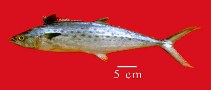 Scomberomorus brasiliensis
Photo von Duarte, L.O.
Bilder | Google Bild
Photo von Duarte, L.O.
Klassifizierung / Names Namen | Synonyme | Catalog of Fishes(Gattung, Arten) | ITIS | CoL | WoRMS | Cloffa
> Scombriformes (Mackerels) > Scombridae (Mackerels, tunas, bonitos) > Scombrinae
Etymology: Scomberomorus: Latin, scomber = mackerel + Greek, moros = silly, stupid (Ref. 45335).
Etymology: Scomberomorus: Latin, scomber = mackerel + Greek, moros = silly, stupid (Ref. 45335).
Umwelt: Milieu / Klimazone / Tiefenbereich / Verbreitungsgebiet Ökologie
Verbreitung Territorien | FAO Gebiete | Ökosysteme | Vorkommen | Punkt Karte | Einführungen | Faunafri
Western Atlantic: along the Caribbean and Atlantic coasts of Central and South America from Belize to Rio Grande do Sul, Brazil. Literature records for Scomberomorus maculatus from the Caribbean and the Atlantic coasts of Central and South America apply to Scomberomorus brasiliensis, which has erroneously been considered a synonym of Scomberomorus maculatus by many authors.
Länge bei der ersten Reifung / Größe / Gewicht / Alter
Geschlechtsreife: Lm 37.0 range ? - ? cm
Max length : 125 cm FL Männchen/unbestimmt; (Ref. 168); common length : 65.0 cm TL Männchen/unbestimmt; (Ref. 9987); max. veröff. Gewicht: 6.7 kg (Ref. 40637)
Max length : 125 cm FL Männchen/unbestimmt; (Ref. 168); common length : 65.0 cm TL Männchen/unbestimmt; (Ref. 9987); max. veröff. Gewicht: 6.7 kg (Ref. 40637)
Kurzbeschreibung Bestimmungsschlüssel | Morphologie | Morphometrie
Rückenflossenstacheln (insgesamt) : 17 - 19; Rückenflossenweichstrahlen (insgesamt) : 15 - 19; Afterflossenstacheln: 2; Afterflossenweichstrahlen: 16 - 20; Wirbelzahl: 47 - 49. Snout much shorter than rest of the head. Interpelvic process short and bifid. Lateral line gradually curving down toward caudal peduncle. Body entirely covered with small scales, no anterior corselet developed. Pelvic fins relatively short. Intestine with 2 folds and 3 limbs. Swim bladder absent. Sides silvery with several rows of round yellowish bronze spots. First dorsal fin black.
Body shape (shape guide): fusiform / normal; Cross section: oval.
Body shape (shape guide): fusiform / normal; Cross section: oval.
Does not migrate extensively, although some seasonal movement appears to occur off Trinidad. Feeds largely on fishes, with smaller quantities of penaeid shrimps and loliginid cephalopods. Most of the catch is consumed fresh, but in Brazil some is salted and some has been canned. Also utilized smoked and frozen; used for ceviche (Ref. 9987).
Lebenszyklus und Paarungsverhalten Geschlechtsreife | Fortpflanzung | Ablaichen | Eier | Fruchtbarkeit | Larven
Hauptreferenz
Laden Sie Ihre Referenzen hoch | Referenzen | Koordinator : Collette, Bruce B. | Partner
Collette, B.B. and C.E. Nauen, 1983. FAO Species Catalogue. Vol. 2. Scombrids of the world. An annotated and illustrated catalogue of tunas, mackerels, bonitos and related species known to date. Rome: FAO. FAO Fish. Synop. 125(2):137 p. (Ref. 168)
IUCN Rote Liste Status (Ref. 130435: Version 2025-2 (Global))
nicht bedroht (LC) ; Date assessed: 01 June 2022
CITES
Not Evaluated
Bedrohung für Menschen
Harmless
Nutzung durch Menschen
Fischereien: kommerziell; Sportfisch: ja
FAO - Fischereien: landungen; Publication: search | FIRMS - Stock assessments | FishSource | Das Meer um uns herum
Mehr Information
Trophische Ökologie
Lebensmittel (Beutetiere)
Nahrungszusammensetzung
Nahrungsaufnahme
Lebensmittelrationen
Räuber
Lebensmittel (Beutetiere)
Nahrungszusammensetzung
Nahrungsaufnahme
Lebensmittelrationen
Räuber
Populationsdynamik
Wachstumsparameter
Max. Alter/Größen
Länge-Gewicht-Rel.
Länge-Länge-Verhältnis.
Längenhäufigkeiten
Massenkonvertierung
Rekrutierung
Dichte
Wachstumsparameter
Max. Alter/Größen
Länge-Gewicht-Rel.
Länge-Länge-Verhältnis.
Längenhäufigkeiten
Massenkonvertierung
Rekrutierung
Dichte
Lebenszyklus
Fortpflanzung
Geschlechtsreife
Reifung/Kiemen rel.
Fruchtbarkeit
Ablaichen
Laichaggregationen
Eier
Eientwicklung
Larven
Larven Pop.Dyn.
Fortpflanzung
Geschlechtsreife
Reifung/Kiemen rel.
Fruchtbarkeit
Ablaichen
Laichaggregationen
Eier
Eientwicklung
Larven
Larven Pop.Dyn.
Anatomie
Kiemenoberfläche
Gehirn
Otolith
Kiemenoberfläche
Gehirn
Otolith
Physiologie
Körperliche Zusammensetzung
Nährstoffe
Sauerstoffverbrauch
Schwimmart
Schwimmgeschwindigkeit
Visuelle Pigmente
Fischgeräusche
Krankheiten und Parasiten
Toxizität (LC50s)
Körperliche Zusammensetzung
Nährstoffe
Sauerstoffverbrauch
Schwimmart
Schwimmgeschwindigkeit
Visuelle Pigmente
Fischgeräusche
Krankheiten und Parasiten
Toxizität (LC50s)
Menschenbezogen
Aquakultur-Systeme
Aquakultur Profile
Zuchtlinien
Ciguatera-Fälle
Briefmarken, Münzen, Verschiedenes.
Aquakultur-Systeme
Aquakultur Profile
Zuchtlinien
Ciguatera-Fälle
Briefmarken, Münzen, Verschiedenes.
Tools
E-Book | Feldführer | Bestimmungsschlüssel | Längenhäufigkeits Tool | Lebensdaten Tool | Punkt Karte |
Catch-MSY |
Zusatzinformationen
Download XML
Zusammenfassung | Punktdaten | Namen | Photos
Internet Quellen
AFORO (otoliths) | Aquatic Commons | BHL | Cloffa | Websites from users | FishWatcher Einträge suchen | CISTI | Catalog of Fishes: Gattung, Arten | DiscoverLife | ECOTOX | FAO - Fischereien: landungen; Publication: search | Faunafri | Fishipedia | Fishtrace | GloBI | Google Books | Google Scholar | Google | IGFA World Record | Nationale Datenbanken | OneZoom | Open Tree of Life | Otolith Atlas of Taiwan Fishes | PubMed | Reef Life Survey | Socotra Atlas | TreeBase | Tree of Life | Wikipedia: Gehe zu, Suchen | World Records Freshwater Fishing | Zoobank | Zoologischer Rekord
Schätzungen auf der Grundlage von Modellen
Bevorzugte Temperatur (Ref. 123201): 24.9 - 28, mean 27.5 °C (based on 176 cells).
Phylogenetischer Diversitätsindex (Ref. 82804): PD50 = 0.5000 [Uniqueness, from 0.5 = low to 2.0 = high].
Bayesian length-weight: a=0.00776 (0.00479 - 0.01258), b=2.97 (2.84 - 3.10), in cm total length, based on LWR estimates for this species & Genus-body shape (Ref. 93245).
Trophische Ebene (Ref. 69278): 3.3 ±0.4 se; based on diet studies.
Widerstandsfähigkeit (Ref. 120179): mittel, Verdopplung der Population dauert 1,4 - 4,4 Jahre. (K=0.18; tm=3-4).
Prior r = 0.56, 95% CL = 0.37 - 0.84, Based on 2 data-limited stock assessments.
Nährstoffe (Ref. 124155): Calcium = 8.97 [3.62, 31.76] mg/100g; Iron = 0.344 [0.142, 0.904] mg/100g; Protein = 20.4 [18.8, 22.0] %; Omega3 = 0.117 [0.072, 0.195] g/100g; Selenium = 54.5 [16.0, 179.7] μg/100g; VitaminA = 77 [14, 433] μg/100g; Zinc = 0.793 [0.457, 1.403] mg/100g (wet weight); based on nutrient studies.